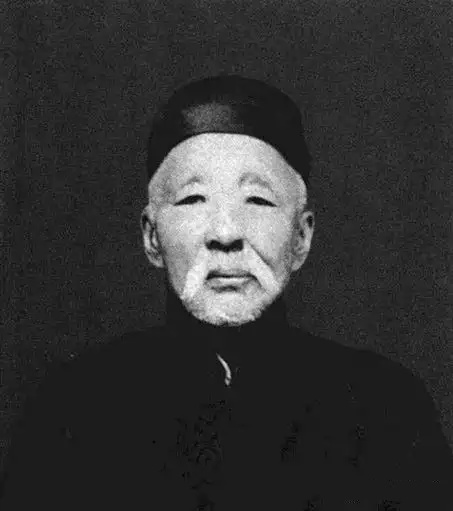
Why Shang Binghe Matters for Modern I Ching Readers
In the modern history of I Ching (Zhouyi) studies, Shang Binghe (1870 to 1950) remains one of the most consequential figures for readers who care about practice, verification, and method. He is frequently associated with a return to images and numbers (xiangshu), and he is remembered for insisting on a disciplined, usable approach to the classic, rather than treating it as a purely literary or philosophical text.
For English-language readers in the United States, Canada, the United Kingdom, Australia, and Europe, Shang’s value is especially clear. Many people first encounter the I Ching through quotations, “life guidance” summaries, or modern inspirational readings. Shang pushes in the opposite direction. He treats the Zhouyi as a technical divination classic whose language comes from procedure, symbolic structure, and recorded cases. If you want to read the text the way historical actors used it, his work is a direct doorway.
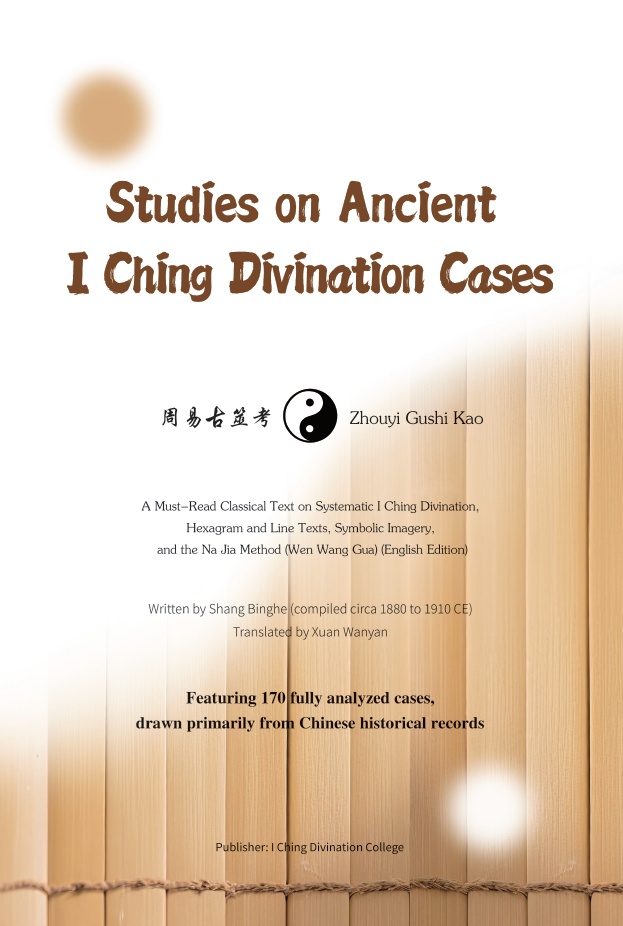
This is why his most influential case compilation, Studies on Ancient I Ching Divination Cases (Zhouyi Gushi Kao, 《周易古筮考》), continues to function as a practical training ground. It is not simply a collection of anecdotes. It is a method-centered reconstruction of how divination worked in real decisions, with historical names, contexts, and interpretive constraints.
“To Learn the Yi, Begin with Casting” as a Technical Principle
The phrase “To learn the Yi, begin with casting” captures a practical truth that many serious students eventually discover: without casting procedures, core Zhouyi language becomes opaque.
Even if you never intend to become a full-time diviner, the logic of casting clarifies questions that otherwise remain mysterious, including:
- Why the line values appear as “six, seven, eight, nine,” and why these numbers matter in interpretation
- Why historical records describe “this hexagram becoming that hexagram” as a concrete event, not a metaphor
- Why early sources treat divination outcomes as decision-relevant evidence
- Why “image” is not decoration, but a functional layer of meaning tied to how the reading is formed
Shang’s stance is not that philosophy is irrelevant. Rather, his point is methodological: the Zhouyi’s technical vocabulary and interpretive grammar are anchored in divination use. If you remove that anchor, you can still produce reflections, but you lose the system that generated the text’s distinctive way of speaking.
For modern learners, this matters because “casting literacy” prevents two common errors:
- Over-quoting: forcing a line phrase to match your situation without reconstructing the symbolic structure behind it
- Over-freeing: treating the I Ching as an open-ended poetry generator, where any line can mean anything
Shang’s approach offers a third path: disciplined flexibility. The Yi is change, but change has structure.
“The Text Arises from the Images” and Why Image-Based Reading Works
A central idea in Shang Binghe’s scholarship can be summarized in one sentence: the hexagram and line texts arise from images.
This is not a slogan. It is a technical claim about how meaning is generated.
When readers rely only on the surface wording of a line, the Zhouyi can feel fragmented or contradictory. Image-based reading addresses this by asking a more primary question: What image is the text attached to, and how does that image map to the concrete situation?
In practice, this means:
- Treating trigrams as structured symbolic fields, not merely philosophical categories
- Using image logic to explain why a phrase points to a particular event type (travel, illness, conflict, return, imprisonment, ritual, military movement, concealment)
- Recognizing that the same image can express multiple concrete referents, depending on which aspect is activated by the case context
This is why image-based reading scales. It supports both beginners and advanced practitioners:
- Beginners gain a coherent method that is more stable than “intuition only”
- Advanced readers gain a non-mechanical way to adapt without losing rigor
Shang’s work is often described as a “return” because it attempts to rebuild older interpretive tools that became scattered, overstated, or misunderstood. His contribution is not merely collecting images, but organizing them into something that can be learned, tested, and applied.
What Is Studies on Ancient I Ching Divination Cases (Zhouyi Gushi Kao, 《周易古筮考》)
Shang Binghe’s signature case compilation, Studies on Ancient I Ching Divination Cases (Zhouyi Gushi Kao, 《周易古筮考》), is designed to do one thing extremely well: show how divination operated in real historical affairs, with interpretable constraints.
Instead of presenting the Zhouyi as abstract wisdom, the book anchors study in transmitted records of concrete decisions. Cases involve high-stakes matters like national politics, military campaigns, illness, travel, omens, fate, and urgent personal choices. This case-driven structure teaches a student how to read under pressure, where an interpretation must account for the situation, the symbolic structure, and what the recorded outcome implies about method.
Just as importantly, Shang’s case selection and commentary style aim at verification. The reader is not asked to “feel inspired.” The reader is asked to follow the logic, see the image, and understand why the reading fits.
Why case study is the fastest route to competence
In most technical traditions, competence develops when theory is forced through real examples. Zhouyi divination is no different.
Case work trains:
- How to identify which part of the system is doing the “real work” in a reading
- How to distinguish primary interpretive drivers from secondary ornamentation
- How to avoid overfitting a line phrase to a modern story
- How to build interpretive discipline without becoming rigid
Shang’s enduring value is that his compilation is structured as training, not as entertainment.
Where This Fits for Wen Wang Gua and Applied Methods
Many English readers today learn applied divination through Six Lines approaches, including the Na Jia method (Wen Wang Gua). Shang’s work remains relevant here, for a simple reason: technical systems collapse if the image layer is weak.
The more technical your divination becomes, the more you need:
- A stable image framework that does not devolve into formula recitation
- A disciplined way to handle “mismatch,” when the line text looks distant from the matter at hand
- A method for identifying which image is most intimate to the situation, rather than forcing one fixed rule
Shang’s cases model exactly this balance: structured and image-based, but not mechanical.
For readers working in Wen Wang Gua, this case tradition is especially useful because it keeps the Zhouyi from becoming purely computational. It returns the practitioner to the symbolic engine beneath the technique.
The English Edition on I Ching Stream
An English edition of Studies on Ancient I Ching Divination Cases (Zhouyi Gushi Kao, 《周易古筮考》) is available on I Ching Stream, translated by Xuan Wanyan.
This edition is positioned for serious students who want more than generalized commentary. It emphasizes:
- Historically anchored cases that show divination functioning in real decision contexts
- A method-preserving presentation, designed to support actual study and skill-building
- Readable background context for historical figures and events, so non-Chinese readers can follow the case logic without getting lost
If your goal is to understand how the I Ching operated as a working divination system, Shang Binghe is a central figure, and Zhouyi Gushi Kao is one of the clearest gateways into that tradition.
How to Use This Book for Skill-Building
If you want to extract practical value from Zhouyi Gushi Kao, use it like a training manual:
- Read the case context first, then pause. State what you think the decision pressure is, and what a “successful reading” would need to account for.
- Identify the image drivers. Before you interpret wording, ask what images are active and how they map onto the situation.
- Only then read the line text closely. The text becomes clearer once you know what it is attached to.
- Compare your interpretation to the recorded logic. Focus on method, not on whether you personally “like” the result.
- Repeat in sets. Skill comes from patterns across multiple cases, not from one impressive reading.
This is also why Shang’s “begin with casting” orientation matters. Casting creates constraints. Constraints create discipline. Discipline creates real interpretive power.
Why Shang Binghe Still Matters Today
Shang Binghe’s importance is not nostalgia. It is methodological clarity.
- He restores images as the engine of meaning, so the Zhouyi becomes coherent as a symbolic system, not a pile of poetic fragments.
- He treats divination procedure as essential literacy, because it explains how the text’s technical language arises.
- He proves his claims through cases, grounding interpretation in transmitted records rather than purely abstract debate.
For modern readers, especially in global English-speaking communities where the I Ching is often reduced to quotation culture, Shang offers a corrective: the Zhouyi is a working method. If you want the method, you study what it did, how it did it, and why it worked.
Reference Links and Further Reading
- Studies on Ancient I Ching Divination Cases (Zhouyi Gushi Kao, 《周易古筮考》) English Edition on I Ching Stream: https://www.ichingstream.com/books/?book_detail=1&id=887
- Shang Binghe overview (Wikipedia): https://en.wikipedia.org/wiki/Shang_Binghe
- 360doc material: http://www.360doc.com/content/23/0718/03/29880059_1089042235.shtml
- Sohu article: https://www.sohu.com/a/282030986_120044706
- Zhihu column: https://zhuanlan.zhihu.com/p/578197029?utm_psn=1706719054918909952
- KKNews material: https://kknews.cc/n/kg8x298.html
- cnmzppw material: http://www.cnmzppw.com/tv/20200121132513.html
Studies on Ancient I Ching Divination Cases (周易古筮考, Zhouyi Gushi Kao)
Studies on Ancient I Ching Divination Cases (Zhouyi Gushi Kao) is a classical case-based work that shows how Zhouyi divination was practiced in real historical contexts. Compiled by the modern I Ching scholar Shang Binghe, it presents 170 case analyses drawn primarily from major Chinese historical sources, including records from the Zuo Commentary and the a-start=”496″ data-end=”522″>Discourses of the States. The cases span court politics, military campaigns, national fortune, illness, travel, omens, and private affairs, and include well-known figures such as Confucius and the Jin-era master Guo Pu.
This English edition also explains the yarrow-stalk divination procedure step by step, clarifies the meanings of “Use-Nine” and “Use-Six,” introduces the Na Jia (Wen Wang Gua) method, and preserves extensive “Hidden Object Divination” (shefu) material used for image-based training. Translated and annotated by Xuan Wanyan, the book offers a structured and method-oriented gateway to classical I Ching divination for modern readers.
相关产品
-
Encompassing I Ching Divination (易冒, Yi Mao)
Original price was: $249.99.$199.99Current price is: $199.99. -
Fire Pearl Forest – I Ching (Six Lines) Divination Classical Text (Huo Zhu Lin火珠林)
Original price was: $119.99.$89.99Current price is: $89.99. -
Hidden Principles Ode: A Classic of I Ching (Six Lines) Divination (阐奥歌章, Chan Ao Ge Zhang)
Original price was: $39.99.$29.99Current price is: $29.99. -
I Ching Divination – Complete and Restored (Zengshan Buyi 增删卜易) Wild Crane Elder / Yehe Elder
Original price was: $399.99.$299.99Current price is: $299.99.