Disclaimer:
All personal information in this case study has been anonymized or omitted. This case study is provided for learning and reference only. It is not intended as medical, veterinary, legal, financial, investment, or other professional advice.
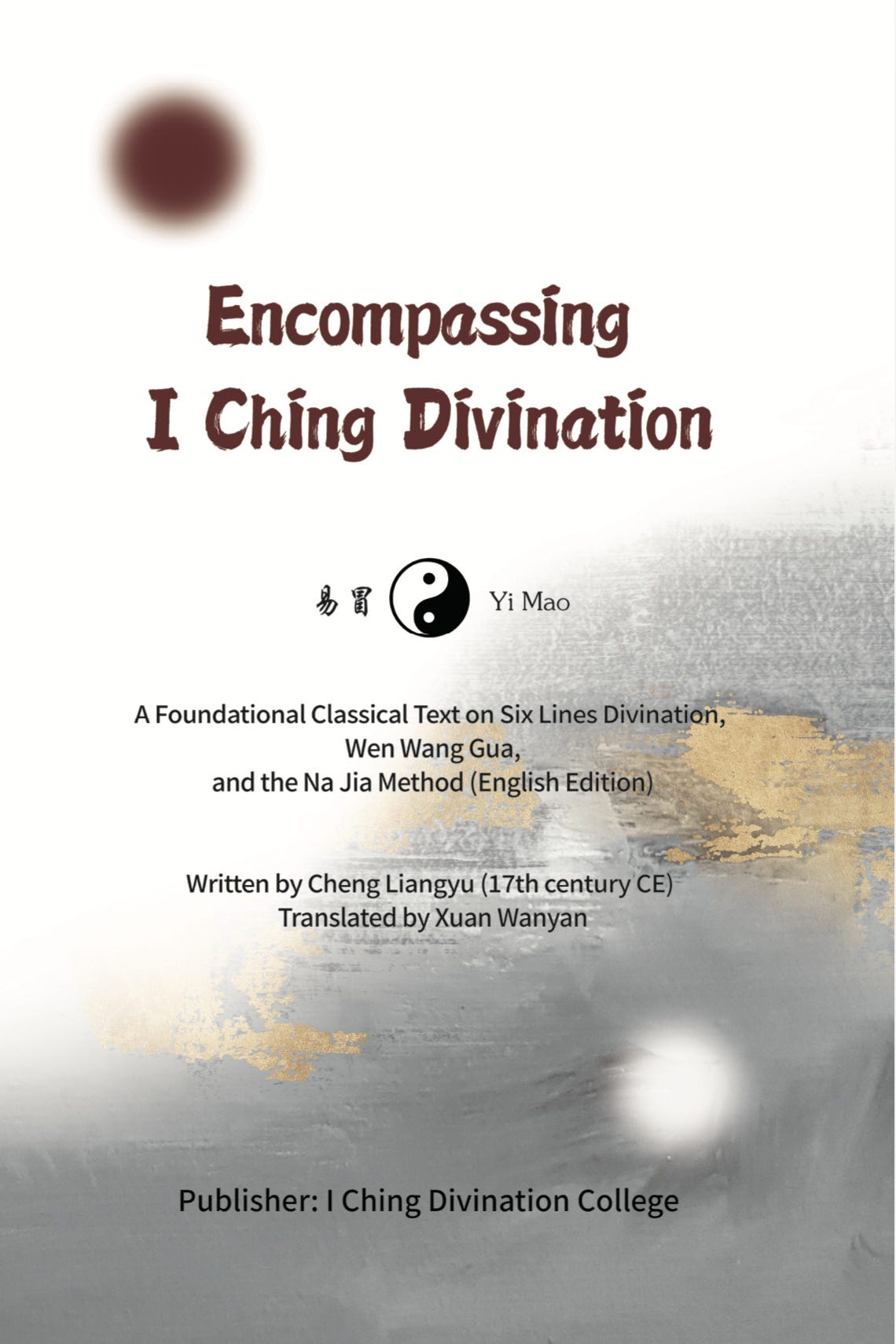
Before that happens, the current I Ching Stream package remains available at $699.99 before applicable taxes. Once Yi Mao is added, the package will expand from 7 to 8 major classical works and collections, and the package price will increase to $849.99 before applicable taxes.
For readers who have been waiting, these are the final few days to lock in the current package price before the increase.
In the previous two posts, we shared Cheng Liangyu’s own Author’s Preface and Wang Zehong’s deeply moving preface.
Cheng Liangyu’s own preface showed us the life of the blind master behind Yi Mao: his childhood blindness, his turn from medicine to I Ching divination, his study under Zhang Xingyuan, his encounter with the Kupao Elder, and his lifelong effort to preserve the deeper reasoning of the tradition.
Together, those first two prefaces show us how Yi Mao was written and entrusted.
Today, I would like to share two more prefaces: Lu Jin’s Preface to Yi Mao and Gu Baowen’s Preface to Yi Mao.
These two prefaces answer another important question:
Why did Cheng Liangyu’s contemporaries regard him as more than an ordinary fortune-teller?
Some readers approach the I Ching mainly through philosophy, symbolism, ethics, or the Judgment and Line statements. Others may see practical divination as something secondary, popular, or merely superstitious.
But the prefaces to Yi Mao show a different classical Chinese understanding.
For Lu Jin and Gu Baowen, Cheng Liangyu’s mastery of divination was not outside Yi learning. It was one of the ways Yi learning became visible, testable, and useful in the world.
This is why Yi Mao is more than a manual of techniques.
It is a bridge between principle, number, image, method, and living practice.
Below are the full prefaces by Lu Jin and Gu Baowen from the upcoming I Ching Stream English edition.
Lu Jin’s Preface to Yi Mao
When I[1] was still a boy, I heard that in Xin’an there was a Master Cheng Yuanru who was skilled in divination. He lived in seclusion to the west of our Hangzhou city, yet carriages and horses crowded before his door as if at a marketplace. Even when the sun had already declined toward evening, he still could not lower the curtain and rest. My friend Hu Lütang repeatedly praised this man, so I once followed along and secretly observed him. His appearance was tall and imposing, and his speech flowed like a river. I knew in my heart that he was not of the ordinary class of fortune-tellers and diviners.
Later, Yuanru moved outside the city wall and lived near me as a neighbor, so our friendship became increasingly close. From time to time, we visited one another, and I heard his broader discussions. Even aged scholars and seasoned Confucians could not match him. I privately thought: Jing (Jing Fang, 京房),[2] Jiao (Jiao Yanshou, 焦延寿), Guan (Guan Lu, 管辂), and Guo (Guo Pu, 郭璞) were all deeply skilled in the numbers of the Yi and became renowned through their writings. Yuanru, though blind, possessed such extensive learning. If he had not long possessed a spiritual understanding, how could he have reached this level?
People said, “Yuanru is skilled in numbers. He keeps them secret and does not reveal them, merely concealing his words within ordinary conversation.”
Yuanru smiled and replied, “The sages exhausted principle and number, using them for principle. Later worthies exhausted number and principle, making principle manifest through number. How could this be appropriate?
“People know that what principle shows to others is manifest, while what number tells to others is subtle. Fortunately, I encountered Master Xingyuan and the Kupao Elder. I deeply studied the books and numbers of the sages and worthies, and from them searched for principle.
I knew that Yuanru was probably a man who had attained the Way. Even Jizhu[3] and Junping might not have surpassed him.
Yuanru said, “To go is not difficult. But the Way of divination has long followed inherited dregs and has not yet exhausted its profundities. I have received the transmission of my teachers and wish to establish words to ask the world. I have held this intention for nearly twenty years, yet in the end I have not completed it. What am I to do?”
The clerks said, “We will ask on your behalf. There will be enough time for you to complete your matter.”
When he awoke, he immediately exerted himself to write the book. He entrusted it to Lütang for punctuation and arrangement.
Alas. To establish words and transmit them to the world is an achievement that benefits humanity. Yuanru held this aspiration for nearly twenty years, yet its completion was so difficult.
This cannot be falsely denied. Those who read Yi Mao will naturally understand this in their own hearts. It is not merely because my friendship with him was deep that I privately praised him in this way.
Respectfully Written in the Middle Autumn Month, the Jiachen (I E) Year of the Kangxi Reign (1664 CE)
Lu Jin, courtesy name Jinsi, of Xiling
Notes to Lu Jin’s Preface
[1] Lu Jin (陆进), courtesy name Jinsi (荩思, also written 尽思 in some editions), was a Qing dynasty scholar and poet from Renhe, with some sources identifying him as from Yuhang. He was a tribute student and once served as an instructor in Wenzhou.
[2] Jing Fang (京房, 77 to 37 BCE), courtesy name Junming (君明), was a Western Han scholar of the I Ching. After the ancient Great Expansion Method of yarrow-stalk divination gradually declined in practical use, this Na Jia-based line system became one of the mainstream methods of I Ching divination in China. Later I Ching divination writings frequently cite “Jing” as a representative master of technical I Ching interpretation.
[3] Jizhu refers to Sima Jizhu (司马季主), a renowned Western Han diviner recorded in Records of the Grand Historian.
Gu Baowen’s Preface to Yi Mao
I[1] once read historical accounts stating that Guan Gongming was skilled in the Yi, yet some dismissed his Yi learning as nothing more than evasive replies to reckless rhetoric. Only after reading Master Cheng’s book did I truly come to believe otherwise.
Master Cheng once sat behind lowered curtains in the Hulin marketplace, discerning fortune and misfortune and discussing regret and shame, all of which were nothing other than the Yi. Yet the book Yi Mao does not fully discourse on the Yi, and yet nothing in it lies outside the Yi. Principle arises from the Yi, and outside the Yi there is no principle. That it does not fully discourse on the Yi is because the Yi manifests through numbers; the application of numbers is not itself the Yi.
The Yi gives rise to generation without fixed form, extending analogies to exhaust the numinous and reach transformation. The sages never intended people to wither among hexagram and line statements and call that the Yi.
Thus the Appended Commentary (Xi Ci, 《系辞》) say that Mao (冒) means to encompass and to cover. The Yi governs their overarching structure.
The sexagenary cycle, the Six Gods, transformations, mutual change, contradictory echo and repetitive echo, the stars, the host and corresponding lines, and the essential teachings contained in the ninety-one chapters are not, strictly speaking, direct discourses on the Yi itself; yet none of them lies outside the affairs of the Yi. Thus, Master Cheng’s book does not explicitly speak of the Yi, yet it is supremely precise in speaking of the Yi.
Those today fail to perceive this. Upon obtaining the books of Jiao Shi[2] and others, they hide them away and believe the Way resides entirely therein. How could they know the depth contained here? Master Cheng stands among the modern counterparts of Guan and Guo.[3] Those who divined invariably found response. He practiced thus for over twenty years. At forty, illness confined him behind closed doors. Inner movements arose, signs appeared repeatedly, and he resolved to write.
Exclusive secrets seem disfavored by creation. Looking upon this single volume of Yi Mao, one may say that Master Cheng has not truly died.
Written in Autumn, on the Day After the Full Moon of the Seventh Lunar Month, the Jiachen (I E) Year of the Kangxi Reign (1664 CE)
Gu Baowen of Qiexiang, Qiantang
Notes to Gu Baowen’s Preface
[1] Gu Baowen (顾豹文, 1618 to 1693 CE), courtesy name Jiwei (季蔚) and literary name Qie’an (且庵), was a Qing dynasty official and scholar from Qiantang, present-day Hangzhou. He passed the imperial examination in 1655 CE and later served in several official posts, including Censor of the Henan Circuit. In Yi Mao, he wrote one of the prefaces, explaining the meaning of the title and praising Cheng Liangyu’s work as an important transmission of Yi learning.
[2] Jiao Shi refers to the tradition associated with Jiao Yanshou (焦延寿), a Western Han dynasty Yi scholar to whom Jiao’s I Ching Forest (Jiaoshi Yi Lin, 《焦氏易林》) is traditionally attributed. This work is one of the most famous divinatory texts in the history of Yi learning. It arranges judgments according to the transformations among the sixty-four hexagrams, producing a large body of poetic and symbolic divination statements.
[3] Guan and Guo refers to Guan Lu (管辂, 209 to 256 CE, courtesy name Gongming, 公明) and Guo Pu (郭璞, 276 to 324 CE, courtesy name Jingchun, 景纯). Guan Lu was a famous diviner and Yi scholar of the Three Kingdoms period, renowned for his skill in interpreting omens, dreams, and divination signs. Guo Pu was a scholar, writer, commentator, and diviner of the Eastern Jin period, later widely associated with geomancy, omen interpretation, and classical divinatory learning. In traditional Chinese discussions of divination, Guan and Guo are often invoked as exemplary masters of Yi-based prediction.
Reading Lu Jin and Gu Baowen’s prefaces, we can understand why Yi Mao became an enduring classic.
It was not preserved merely because it contained many rules.
Lu Jin saw that Cheng Liangyu was not of the ordinary class of fortune-tellers and diviners. He understood that Cheng’s mastery came from the unity of principle and number. To Cheng Liangyu, number was not opposed to principle, and technique was not separate from meaning.
Gu Baowen went even further. He explained that although Yi Mao does not fully discourse on the Yi in the usual philosophical manner, nothing in it lies outside the Yi. The sexagenary cycle, the Six Gods, transformations, mutual change, contradictory echo, repetitive echo, stars, host and corresponding lines, and the ninety-one chapters of methods are not external decorations. They are ways in which the Yi becomes operational in the world.
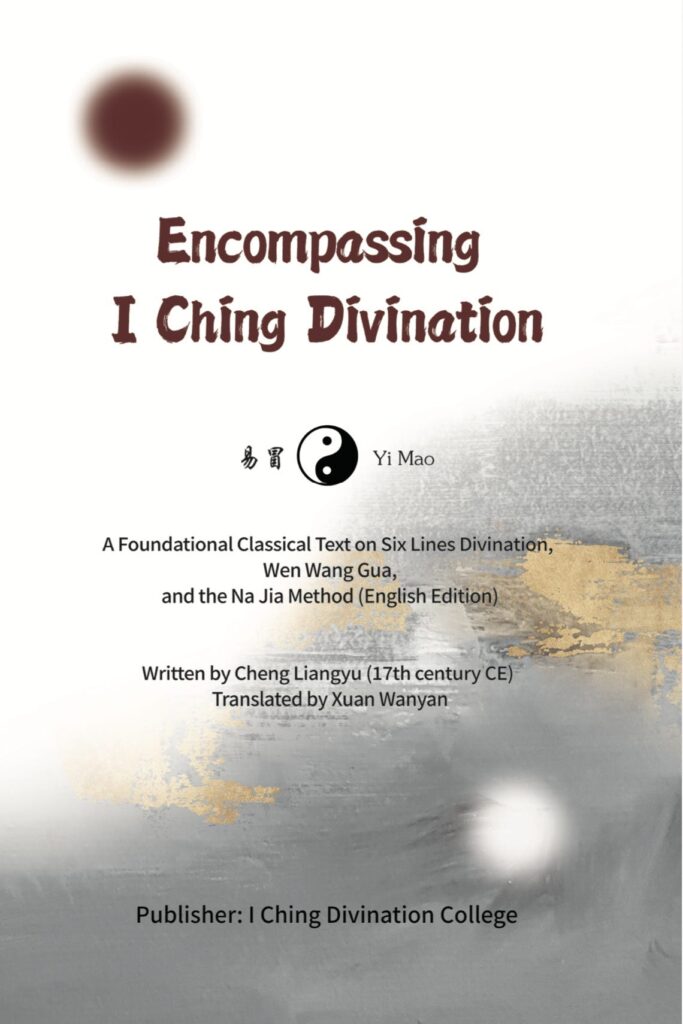
This is one of the core reasons I Ching Stream is publishing Encompassing I Ching Divination (Yi Mao, 《易冒》) in English.
For too long, English readers have often encountered the I Ching mainly as philosophy, symbolism, or personal reflection. These dimensions are valuable, but they do not exhaust the living divinatory tradition of the Yi.
Yi Mao helps restore that missing dimension.
It shows that practical divination is not necessarily a lower form of Yi learning.
In the first post, Cheng Liangyu’s own preface showed us the life of a blind master.
I Ching Stream is honored to help carry this transmission forward.
May this flame continue to be passed from hand to hand.