Disclaimer: This article is intended solely for academic discussion and methodological analysis of Yi principles and divination interpretation. We encourage rational judgment and respect for modern science. In any real emergency, missing-person case, medical crisis, rescue situation, or life-threatening event, always contact professional emergency services, rescue teams, medical personnel, law enforcement, or other qualified authorities immediately.
🎉😄A quick note before today’s content: our charting feature can now provide simple case analysis to help users interpret hexagrams. It is not a replacement for systematic study, but it can assist beginners in identifying basic structures, line relationships, movement, transformation, void, and other key points in a reading.
Background:
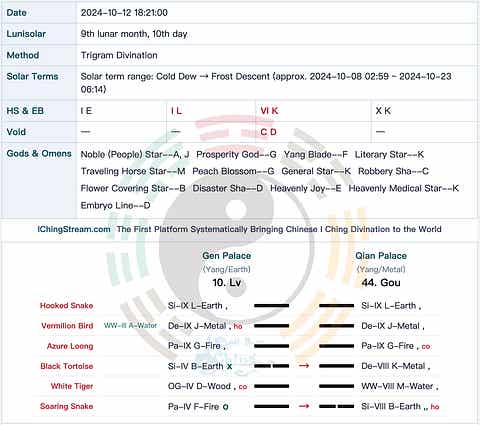
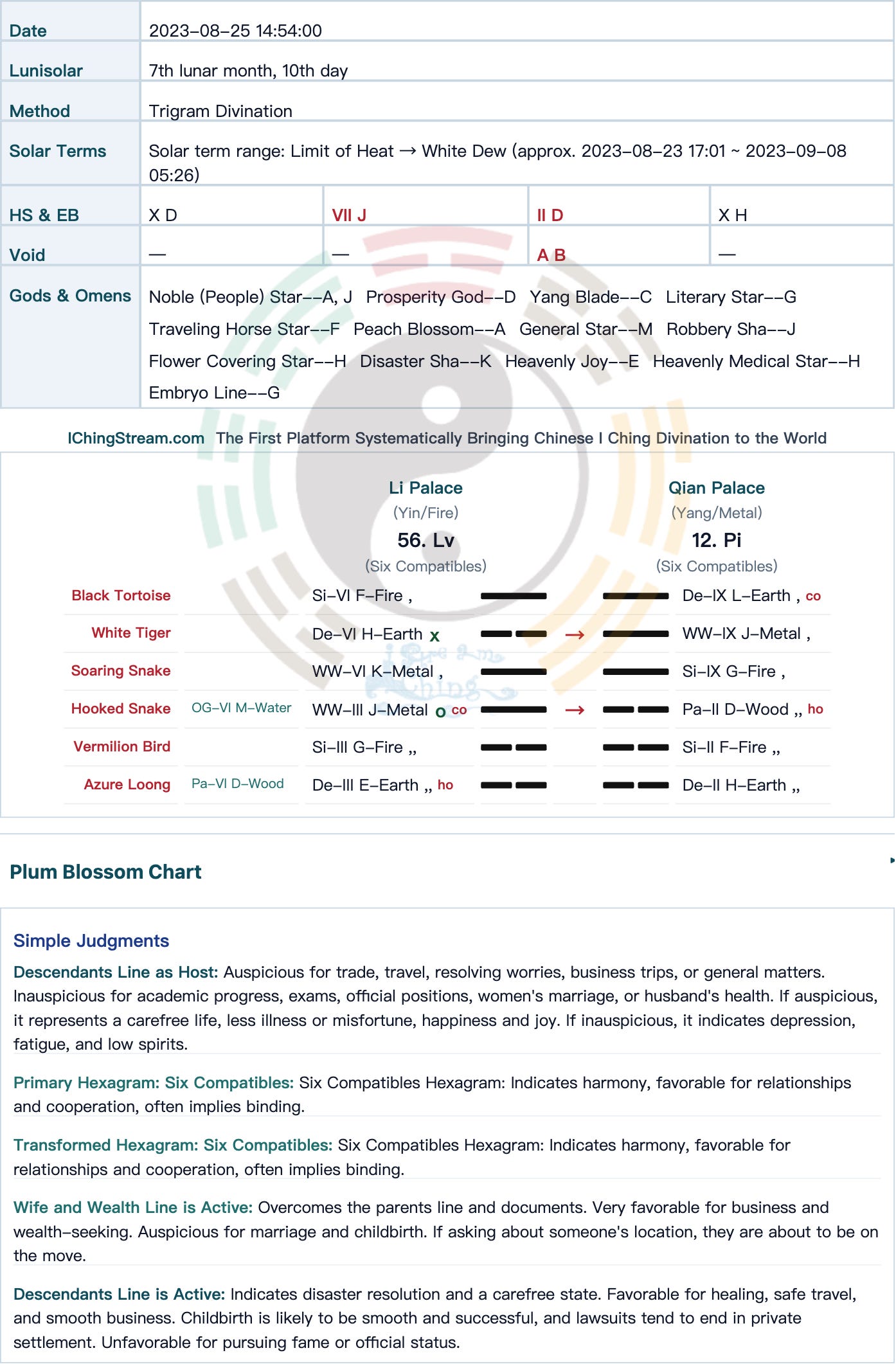
The querent asked whether a bid scheduled for the following Thursday would be successful.
Hexagram obtained: Lv to Gou.
Judgment:
This hexagram showed a typical bidding failure. The parents line representing the bid documents and contract was active but transformed into siblings, representing a competitor. At the same time, a strong F-K-B trine formed a descendants metal structure that overcame the corresponding officials and ghosts line representing the matter. The overall structure showed that the bid would ultimately be lost to another competitor.
1. Locating the significator god: the parents line represented the bid documents and contract
In this hexagram, the first-line parents F fire was active and represented the bid documents and contract.
The host line was fifth-line descendants J metal, representing the querent, while the corresponding line was second-line officials and ghosts D wood, representing the bidding matter and the other side.
2. An F-K-B trine formed a descendants metal structure and overcame the corresponding line
The first-line parents F fire was active and transformed into siblings B earth.
The third-line siblings B earth was also active and transformed into descendants K metal.
K metal was not only present as the transformed descendants line, but also coincided with the K day. Together, F, K, and B formed a very strong F-K-B trine, creating a descendants metal structure. The K day further strengthened this Metal structure.
This powerful Metal structure directly overcame the corresponding line, officials and ghosts D wood, because metal overcomes wood.
The overall force of the hexagram was therefore acting against the bidding matter. This showed that the project faced strong obstruction and that it would be difficult for the querent to secure the bid.
3. Parents transformed into siblings: the contract ultimately went to a competitor
The clearest indication of losing the bid came from the transformation of the significator god itself.
The first-line parents F fire represented the bid documents and contract. After becoming active, it transformed into siblings B earth.
In business and financial divination, siblings represents competitors, industry rivals, and others competing for the same business opportunity or financial benefit.
Parents transforming into siblings therefore formed a very direct image: the contract and project opportunity ultimately shifted toward a competitor rather than remaining with the querent.
This went beyond simply showing strong competition.
Conclusion:
The querent would not win the bid.
The strong F-K-B trine formed a descendants metal structure that overcame the corresponding officials and ghosts D wood, showing that the overall forces were unfavorable to the project.
More importantly, the parents line representing the bid documents and contract transformed directly into siblings, indicating that the contract opportunity would ultimately pass to a competitor.
Disclaimer: This article is intended solely for academic discussion and methodological analysis of Yi principles and divination interpretation. We encourage rational judgment and respect for modern science. In any real emergency, missing-person case, medical crisis, rescue situation, or life-threatening event, always contact professional emergency services, rescue teams, medical personnel, law enforcement, or other qualified authorities immediately.
🎉😄A quick note before today’s content: our charting feature can now provide simple case analysis to help users interpret hexagrams. It is not a replacement for systematic study, but it can assist beginners in identifying basic structures, line relationships, movement, transformation, void, and other key points in a reading.
Background:
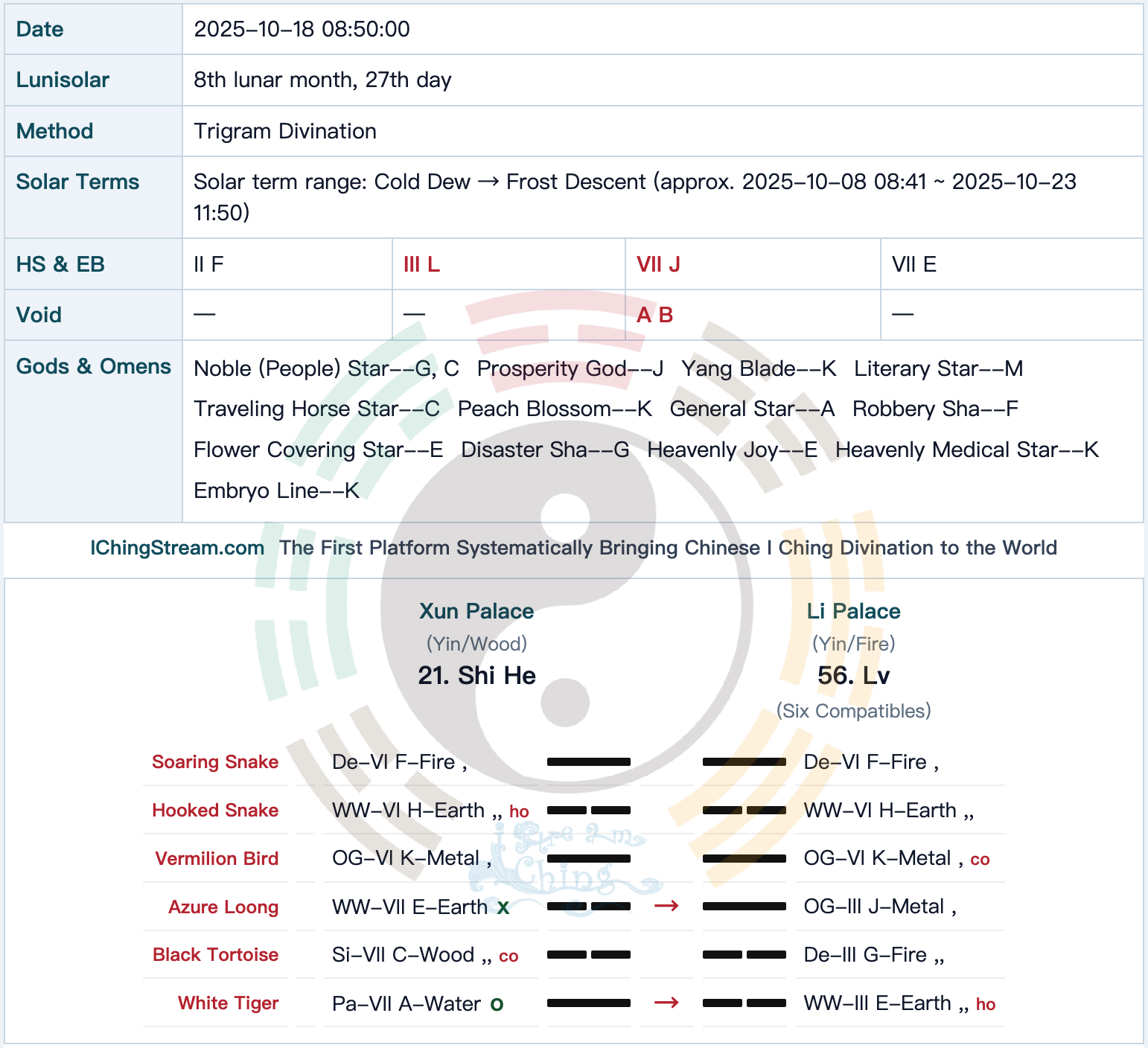
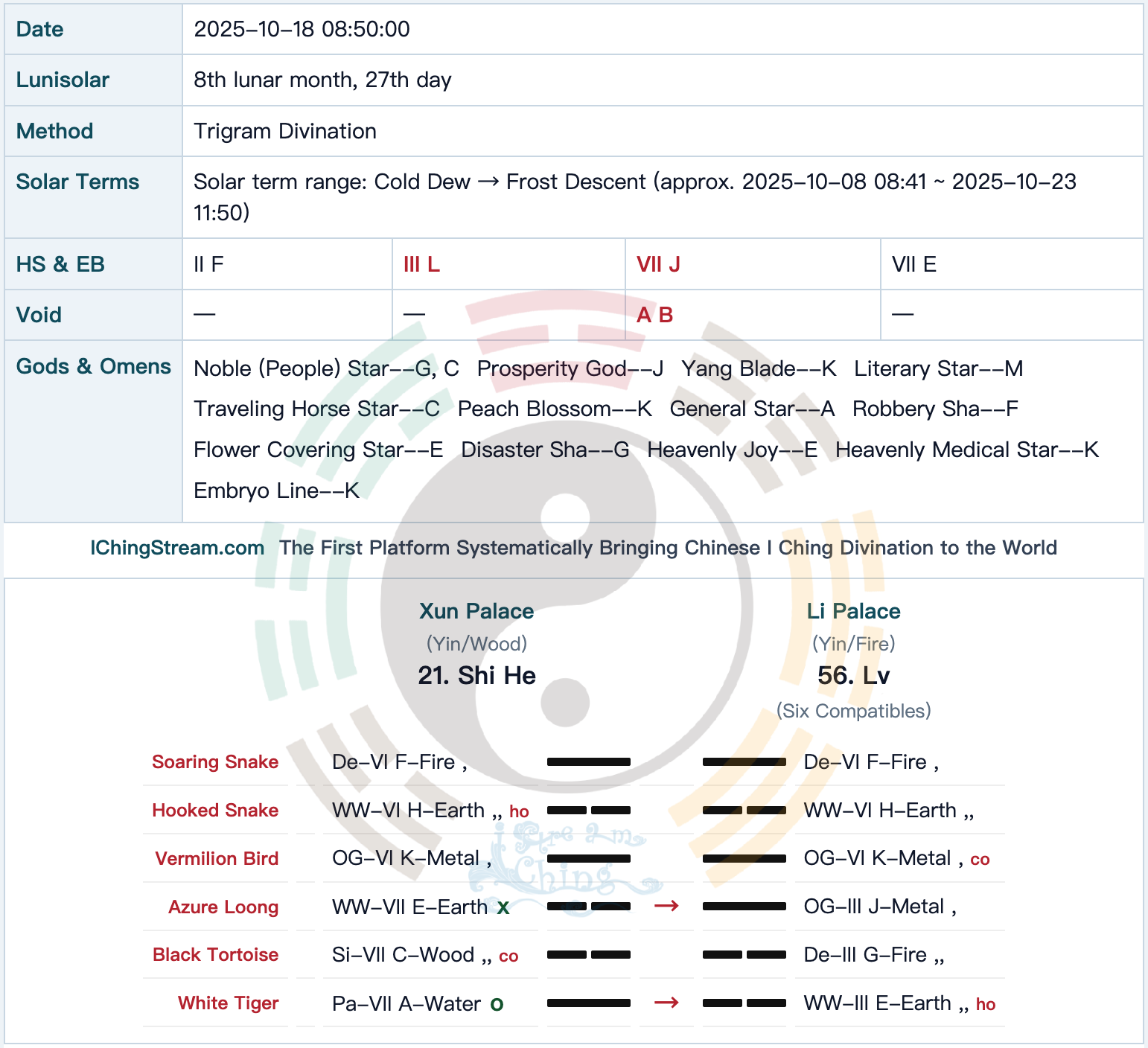
The querent had a strange and unsettling dream. Because the dream felt unusually eerie and ominous, the querent suspected that it might be a warning. Therefore, the querent cast a hexagram to ask:
Hexagram obtained: Shi He to Lv. Host body: C wood.
Judgment:
This hexagram showed how the indications of the Six Gods in a dream reading could be combined with a trine structure, harm between Earthly Branches, image-based interpretation, and timing analysis. In this way, one could identify a sudden danger involving the querent and determine when it might occur.
1. The nature of the dream: the corresponding line aligned with Black Tortoise and overcame the host line
In a dream divination, the host line represents the querent, while the corresponding line represents the dream itself.
In this hexagram, the corresponding line aligned with Black Tortoise and directly overcame the host line. This formed the structure of the corresponding line overcoming the host line.
Black Tortoise represents strange, mysterious, dark, hidden, and unusual phenomena. More importantly, because the corresponding line representing the dream directly overcame the host line representing the querent, the information carried by the dream exerted an unfavorable influence on the querent himself.
This was a decisive indication that the dream was not an ordinary dream, but an ominous warning. It suggested that the unfavorable image revealed by the dream could eventually affect the querent directly.
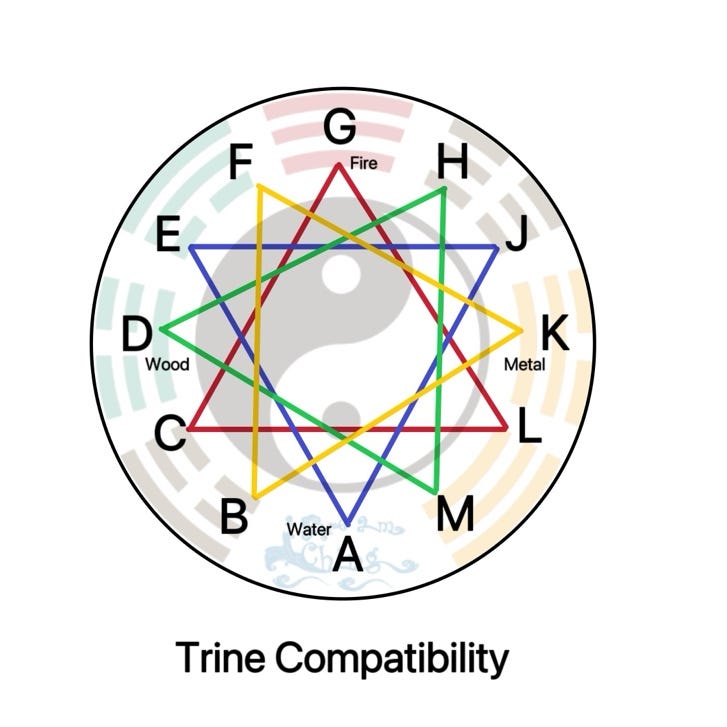
2. A J-A-E trine formed a parents water structure with White Tiger: a violent hidden danger
The J, A, and E branches formed a J-A-E trine. This created a parents A water structure, with A water as the central branch of the trine.
This structure aligned with White Tiger.
White Tiger can represent violence, fright, injury, bloodshed, or explosive events. Its presence therefore gave the parents water structure a much more intense and dangerous image.
In image-based interpretation, the parents line can also represent vessels, containers, coverings, and household objects. Combined with White Tiger, this added the image of a household object being involved in a sudden and violent incident.
The parents A water structure was overcome by the L month but generated by the J day. A water, the central branch of the trine, was also void at the time of the divination.
The structure was therefore temporarily restrained. Once A water emerged from void and came into command in the A month, however, the force of the trine could become fully expressed.
The strong parents water structure would then overcome descendants G fire.
Descendants represents peace, ease, relaxation, and a good state of mind. Water overcoming fire therefore indicated that once this structure was activated, it would bring a sudden event. This event would be accompanied by intense fear and emotional disturbance.
3. The host line and A-H harm: the danger would ultimately affect the querent
The host line representing the querent was H earth.
As established above, A water was the central branch of the J-A-E parents water structure. When the timing reached the A month, A water would come into command and become strongest.
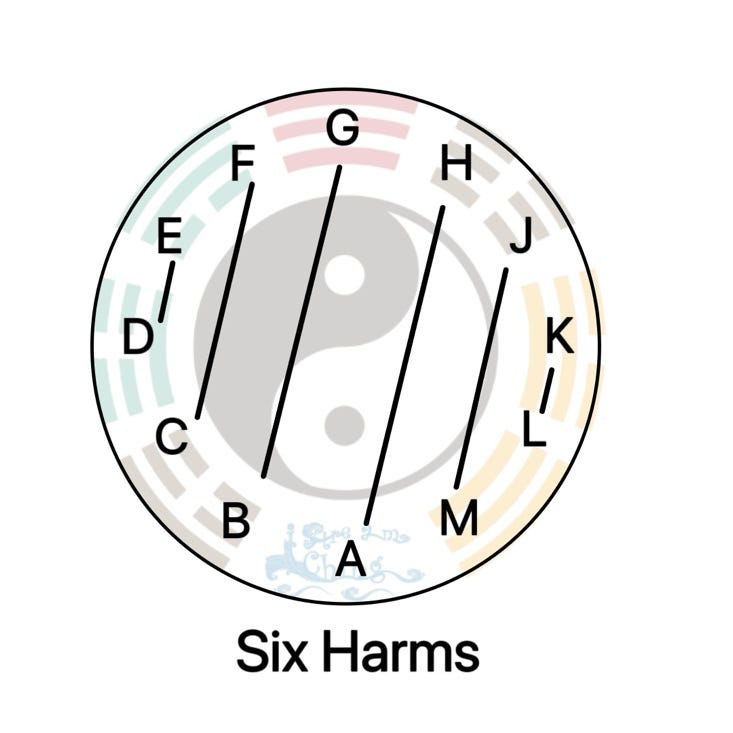
This powerful A water would then form A-H harm with the host line H earth.
In Six Lines interpretation, A-H harm carries the image of being harmed, disturbed, frightened, or suddenly affected. As the traditional interpretation states, “A-H harm means being harmed.”
This showed that once the parents water structure became fully activated in the A month, its unfavorable force would directly affect the querent represented by H earth.
The A-H harm also provided an additional timing clue: an H day within the A month deserved particular attention.
4. Timing: “stopping at three” pointed to the A month
The upper trigram was Li, whose Pre-Heavenly Number is 3, while the lower trigram was Gen, which represents stopping.
Combining these two images gives the indication of “stopping at three.” This means that the event should occur within no more than three months.
The divination was cast in the L month. Counting the L month as the first month, the M month was the second. The A month was the third.
The A month was also precisely when the central branch A water of the J-A-E trine would come into command. At that time, it would emerge from void.
The timing therefore pointed directly to the A month.
Conclusion:
😄 Thank you all for your support.
For students who want a guided learning path, our current main recommendation is the I Ching Divination Foundations Course.
The course is scheduled to begin in July and is currently available at the pre-order price of $299.99. After the course is completed and fully released, the price will increase to $399.99.
This course introduces the basic structure of I Ching divination, including casting, arranging the Six Lines chart, trigrams, hexagrams, Na Jia, Six Relationships, and the practical workflow of interpretation.
For readers who want to study Six Lines divination more seriously through classical sources, the I Ching Stream Classical Text Package brings together major classical works and collections for Na Jia, Wen Wang Gua, and traditional Chinese I Ching divination.
This package is designed for students who do not want to learn from isolated fragments. It helps readers compare methods, study classical cases, understand chart structure, and gradually build a complete view of the Six Lines tradition.
For readers who are just beginning and want a simple first step, we recommend:
👉 Your First Book:“I Ching Divination: A Practical Study Roadmap: A Simplified Guide to the Na Jia Method (Wen Wang Gua), Based on I Ching Divination: Complete and Restored (Zengshan Buyi 增删卜易)” A practice-first roadmap for setting up charts, learning the core workflow, and building timing-aware judgment with a simplified, beginner-friendly structure. → Amazon US
Package buyers also receive access to our private Discord study group. This group is expected to begin formal operation in the second half of this year.
Already bought individual books? Contact contact@ichingstream.com. We’ll calculate the difference so you only pay the remaining balance to upgrade.
Disclaimer: This article is intended solely for academic discussion and methodological analysis of Yi principles and divination interpretation. We encourage rational judgment and respect for modern science. In any real emergency, missing-person case, medical crisis, rescue situation, or life-threatening event, always contact professional emergency services, rescue teams, medical personnel, law enforcement, or other qualified authorities immediately.
🎉😄A quick note before today’s content: our charting feature can now provide simple case analysis to help users interpret hexagrams. It is not a replacement for systematic study, but it can assist beginners in identifying basic structures, line relationships, movement, transformation, void, and other key points in a reading.
Background:
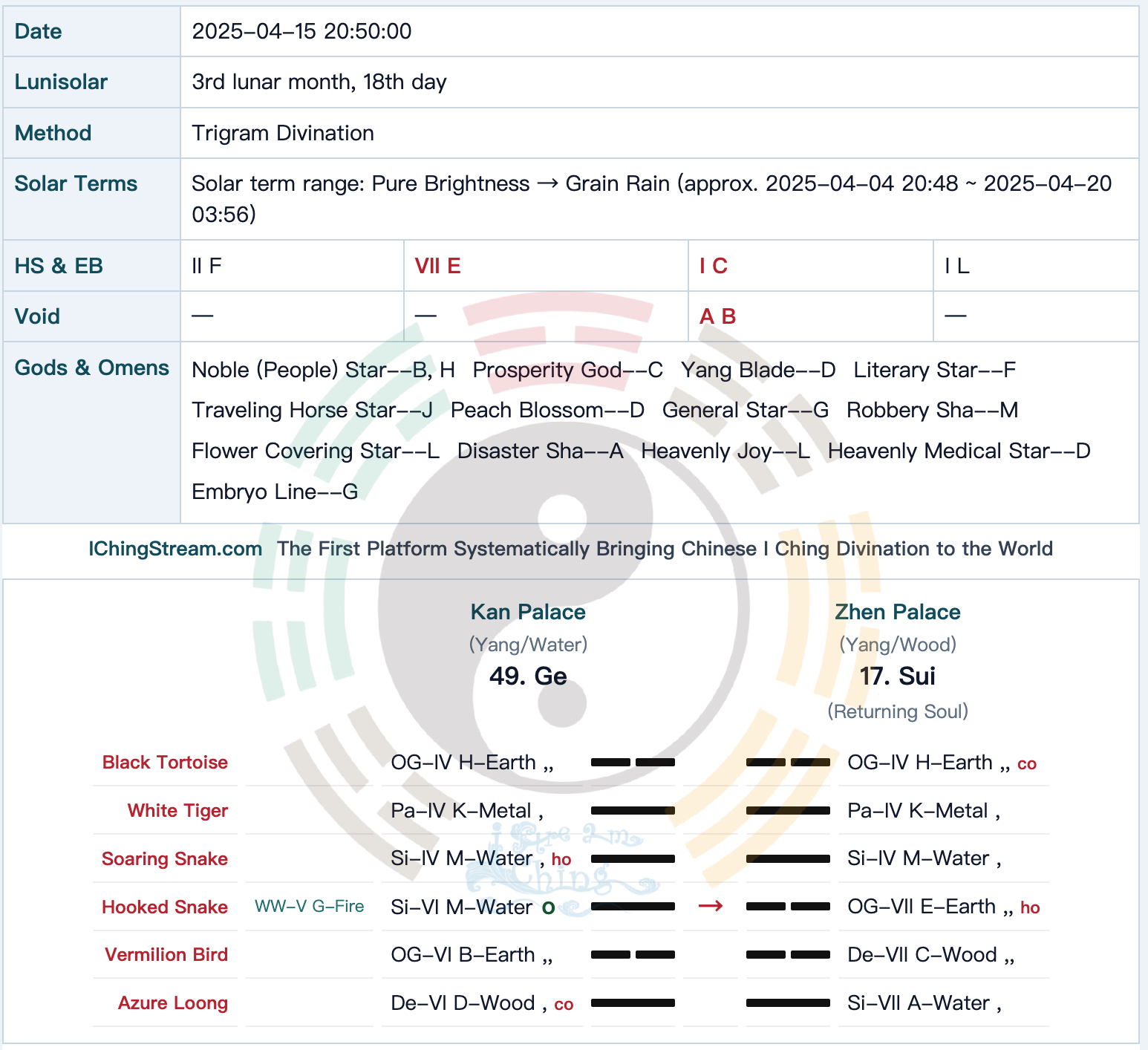
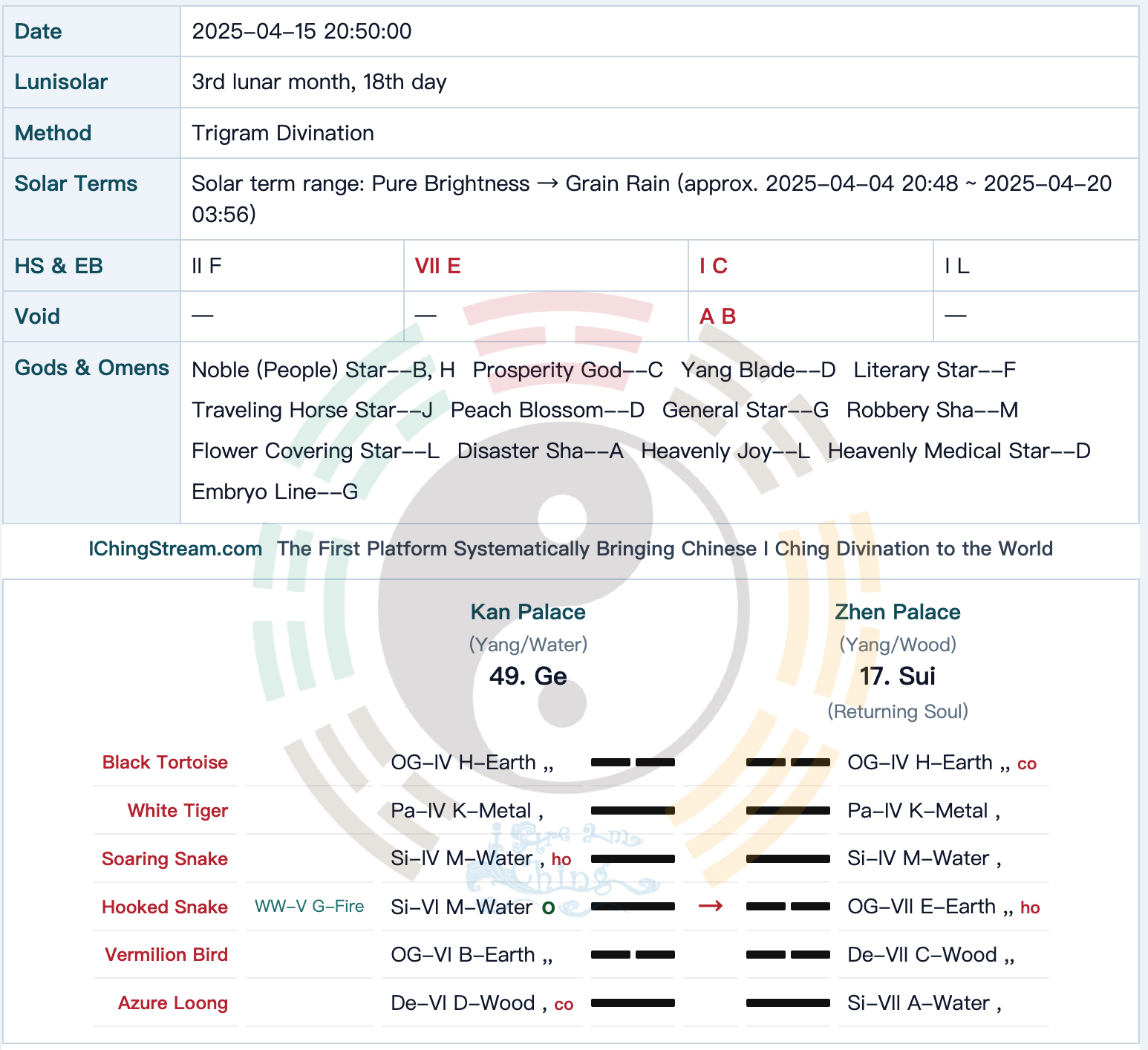
A male sales representative working for an internet company asked whether he could close three deals during the week.
Hexagram obtained: Ge to Sui.
Judgment:
This hexagram showed that the significator god was prosperous and supportive and generated the host line, originally indicating that the querent could achieve his target of three orders. However, a solitary active line fell at the Sickness stage of the significator god, while self-punishment also appeared around the host line. The result would therefore be favorable but imperfect: three orders could initially be closed, but one would later be canceled.
1. Locating the significator god: parents K metal represented the orders
For general work questions, the officials and ghosts line is usually taken as the significator god. However, when the question concerns specific sales performance, contracts, or orders, the parents line is taken as the significator god.
In this hexagram, the fifth-line parents K metal represented the orders.
K metal received generation and support from the E month, with E and K also forming compatibility. Although it was in rest and constraint on the C day, it was not overcome. Overall, the parents line remained prosperous and supportive.
The prosperous parents K metal generated the host line, siblings M water, because metal generates water.
This originally indicated that the querent could achieve his expected target of three orders.
In Six Lines interpretation, the significator god often represents the specific result or expectation contained in the question. When the significator god is prosperous and supportive and remains undamaged, the expected result can often be achieved.
2. The core reversal: the Sickness stage was solitary active, indicating an imperfect result
The third-line siblings M water was solitary active.
The third-line siblings M water was solitary active. However, M water itself was not prosperous and supportive. It was overcome by the E month and drained by the C day, leaving it relatively weak. This further showed that the matter lacked sufficient strength to fully achieve the expected target of three completed orders.
M water did not directly clash or overcome the parents K metal significator god. However, within the Twelve Stages of Life, metal begins at Birth in F, reaches Peak in K, and reaches Sickness in M.
Therefore, the solitary active M water was exactly the Sickness stage of the parents K metal significator god.
Sickness represents a defect, problem, flaw, or something falling short of perfection.
This indicated that although the querent could initially achieve the expected three orders, one of those orders would develop a problem and would not ultimately remain secured.
In Pre-Heavenly numerical interpretation, metal corresponds to the number 4. Because the result contained a defect and was also weakened, the number was reduced by half, pointing to two successfully completed orders.
3. The reduction in orders was partly related to the querent himself: M-M self-punishment
The host line representing the querent was siblings M water, while the solitary active line was also siblings M water.
The two M water lines formed M-M self-punishment.
Self-punishment represents problems arising from oneself, such as subjective mistakes, hesitation, poor handling, or communication issues.
This suggested that the later change or reduction in the orders was also partly related to the querent’s own communication, service, or handling of some part of the sales process.
Conclusion:
The querent could initially close three deals, but not all three would remain completed.
The parents K metal significator god was prosperous and supportive and generated the host line, showing that the target of three orders could initially be achieved.
However, the solitary active M water was the Sickness stage of K metal within the Twelve Stages of Life, indicating a flaw or imperfection in the final result. M-M self-punishment further suggested that part of the problem would arise from the querent’s own handling of the transactions.
The final number of successfully retained orders was therefore judged to be two.
Feedback:
The querent closed exactly three deals that week.
One client later canceled the order, leaving two successfully completed deals.
Post-Case Review:
Six Lines divination can be used not only to judge outcomes and timing, but in some cases also to estimate quantities according to the specific question being asked.
A similar example appeared in Case Study-2026-057 Employment Dispute Divination, where the wife and wealth line was used to estimate the amount of compensation that would ultimately be awarded. The original claim was more than RMB 20,000, while the reading pointed toward approximately RMB 7,000. The final court award was slightly more than RMB 5,000.
In the present case, the question concerned the number of sales rather than an amount of money. The strong parents line showed that the target could initially be reached, while the Sickness-stage indication showed that the final result would be imperfect. Three orders were indeed closed, but only two ultimately remained.
These cases demonstrate how numerical information can sometimes be extracted from a hexagram according to the specific question being asked.
Disclaimer: This article is intended solely for academic discussion and methodological analysis of Yi principles and divination interpretation. We encourage rational judgment and respect for modern science. In any real emergency, missing-person case, medical crisis, rescue situation, or life-threatening event, always contact professional emergency services, rescue teams, medical personnel, law enforcement, or other qualified authorities immediately.
🎉😄A quick note before today’s content: our charting feature can now provide simple case analysis to help users interpret hexagrams. It is not a replacement for systematic study, but it can assist beginners in identifying basic structures, line relationships, movement, transformation, void, and other key points in a reading.
Background:
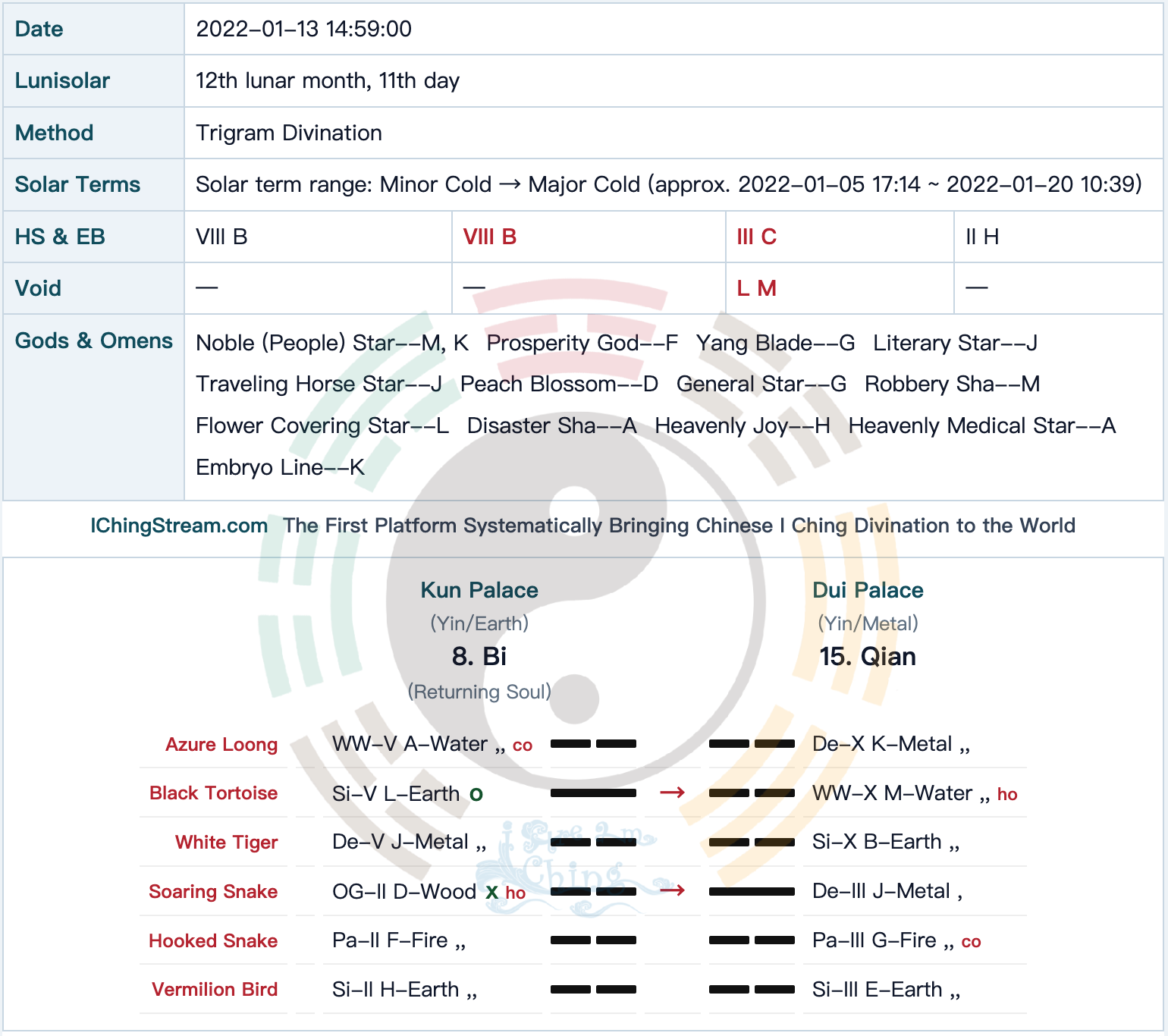
A woman asked whether she would successfully obtain a job she had applied for.
Hexagram obtained: Bi to Kun.
Judgment:
This hexagram showed a typical job-search pattern of an opportunity that appeared promising at first but ultimately failed. Although the querent had reasonable qualifications and the position offered decent compensation, the transformed hexagram became Six Clashes, indicating that the matter would first appear favorable and then fall apart.
1. The significator god held the host line: the querent was reasonably well suited to the position
For job applications, the officials and ghosts line is taken as the significator god.
In this hexagram, officials and ghosts D wood held the host line, forming a structure in which the significator god held the host.
Although D wood was drained in the B month, it was prosperous and supportive on the C day. This showed that the querent’s qualifications and overall fit with the position were actually quite good.
2. The wife and wealth line showed decent compensation
The wife and wealth A water represented salary and compensation.
A water formed compatibility with the B month and was drained on the C day, but overall it still retained strength. This indicated that the position offered reasonably good pay.
3. The active line was void and transformed into void: the source of support would later be obstructed
The fifth-line siblings L earth was active.
L earth received support from the month but was drained by the day. More importantly, it was void in the cycle, and its transformed line, wife and wealth M water, was also void, forming the pattern of void transforming into void.
Once L earth came out of void, the active siblings line would overcome wife and wealth A water.
A water was the source god of the officials and ghosts D wood significator god because water generates wood. Once the source god was overcome, the support behind the job opportunity would be weakened, preventing the position from being successfully secured.
4. The broad image: the main hexagram transformed into Six Clashes, showing initial promise followed by failure
The main hexagram, 8.Bi, was a Returning Soul hexagram, while the transformed hexagram, 2.Kun, was one of the Eight Pure Hexagrams and a Six Clashes hexagram.
In job seeking and other matters, a main hexagram transforming into Six Clashes is a strong image of initial progress followed by failure.
The early stages could therefore feel promising, and the interview or communication might appear to go well. However, later external resistance or unexpected changes would ultimately prevent the job from being secured.
Conclusion:
The job application would not succeed.
The querent’s own qualifications were reasonably good, and the salary also appeared attractive. However, the source god supporting the officials and ghosts significator god would later be weakened, while the transformed Six Clashes hexagram showed that the matter would ultimately disperse after appearing promising at first.
Feedback:
The querent later reported that the job application was unsuccessful.
We encourage rational judgment and respect for modern science.
🎉😄A quick note before today’s content: our charting feature can now provide simple case analysis to help users interpret hexagrams. It is not a replacement for systematic study.
Background:
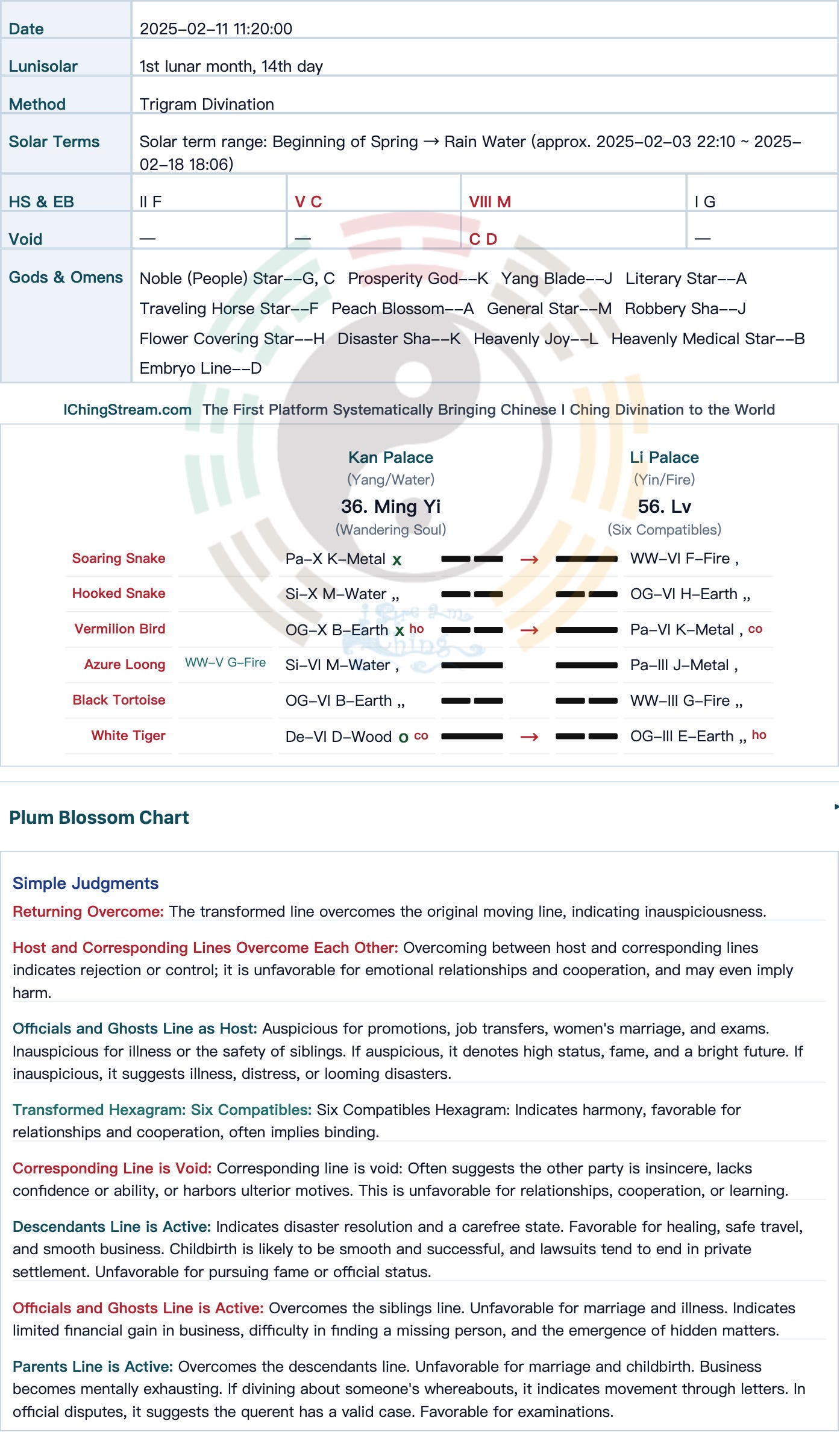
A woman had recently started a relationship with a man. Since they had not been together for long, she cast a hexagram to ask whether the relationship could eventually lead to marriage.
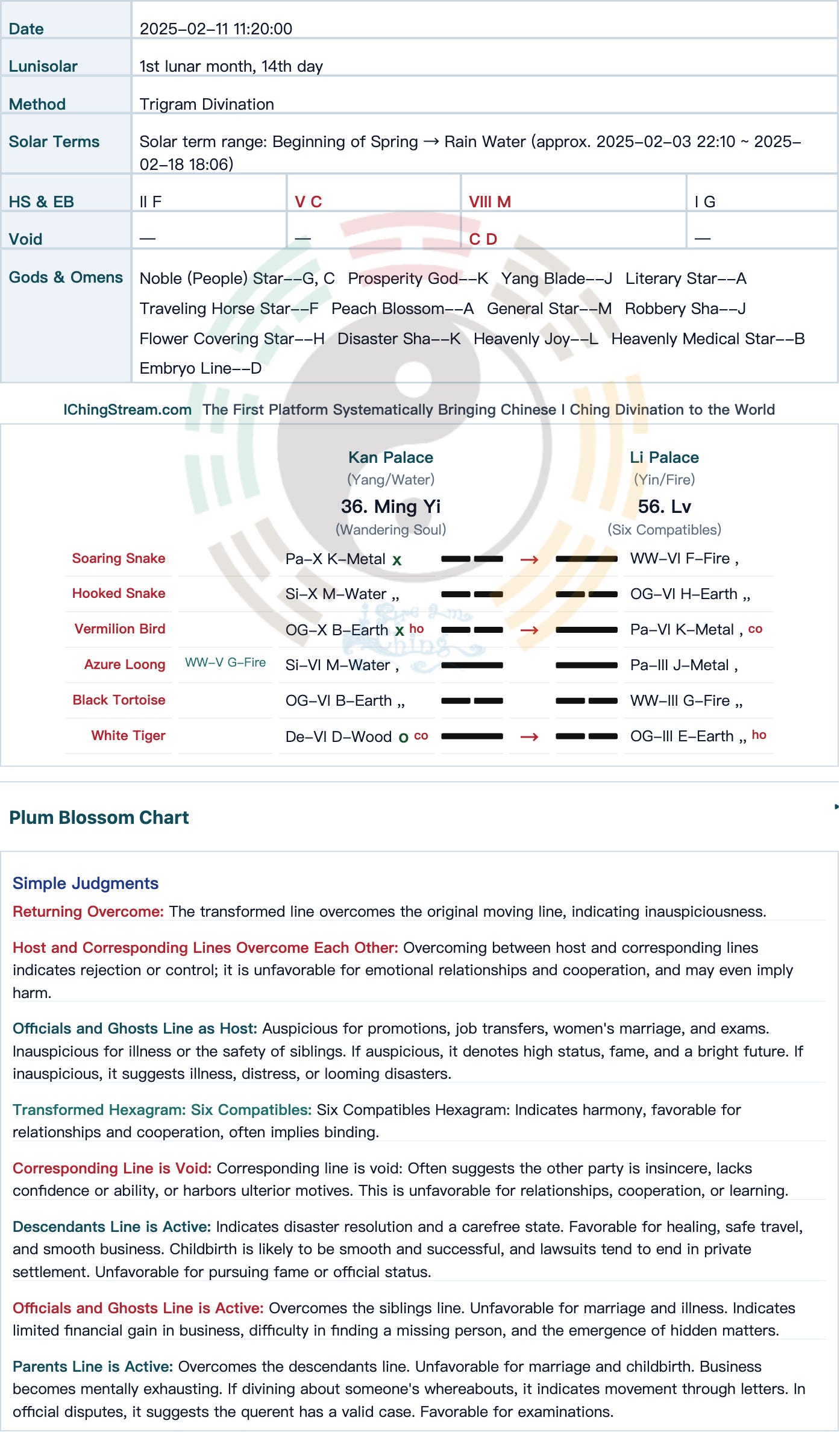
Hexagram obtained: 36.Ming Yi to 56.Lv.
Judgment:
This hexagram showed that, because the relationship was still new, the man initially lacked readiness for marriage and showed resistance toward commitment. However, his attitude would later change. Strong pressure from family elders, together with an F-K-B Metal trine centered on the parents line representing the marriage certificate, would ultimately help overcome the obstruction and push the relationship toward marriage.
1. The woman’s feelings and intention: the host line and significator god were united, while the host transformed into parents K metal
In a relationship reading by a woman, the officials and ghosts line is taken as the significator god for the man.
In this hexagram, the host line itself was officials and ghosts, forming a structure in which the host line and the significator god were united. This showed that the woman cared deeply about the man and was highly invested in the relationship.
The host line was active and transformed into parents K metal. In relationship divination, the parents line can represent documents and, specifically, the marriage certificate.
This strongly reflected the querent’s own intention. She genuinely wanted to marry the man and was eager for the relationship to progress toward legal marriage.
2. The man’s initial avoidance and resistance: the corresponding descendants line was void and overcame the host line
The corresponding line represented the man’s attitude and thoughts. It was descendants D wood.
It also directly overcame the host line representing the woman and her marriage expectations.
He showed avoidance and resistance toward formal commitment. He was not ready to turn the relationship into a concrete marriage plan.
3. The man’s later change of attitude: the corresponding line transformed into officials and ghosts E earth
Although the man initially lacked the intention to marry, the corresponding line transformed into officials and ghosts E earth.
Officials and ghosts represents the husband role as well as responsibility within marriage and family.
This transformation indicated that as the relationship developed, the man would gradually change his attitude. His resistance would weaken, and he would begin to reconsider marriage. He would become more willing to cooperate with the relationship moving toward commitment. The transformed hexagram is a Six Compatibles hexagram, so the overall outlook is favorable.
😄 Thank you all for your support.
For students who want a guided learning path, our current main recommendation is the I Ching Divination Foundations Course.
Disclaimer: This article is intended solely for academic discussion and methodological analysis of Yi principles and divination interpretation. We encourage rational judgment and respect for modern science. In any real emergency, missing-person case, medical crisis, rescue situation, or life-threatening event, always contact professional emergency services, rescue teams, medical personnel, law enforcement, or other qualified authorities immediately.
🎉😄A quick note before today’s content: our charting feature can now provide simple case analysis to help users interpret hexagrams. It is not a replacement for systematic study, but it can assist beginners in identifying basic structures, line relationships, movement, transformation, void, and other key points in a reading.
Background:
At around 9:00 PM, a mother scolded her son over something, and he subsequently left home. Unable to find him, she cast a hexagram to ask whether he was in danger and whether he would return home by himself.
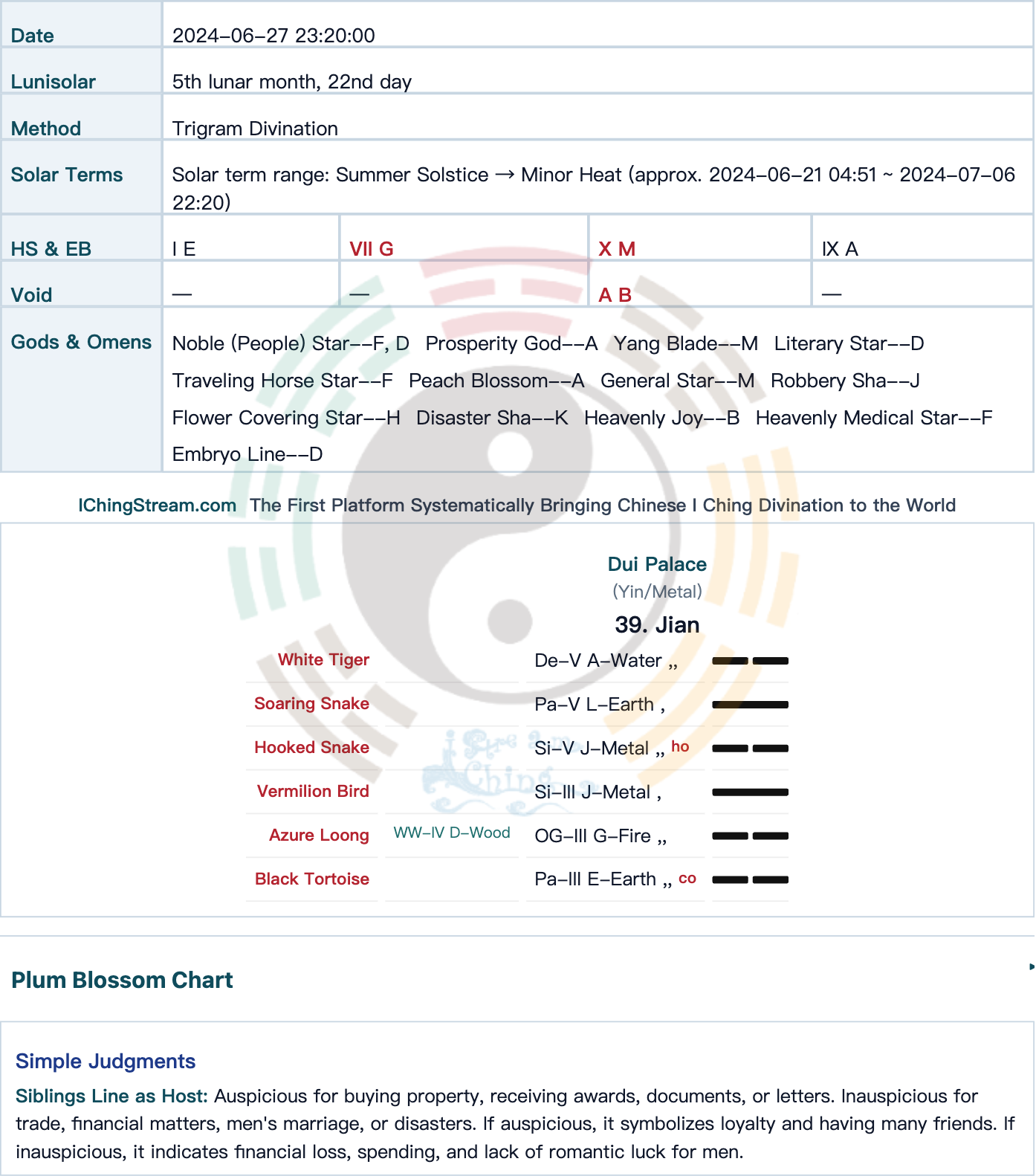
Hexagram obtained: Jian.
Judgment:
This case demonstrates how, in missing-person divination, the strength of the significator god, trigram imagery, direction, and timing can be combined to judge whether the missing person is safe, where they may be located, and when news or a return may occur.
1. Locating the significator god and judging personal safety: clashed but not overcome, therefore safe
When a mother asks about her son, the descendants line is taken as the significator god.
In this hexagram, the upper-line descendants A water represented the son.
Although A water was void in the cycle and was clashed by the G month because A and G clash, the day of divination was the X M day. The significator god A water received support from the M day because both belong to water.
Therefore, although the significator god was clashed, it was not overcome and still had strength.
In Six Lines judgment, this was a structure of being clashed without being overcome. The significator god still had qi and was not seriously damaged.
The child was therefore safe and was not in danger.
2. Locating the child: north and near water
The significator god was A water.
In Five Elements directional imagery, A water represents the north.
The significator god was also located in the upper trigram Kan. Kan likewise represents the north and belongs to water.
The directional and environmental indications therefore overlapped: the child was likely somewhere north of the home and near water, such as beside a river or another body of water.
The mother confirmed at the time that there was indeed a river to the north of their home.
3. Timing of news and return: the A hour coincided with the significator god, while the A day would fill the void
The divination was cast during the A hour.
The descendants A water significator god therefore coincided with the hourly branch. Coinciding with the current hourly branch indicates that the matter is already unfolding and that news should come very quickly.
The diviner therefore told the mother that there should be news before 1:00 AM, before the end of the A hour.
The significator god A water was also void in the cycle. By the 28th, an A day, the line would be filled.
Therefore, even if there were no immediate news, the child should return or be found no later than the 28th.
Conclusion:
The child was safe and would return.
The descendants A water significator god was clashed by the month but not overcome, while receiving support from the M day, showing that there was no serious danger.
Both A water and the Kan trigram pointed toward the north and toward water, indicating that the child was likely staying near a river or another waterside location north of the home.
The A hour coincided with the significator god, showing that news would arrive very quickly.
Feedback:
Not long after the divination, the mother reported that her son had returned home safely by himself. He had spent the time beside the river north of their home, watching other people fish.
Disclaimer: This article is intended solely for academic discussion and methodological analysis of Yi principles and divination interpretation. We encourage rational judgment and respect for modern science. In any real emergency, missing-person case, medical crisis, rescue situation, or life-threatening event, always contact professional emergency services, rescue teams, medical personnel, law enforcement, or other qualified authorities immediately.
🎉😄A quick note before today’s content: our charting feature can now provide simple case analysis to help users interpret hexagrams. It is not a replacement for systematic study, but it can assist beginners in identifying basic structures, line relationships, movement, transformation, void, and other key points in a reading.
Background:
This case comes from an online source and is a classic example of an extremely rare phenomenon in Six Lines divination. In these rare cases, the querent asks about one matter, but the hexagram answers another.
During a class, a male querent cast a hexagram to ask when his future romantic partner would appear. After examining the hexagram for a while, however, the teacher’s expression became extremely serious. Instead of discussing his romantic prospects, the teacher suddenly stated that the querent was preparing to buy a used car.
This is a relatively difficult case. However, it provides a useful example of how Six Lines divination and image-based I Ching interpretation can sometimes reveal information beyond the literal question being asked.
Hexagram obtained: Lv to Pi.
Judgment:
Compared with the romantic question the querent originally intended to ask, the hexagram presented another set of images that was far more prominent. These images pointed not to his future partner, but to a planned vehicle purchase. Additionally, they revealed a hidden danger associated with that vehicle.
1. The intention to buy a used car: the parents line, J metal, and H earth as a vehicle market
In Six Lines divination, the parents line can represent a vehicle.
First examine the active lines. The third-line wife and wealth J metal was active and transformed into a parents line. The parents line was associated with J metal and aligned with Hooked Snake. Since Hooked Snake can represent something old or previously used, the image pointed toward a used vehicle.
The parents line was also hidden beneath the first line, where the hidden god aligned with Azure Loong. Azure Loong represents something valuable, high-quality, or distinguished. This suggested that although the vehicle was second-hand, it was originally an expensive and high-quality car.
The fifth-line descendants H earth represented the tomb of the parents line. It could be taken here as the image of a vehicle storage place or used-car market.
H earth became active and transformed into J metal. This movement connected the upper line, and the sequence vividly reflected the real situation of the querent going to a used-car market to select and purchase a vehicle.
2. The hidden danger: officials and ghosts concealed beneath the vehicle
The teacher immediately warned the querent that the vehicle should not be purchased. He judged that a serious accident could occur soon after buying it.
The key indication was the officials and ghosts M water, representing danger and disaster, hidden beneath the third-line wife and wealth J metal. Therefore, this was concealed beneath the vehicle-related structure.
This hidden officials and ghosts line also aligned with Hooked Snake. In this particular context, Hooked Snake strengthened the image of hidden entanglement, obstruction, and danger.
The image of officials and ghosts hidden beneath the vehicle therefore suggested that the car contained an unseen risk. It could be associated with a serious traffic accident.
3. Comparison with an earlier similar case
To illustrate the danger, the teacher presented an earlier real case.
In that case, another querent had asked:
“If I buy a vehicle for transportation work, will it be profitable?”
The dates, querents, and questions in the two cases were completely different. However, the resulting hexagram structures and key line positions were almost identical.
In both cases, the third-line J metal was active. Officials and ghosts was hidden beneath it. The active line transformed into parents while aligned with Hooked Snake.
Unfortunately, the person who interpreted the earlier case did not recognize the image of hidden danger beneath the vehicle.
Not long after purchasing the vehicle, that querent was involved in a serious traffic accident.
Conclusion:
The querent had asked when his future romantic partner would appear. However, the hexagram instead concentrated on a completely different and more immediate matter: his plan to purchase a used car.
The vehicle imagery was unusually concentrated. The parents line represented the car. Azure Loong indicated that it appeared valuable and desirable. In addition, officials and ghosts hidden beneath the vehicle-related structure revealed a concealed danger.
This was therefore a classic example of a hexagram answering a different matter from the one originally asked.
Feedback:
The querent confirmed that, because of his limited budget, he was indeed preparing to buy a high-quality used car. This car appeared very attractive in every respect.
After receiving the warning, he did not proceed with the purchase.
Post-Case Review:
Although the original case did not explicitly explain why the teacher did not continue interpreting the hexagram through the querent’s romantic question, one possible reason is that the structure strongly resembled an earlier case the teacher had already encountered.
Once a diviner has seen a similar configuration produce a concrete real-world event, it becomes much easier to recognize the same pattern when it appears again. In this case, the combination of the same key line positions, movement, hidden officials and ghosts, and transformation into parents may have immediately reminded the teacher of the earlier vehicle case.
This is also why experience matters so much in Six Lines divination. Rules and theory provide the foundation, but interpretive ability develops through repeated exposure to real cases. The more cases a practitioner studies, the more quickly similar structures can be recognized and connected with possible real-world manifestations.
There are many examples in Six Lines divination where the querent asks about one matter but the hexagram appears to respond more clearly to another, usually something more urgent or immediately relevant. This case is a particularly striking example. Studying large numbers of actual cases therefore does more than reinforce technical rules. Moreover, it gradually builds the pattern recognition and image-based interpretive thinking needed to notice when a hexagram may be revealing something more prominent than the question originally asked.
Disclaimer: This article is intended solely for academic discussion and methodological analysis of Yi principles and divination interpretation. We encourage rational judgment and respect for modern science. In any real emergency, missing-person case, medical crisis, rescue situation, or life-threatening event, always contact professional emergency services, rescue teams, medical personnel, law enforcement, or other qualified authorities immediately.
🎉😄A quick note before today’s content: our charting feature can now provide simple case analysis to help users interpret hexagrams. It is not a replacement for systematic study, but it can assist beginners in identifying basic structures, line relationships, movement, transformation, void, and other key points in a reading.
Background:
A female querent planned to travel to another city in March to look for work. She asked how the job search would develop and whether she would be able to find a suitable position.
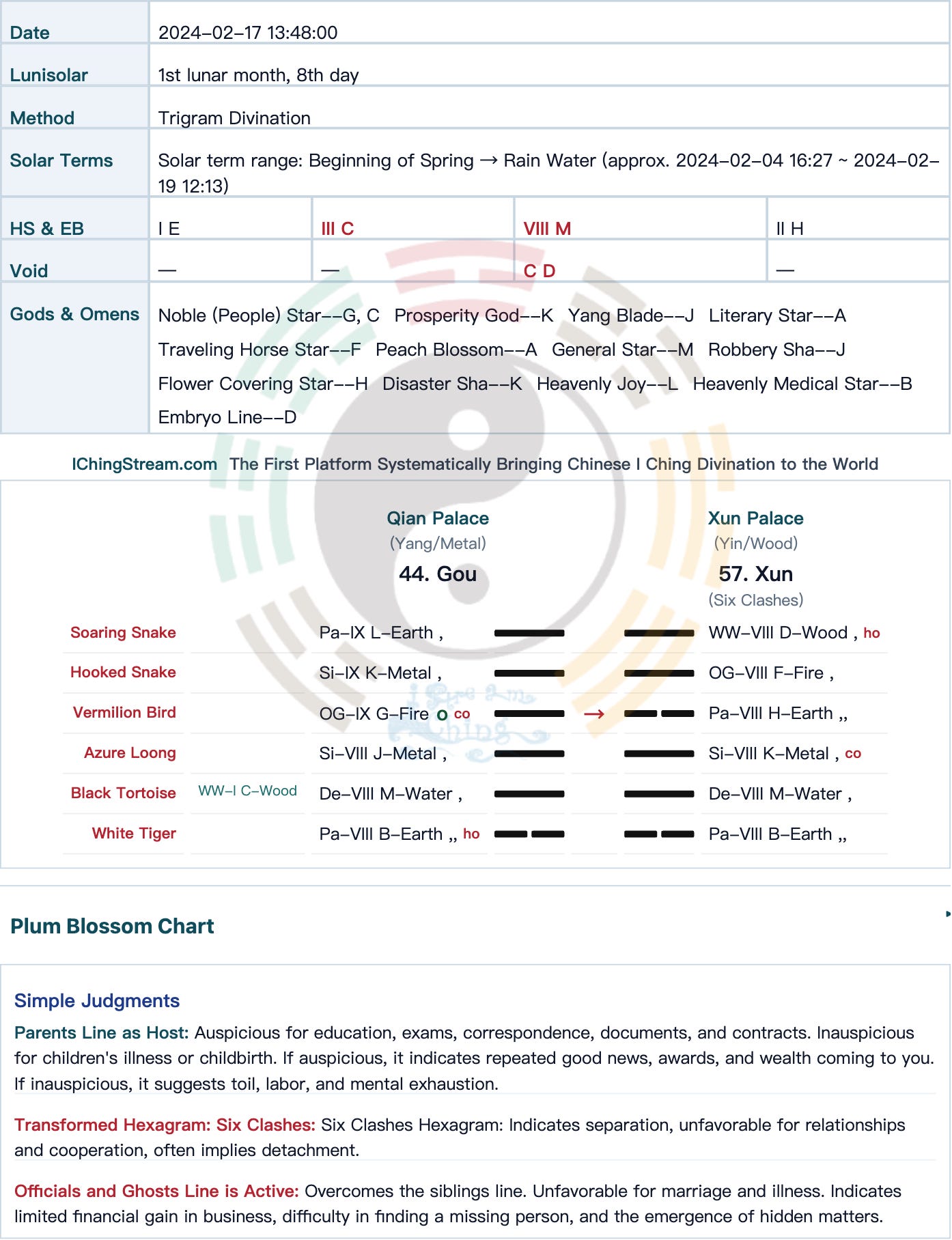
Hexagram obtained: Gou to Xun.
Judgment:
This hexagram showed a complicated job-search process in which an opportunity appeared promising on the surface but ultimately did not belong to the querent. Although a short-term job opportunity would appear, the significator god became preoccupied with compatibility, while the host line remained weak under the month and day. Therefore, the job search would be difficult at that time, and the querent needed to wait for a more favorable period.
1. Locating the significator god and the apparent opportunity: the corresponding officials and ghosts line was active and generated the host line
For job divination, the officials and ghosts line is taken as the significator god.
In this hexagram, the corresponding line, representing the outside location or the other party, was officials and ghosts G fire and was active. G fire generated the host line B earth because fire generates earth.
This objectively showed that the querent could indeed encounter a specific job opportunity that appeared promising at first.
2. The core reversal: the job became preoccupied with compatibility and the transformed line clashed the host line
Although the corresponding officials and ghosts G fire originally generated the host line, it moved and transformed into parents H earth, forming G-H returning compatibility.
In Six Lines interpretation, when an active line becomes preoccupied with compatibility, it is occupied by that compatibility and cannot freely continue generating the host line.
More importantly, the transformed parents H earth directly clashed the host line, parents B earth, because B and H clash.
This indicated that the job opportunity that initially appeared available to the querent would ultimately fall into someone else’s hands, preventing her from obtaining it successfully.
3. The querent’s own condition was weak: finding work in February and March would be difficult
The host line representing the querent was parents B earth.
During February and March, corresponding to the C and D months, B earth was overcome by the monthly wood influence because wood overcomes earth. It was also weak and drained under the day.
The host line itself therefore lacked strength.
This showed that during these two months, the querent would have considerable difficulty finding an ideal job.
4. Timing: waiting until the F or G month for the situation to turn
For the querent to obtain a job successfully, the officials and ghosts fire significator god needed to become prosperous and supportive.
This pointed toward the F and G months. By then, the officials and ghosts fire would regain strength. In particular, when the earlier G-H compatibility was opened by clash or no longer able to restrain the officials and ghosts line, the job opportunity could finally become effective and be obtained by the querent.
Conclusion:
The querent was unlikely to find a satisfactory job in March.
Although a concrete job opportunity could appear, the officials and ghosts significator god became preoccupied with compatibility, while its transformed line clashed the host line. At the same time, the host line remained weak during the C and D months.
The more favorable period for successfully obtaining employment was the F or G month.
Feedback:
The querent did not ultimately make the planned trip in March.
She later reported that she successfully found a job in June, during the lunar fifth month, the G month.
Disclaimer: This article is intended solely for academic discussion and methodological analysis of Yi principles and divination interpretation. We encourage rational judgment and respect for modern science. In any real emergency, missing-person case, medical crisis, rescue situation, or life-threatening event, always contact professional emergency services, rescue teams, medical personnel, law enforcement, or other qualified authorities immediately.
🎉😄A quick note before today’s content: our charting feature can now provide simple case analysis to help users interpret hexagrams. It is not a replacement for systematic study. However, it can assist beginners in identifying basic structures, line relationships, movement, transformation, void, and other key points in a reading.
Background:
The querent asked whether a document that was already under review would be successfully approved.
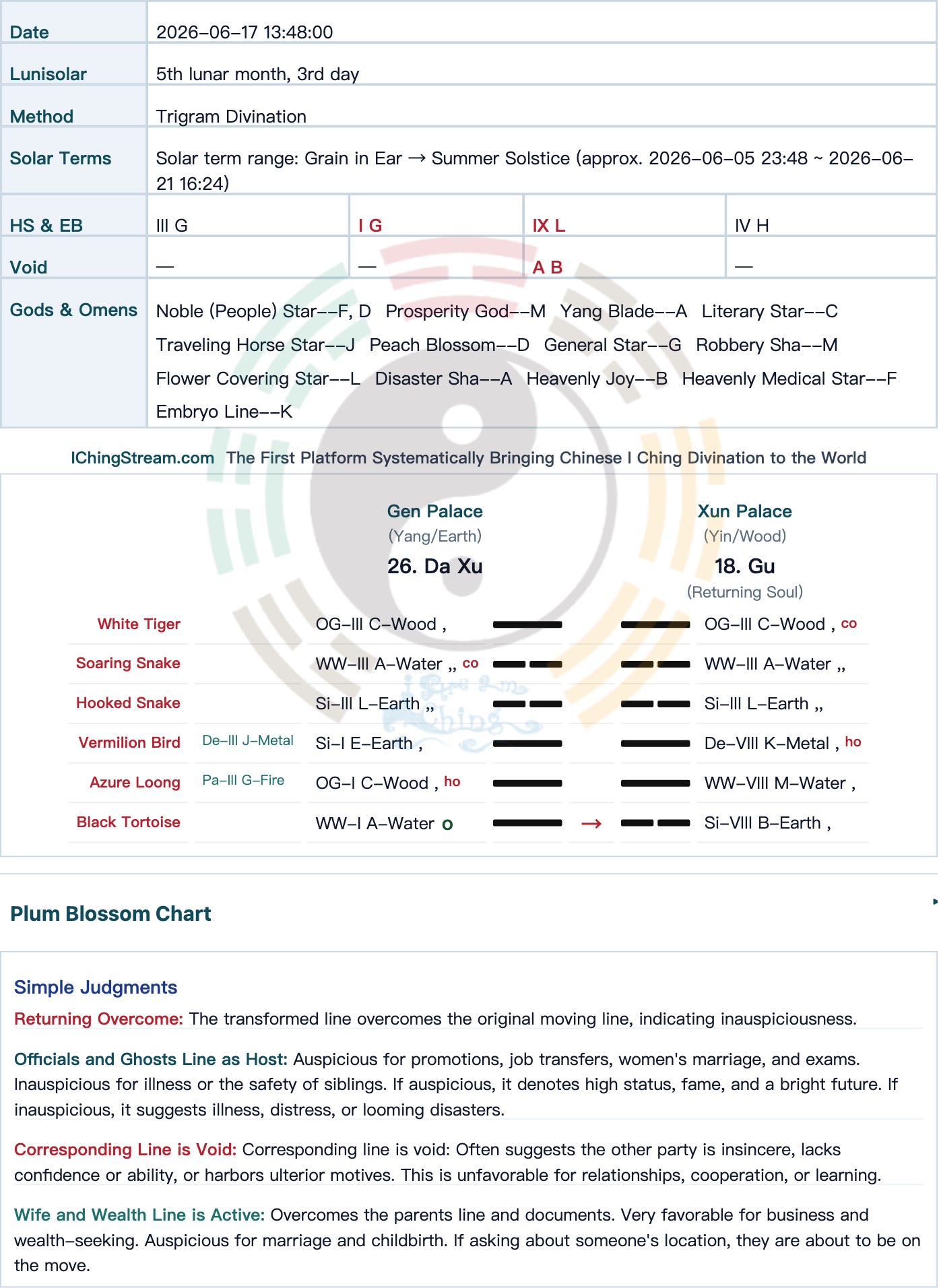
Hexagram obtained: Da Xu to Gu.
Judgment:
This hexagram showed that although the document encountered some minor difficulties because certain conditions were not fully satisfied at the beginning, those obstacles lacked real strength. In addition, covert assistance and rapid movement behind the scenes helped. A trine forming a parents structure ultimately pointed to the document being approved suddenly and smoothly.
1. The host line was officials and ghosts: reflecting the current approval process
The host line representing the querent was officials and ghosts.
In document-approval matters, officials and ghosts can represent the administrative or managing authority responsible for review and approval.
The host line being officials and ghosts objectively reflected the actual situation: the document was already in the approval process.
2. Initial obstacles and deficiencies: the obstacle god was active
Wife and wealth A water was the obstacle god of the parents line and was active on the first line.
This showed that there were clear obstacles during the early stage after the materials were submitted.
When the document first entered the approval process, some documentary requirements, policy conditions, or related criteria had not yet been fully satisfied. Consequently, the active obstacle god overcame the parents line. This caused the process to encounter resistance and made the matter somewhat difficult to handle at the beginning.
3. The obstacles lacked substance while the parents line had a strong foundation
The siblings E earth line, acting as a draining force, was clashed by the day and became covertly active.
However, the actual strength of the obstruction and delay was greatly reduced because the relevant unfavorable lines were themselves weakened by void or break. As a result, the obstacle god, wife and wealth A water, and the transformed siblings B earth line were both unable to exert their full strength.
More importantly, the parents line representing the document coincided with the day and therefore had an extremely strong foundation.
The document itself was strong enough to withstand the draining influence.
4. Covert assistance and the image of Vermilion Bird: hidden help accelerated the approval
The covertly active siblings E earth aligned with Vermilion Bird.
Vermilion Bird can represent speech and communication. In a document-approval case it can also represent written information, documents, signatures, and official seals.
This suggested that someone familiar with the process, or a key person involved behind the scenes, might provide guidance. They might explain how to handle the matter more efficiently or quietly assist in moving the signing and approval process forward.
E earth was clashed by L earth and therefore became covertly active.
Covert activity carries the image of urgency, speed, and sudden development. Therefore, this suggested that while the querent might still have been worrying about whether the document could be approved, the matter was already moving forward quickly behind the scenes.
It could therefore be completed suddenly, before the querent even expected it.
5. The decisive final structure: a C-G-L trine forming a parents structure with Azure Loong
The most important favorable structure in the hexagram was the C-G-L trine forming a parents structure.
The parents line represented the document itself, and this trine compatibility connected the parents structure with the host line.
It also aligned with the auspicious Azure Loong.
This was the decisive indication that the document would ultimately be approved successfully. In effect, the matter would reach a favorable conclusion.
Conclusion:
The document would be successfully approved.
Although the process encountered some difficulties at the beginning, the obstacle god itself lacked sufficient strength to prevent the matter from progressing. The parents line representing the document had a strong foundation. Meanwhile, covert activity showed that the process was moving more quickly behind the scenes than the querent realized.
Most importantly, the C-G-L trine formed a parents structure. It aligned with Azure Loong, providing the decisive favorable indication of successful approval.
Feedback:
The querent confirmed that additional materials had previously been requested during the review process. On Wednesday, the querent reported that the document had been successfully approved.
This paper offers an English-language introduction to I Ching Divination – Complete and Restored (Zengshan Buyi 增删卜易), one of the most influential manuals in the Na Jia based tradition of Six Lines (Liu Yao, Wen Wang Gua) divination. Based on an experiential manuscript left by the mysterious “Wild Crane Elder” (Yehe Laoren) and organised around 1690 by the early Qing scholar Li Wenhui (styled Juezi), with later appraisal by his fellow townsman Chujiang Li Woping, Zengshan Buyi stands at a key moment in late imperial Chinese divination culture, when long image-and-number traditions were tested against lived divinatory practice.
The article outlines the historical background of the Na Jia method, the internal structure of Zengshan Buyi, and its program of “augmenting and deleting” earlier rules on the basis of empirical verification. It highlights how the Na Jia framework differs from many modern oracle systems by building calendrical timing directly into each hexagram through stems, branches, and the Twelve Life Stages.
The final sections describe the first complete English edition of Zengshan Buyi, prepared as a four-volume set.
1. Introduction
Within contemporary practice of I Ching divination outside China, the classical yarrow-stalk method and the line statements of the Zhou Yi are relatively well known, largely through European translations of the canonical text. By contrast, the Na Jia based Six Lines tradition, often called Liu Yao or Wen Wang Gua, remains relatively inaccessible to readers who do not read Chinese. Yet in Chinese divination communities this integrated method, which combines Heavenly Stems, Earthly Branches, and Five Elements with hexagram structures, has been one of the dominant systems for several centuries.
Among the core texts of this tradition, Zengshan Buyi occupies a distinctive place.
The purpose of this article is to introduce I Ching Divination – Complete and Restored (Zengshan Buyi 增删卜易) to an English-reading audience in a way that is useful both for divination practitioners and for scholars interested in late imperial Chinese divination. I summarise its historical background, its internal structure, its self-conscious program of “augmentation and deletion”, and its long-term impact on how Six Lines is taught and practised. I also briefly describe the principles behind the English edition, which aims to make this tradition accessible without sacrificing its technical depth.
2. Historical background: from Na Jia to Zengshan Buyi
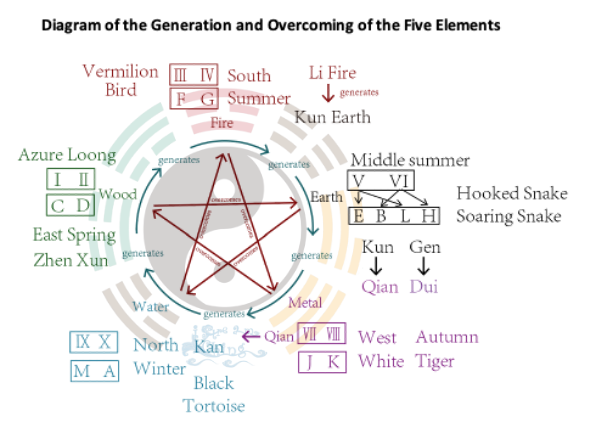
The Na Jia method emerged from the broader image-and-number exegesis of the Zhou Yi associated with Han dynasty figures such as Jing Fang. The system allows diviners to read a hexagram simultaneously in several registers: elemental generation and overcoming, temporal cycles, directional indications, and the so-called Six Relationships (parents, wife and wealth, officials and ghosts, siblings, descendants).
Some branches emphasised dense systems of spirits and omens. Others combined Na Jia with techniques of astrology, calendrics, and physiognomy.
It is within this context that Zengshan Buyi appears. The figure of Yehe Laoren, the “Wild Crane Elder”, is partly veiled in legend. He is variously described as a reclusive adept who “studied the Dao for decades” and kept four decades of divination records, testing written doctrines against lived outcomes. Li Wenhui, styled Juezi, later obtained Wild Crane Elder’s experiential manuscript through his fellow townsman Chujiang Li Woping. Drawing on some forty years of his own divinatory practice, he collated, verified, and supplemented these materials, eventually organising them into the work now known as Zengshan Buyi. Chujiang Li Woping, in turn, wrote an appraisal and assisted in preparing the text for print.
The title itself, often rendered in English as I Ching Divination – Complete and Restored, signals a critical project. In this sense, the book is both a compendium and a polemic. It positions itself as a corrective to an overloaded and sometimes self-contradictory textual tradition.
3. Structure and organisation
I Ching Divination – Complete and Restored (Zengshan Buyi 增删卜易) is not a conventional commentary on the Zhou Yi. It is a structured manual of method and case-based application.
First, there are doctrinal chapters that lay out basic principles.
Second, there are critical essays on earlier doctrines. Here the authors directly engage earlier works, including highly regarded texts such as Huang Jin Ce (“Golden Strategy” or “Golden Yarrow Tally”). They identify rules that allegedly fail in practice, call out logical inconsistencies, and propose revisions. This material gives the book its “augment and delete” character.
Third, there is a large body of applied cases.
4. “Augmentations and deletions”: critique and simplification
The “augment and delete” program of Zengshan Buyi operates on several levels.
One target is the excessive weight given to elaborate systems of spirits and killing stars (shen sha).
A second target is the idea that a single chart can be used to answer all questions about a client’s life. Some traditions claimed that one hexagram could cover wealth, longevity, marriage, and offspring. Zengshan Buyi is critical of this approach, pointing out that it often leads to self-contradictory conclusions. Instead, the authors advocate a principle of “one matter per divination”, arguing that focused questions and focused interpretations are necessary for clarity and reliability.
A third area of critique concerns technical devices such as the hexagram body, additional “bodies” attached to stems, and complicated rules about mutual correlation that proliferated in some lines of transmission. Zengshan Buyi deliberately simplifies this landscape. It retains the host line, the corresponding line, and the significator line as central positions, and it treats many other devices as either unnecessary or secondary in actual practice.
This empirical attitude gives the work a distinctive voice within the wider tradition.
5. Case-based pedagogy and classification by topic
One of the most practical features of I Ching Divination – Complete and Restored (Zengshan Buyi 增删卜易) is its extensive use of topic-based case collections. Rather than present only general rules, the authors provide numerous examples for each major sphere of life.
The marriage section discusses suitability of partners, hidden obstacles, family opposition, and questions of timing.
Crucially, these cases do not only answer whether something will happen. They also pay close attention to when it is likely to happen.
In addition to practical questions about wealth, marriage, and illness, Zengshan Buyi also preserves a number of weather divination cases.
Although such cases are not included in Zengshan Buyi itself, related materials such as Zhouyi Donglin preserve well-known examples.
Volume Four, Chapter on Seeking Wealth
The chapter opens with a succinct rule:
If both the wealth and descendants lines are absent, it is best to wait patiently. If the wealth and descendants lines are not present, or if they are present but in a state of rest and constraint, void, broken, tomb, or extinction, or if they are punished, overcome, clashed, or harmed, it is advisable to wait, as seeking wealth will be futile. Juezi said: If the daily or monthly branches act as wealth, or if they are hidden and prosperous, wealth can still be sought.
Case [364]: Seeking wealth when the wealth line is absent
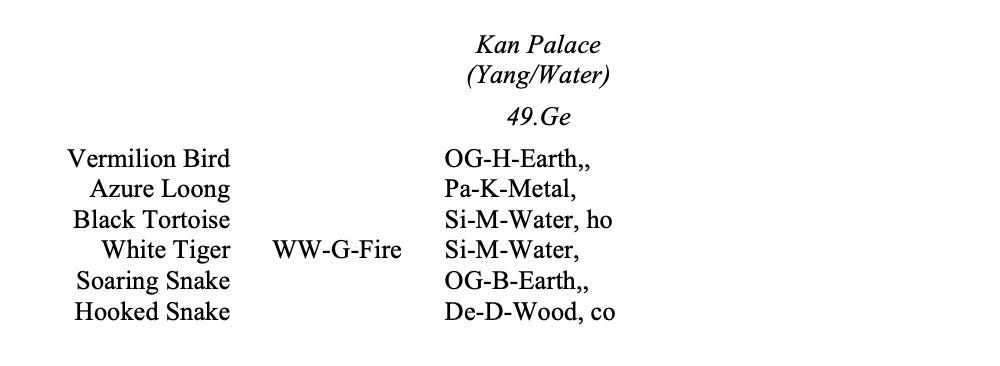
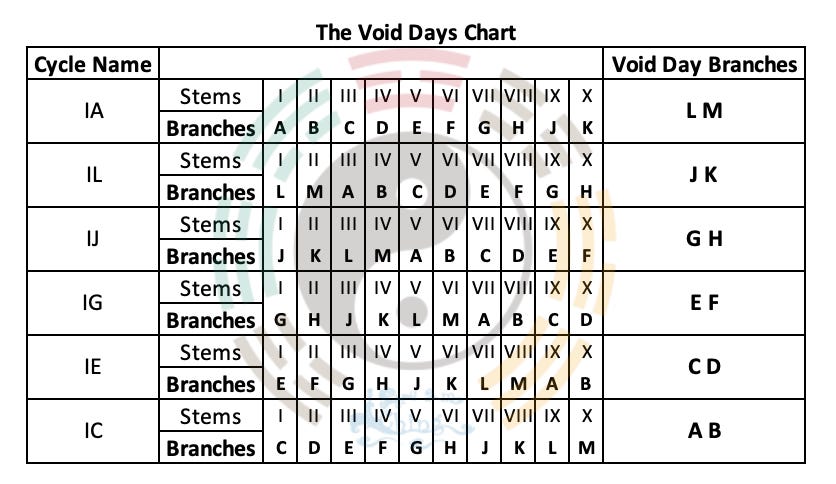
K month, V G day (void: A and B) [1]. The hexagram obtained was Ge.
Judgment: In the hexagram, the wealth line is not present, and the M siblings line holds the host. The parents line coincides with the monthly branch and generates and supports the siblings line, making it as futile as climbing a tree to catch a fish. [2]
[Annotation from the Translator]
[1]
[2] The idiom “缘木求鱼” (yuán mù qiú yú) translates to “climbing a tree to catch a fish.”
It highlights the importance of using appropriate and sensible methods to achieve one’s objectives.
Case [365]: Lending money at interest
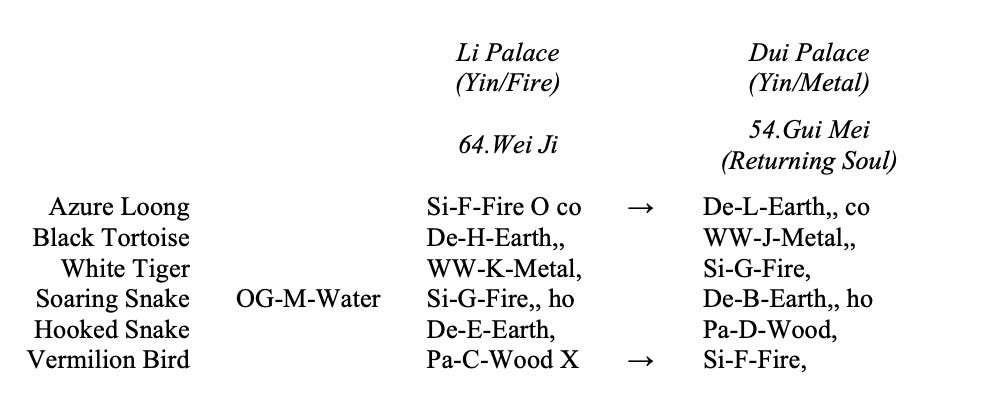
F month, III E day (void: A and B). The hexagram obtained was Wei Ji to Gui Mei.
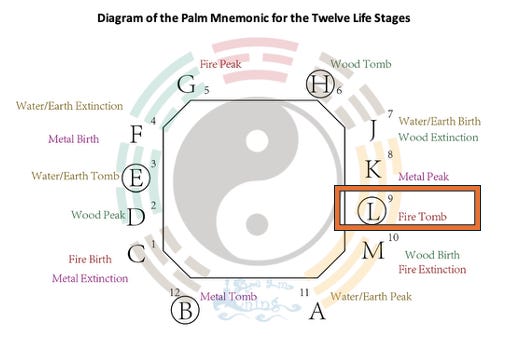
Judgment: In this hexagram, the host line aligns with the monthly branch, and both the active and transformed lines are siblings. During the divination, everything seemed smooth. However, by the ninth month (L), when the siblings line (Fire) entered the tomb [1], financial losses occurred due to deceit. How can it be said that overly active siblings lines do not lead to financial loss?
[Annotation from the Translator]
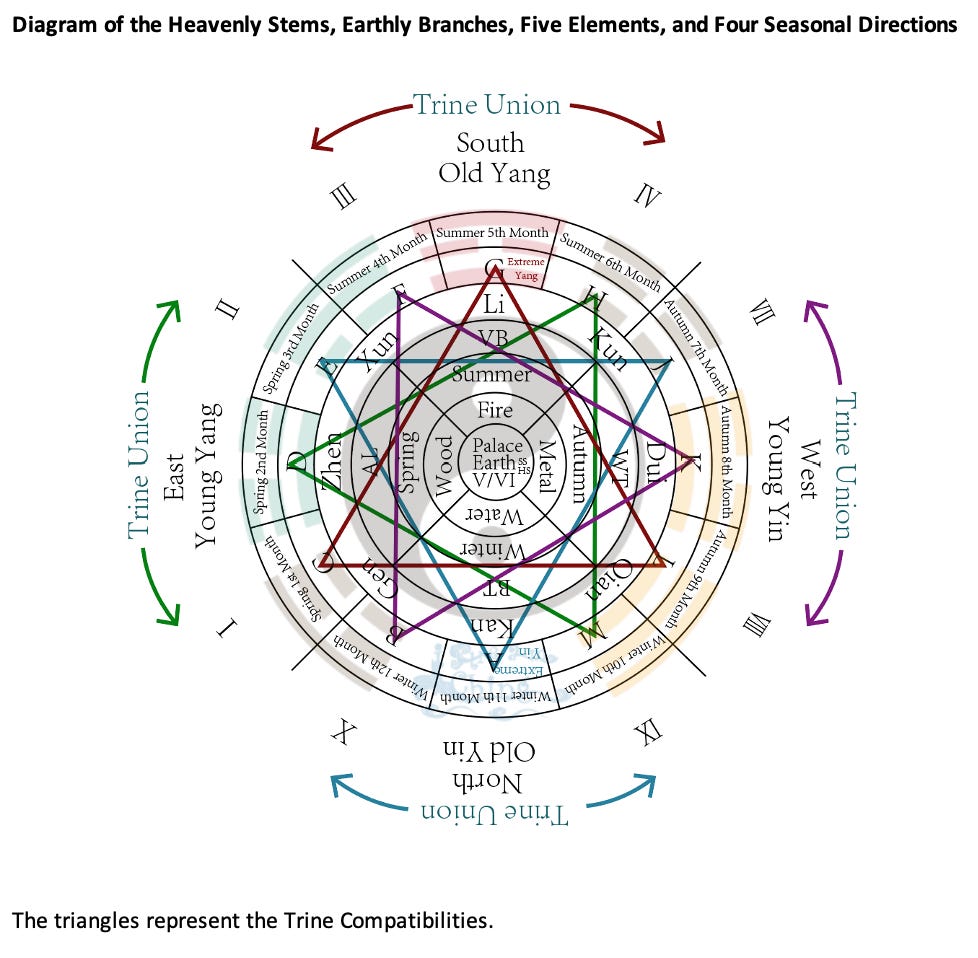
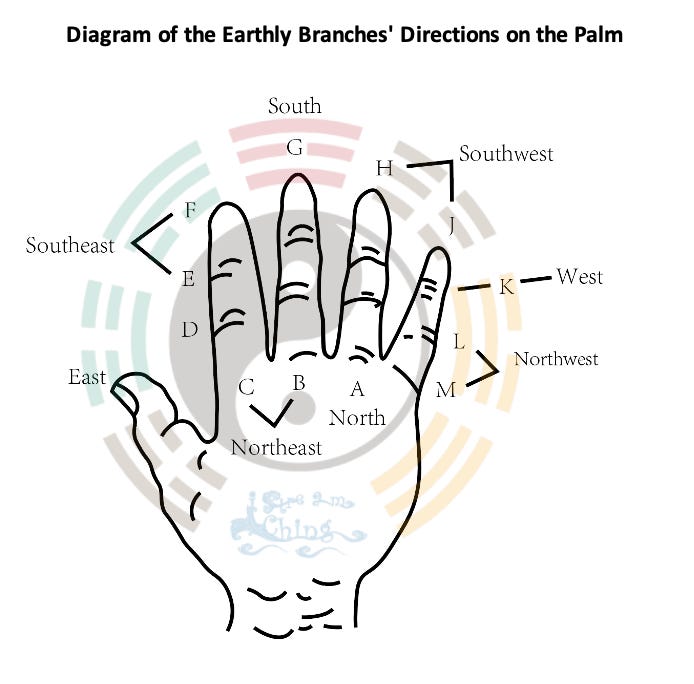
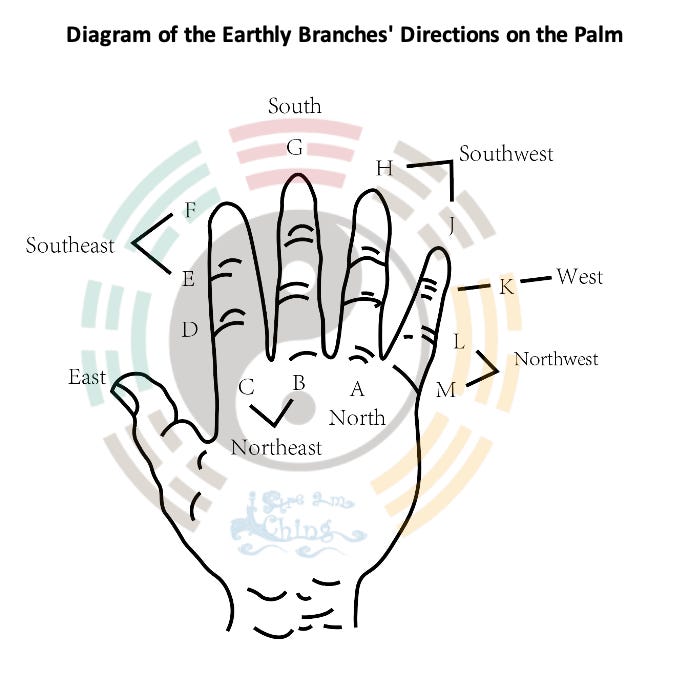
[1] The palm mnemonic for the Twelve Life Stages (see the following figure) shows how, in this case, the siblings line naturally reaches its tomb position in the ninth lunar month, which is why the loss is expected to manifest at that time.
Case [369]: Profit and the hidden cost to a sibling
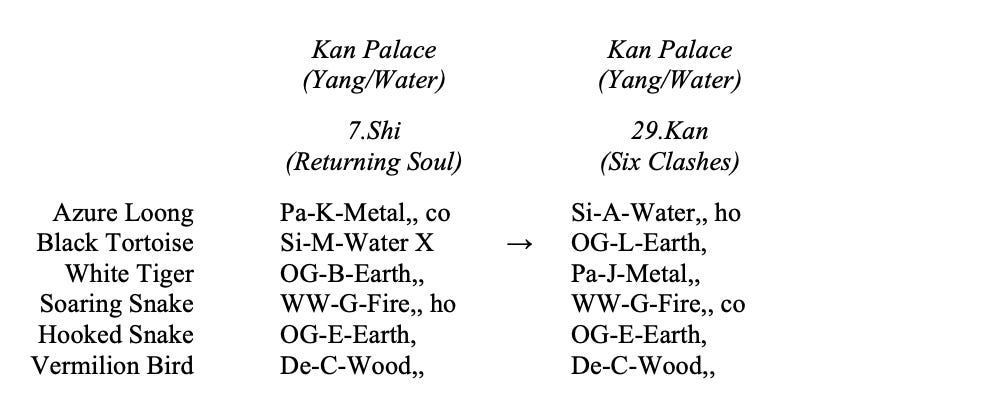
K month, III G day (void: C and D). The hexagram obtained was Shi to Kan.
When the G wealth line holds the host and the siblings line is active, it suggests a risk of financial loss. However, fortunately, the M Water line transforms into L Earth, causing the siblings line to be overcome and thus preventing it from robbing the wealth. This situation is favorable and indicates potential profit. Indeed, profit was gained. Later, in the ninth month, the querent’s younger brother suddenly fell ill and died. It was then realised that the M Water siblings line had transformed into the ghosts line, leading to this outcome.
Volume Four, Chapter on Marriage
The marriage chapter similarly combines concise rules with detailed stories.
Case [382]: Predicting the year of marriage
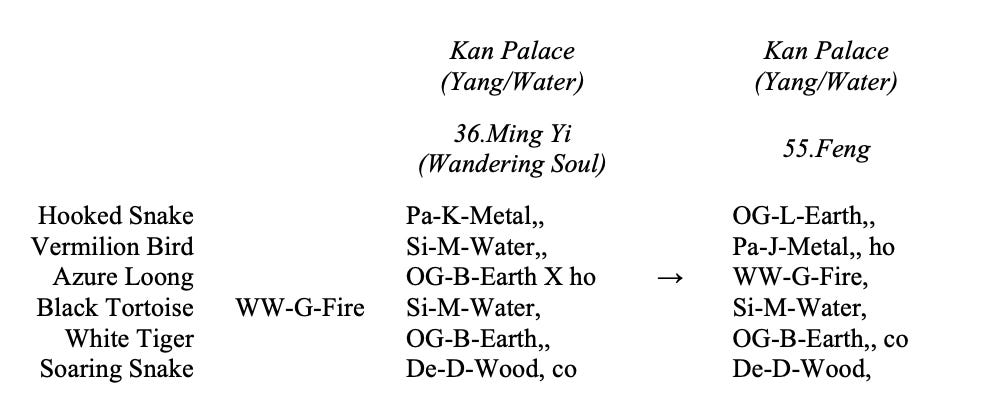
In the year of A, in the H month and on the VI H day (void: A and B), a divination was made regarding marriage. The hexagram obtained was Ming Yi to Feng.
Judgment: The B officials line holds the host, although it encounters both monthly and daily breaks. Fortunately, it transforms into a wealth line that returns to generate the host. Is this not because the wealth line generates the host, and the corresponding line overcomes the host?
Case [385]: Agreement now, regret later
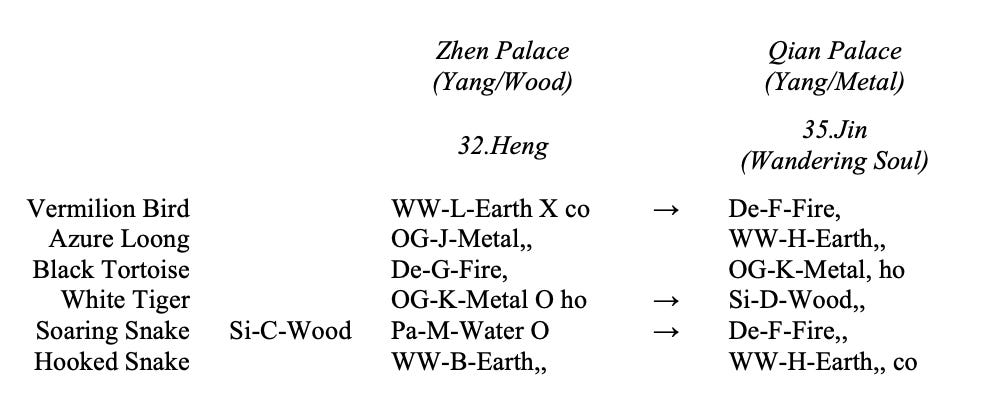
In the month of F, on the V A day (void: G and H), a divination was made to inquire whether the marriage would be approved. The hexagram obtained was Heng to Jin.
Judgment: If the inner trigram has contradictory echoes, it indicates a situation of instability and change, where initial agreement may be followed by regret. He asked, “Is this truly as you say? Will it be successful in the future?” I replied, “Since the corresponding line is associated with wealth, is active, and generates the host, it will certainly succeed in the eighth or ninth month.” Indeed, it was accomplished in the month of K, which corresponds to the host line coinciding with the month and clashing away the D Wood.
The topic-based arrangement also makes the book a useful reference. This has contributed to the book’s status as a “must read” manual among modern Six Lines practitioners.
Weather divination as a training method (Case [201])
Zengshan Buyi also includes a section on weather divination, which the authors explicitly frame as suitable for beginners:
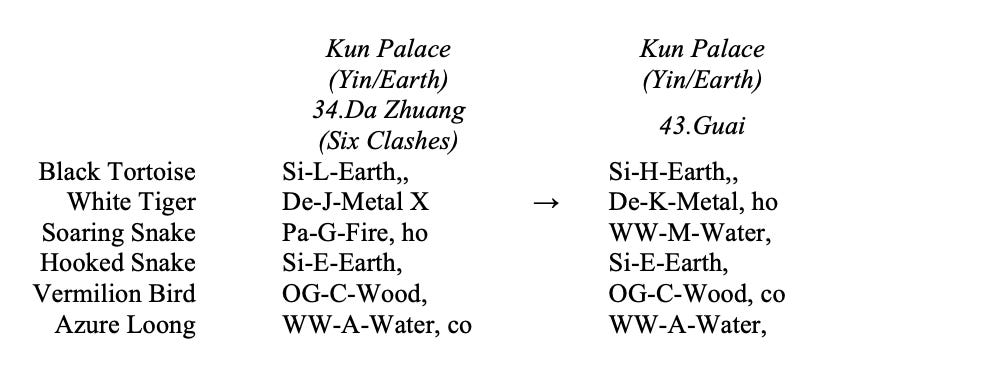
Descendants represent the sun, moon, and stars, and when they are active, they bring clear skies for thousands of miles. The “Golden Strategy” suggests that when wealth is active, it brings sunshine to all directions, but this is not entirely accurate. When the descendants are active, the skies will be clear and cloudless. Descendants are the source gods of wealth. Even if wealth is active and the skies are clear, if the descendants are in rest, in constraint, in void, broken, or present but inactive, it will not be completely sunny and there will be floating clouds or light fog.
For example: In the month of D, on the I G day (void: E and F), a divination was made regarding clear weather. The hexagram obtained was Da Zhuang to Guai. [201]
Some might ask: when recording divinations, should we not focus on rare and extraordinary verifications? Why record such an obvious case? I reply: this is recorded so that beginners can easily understand it, which is why I noted it first.
Here the author is explicit that simple, repeatedly verifiable questions such as “Will it be clear tomorrow?” are pedagogically valuable. Students can practise reading descendants, wealth, and parents lines in different states and immediately test their understanding against observable weather.
Hidden-object divination (shefu) as practice: a case from Zhouyi Donglin
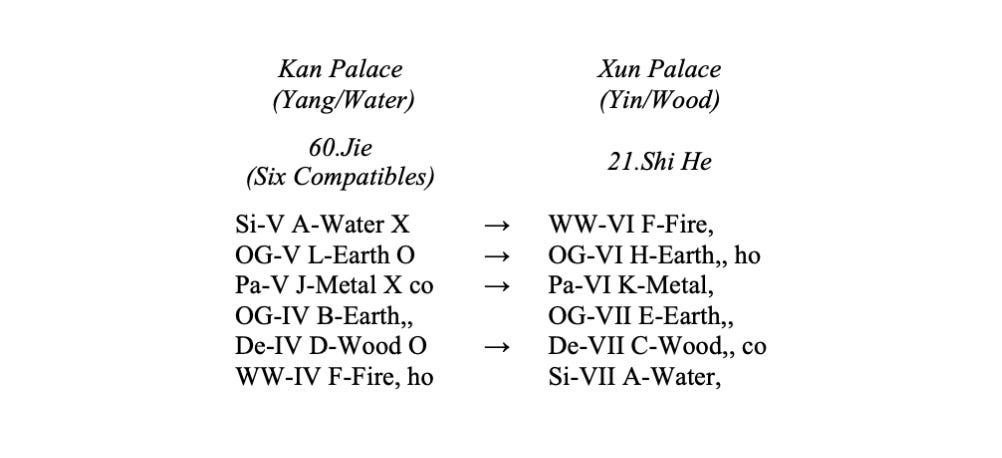
Case 23: Jin – Guo Pu Divines a Hidden Object (Tweezers) – 60. Jie to 21. Shi He
“Beitang Shuchao” cites “Donglin”: Shi An, Magistrate of Juan County, placed tweezers as a hidden object and asked Guo Pu to guess. He cast a divination and obtained “Jie to Shi He.”
Guo said, “It is not a hairpin and not an ornamental clasp; it is usually worn beneath the collar. It is an ornament for the hair at the temples, and it has two prongs.”
Judgment: Taiping Yulan cites it as, “This is a pair of tweezers; they have two prongs.” Hanshang Yi cites it as saying, “Hairpin, not a hairpin; clasp, not a clasp.” This is based on the inner trigram Dui, and Dui is Metal. In general, when interpreting a hexagram, one must begin from within.
It also says, “It is on the lower part of the head and used to trim the beard and moustache.” The term “head” refers to Qian within Kan. The “beard” lies below the head and is soft, and this corresponds to Kan. Zhu’s Jingyi Kao says that these three-character phrases do not rhyme with what follows. But “clasp” and “beard” are not in fact out of rhyme, so Zhu is mistaken.
In “60. Jie” the lower trigram is Dui; Dui opens its mouth in two prongs, and Dui is Metal, so the object is a metal thing with two prongs. The upper trigram Kan is the head, and the mutual trigram Gen is the beard, and the beard is below the head. A metal object with two prongs is again below the beard; therefore one knows that it is tweezers.
[Annotation from the Translator]
[1] Case 11 from Zhouyi Donglin.
[2] In ancient China, Shefu (Hidden Object Divination, Shefu, 射覆) was a type of game in which one attempted to divine the object hidden inside a container, such as a jar or box. Similar to weather forecasting, it also served as a method for honing one’s divinatory skills.
Shefu was not merely a form of entertainment—it was a practical training exercise for I Ching diviners. In historical records, even high-ranking officials and scholars participated in Shefu to test their predictive insight. Over time, it became one of the classic applications of I Ching divination in both scholarly and courtly circles.
[3]
6. Influence on modern Six Lines Divination (Liu Yao) and Wen Wang Gua practice
Many later manuals, whether introductory textbooks or advanced commentaries, assume familiarity with its terminology, structures, and canonical cases. Even authors who criticise the text for allegedly simplifying earlier image-and-number theories generally engage with it as a central reference.
The book’s emphasis on verification has also shaped expectations about what constitutes responsible divinatory practice.
At the same time, the text has played a role in bridging elite and popular divination.
7. The English edition: I Ching Divination – Complete and Restored
The English edition titled I Ching Divination – Complete and Restored (Zengshan Buyi 增删卜易) grew out of a desire to make this Na Jia classic accessible to readers who do not read Chinese, while preserving the technical precision that practitioners require. It is, to my knowledge, the first complete translation of the work into English.
Several principles guide the translation.
First, there is a commitment to one-to-one correspondence between the Chinese text and the English rendering.
Second, specialised terminology of Six Lines divination is translated in a stable and transparent way, so that the same technical phrase is always rendered by the same English expression. Wherever possible, this terminology is aligned across related classics, such as Fire Pearl Forest, Undersea Eye, and the Donglin materials, to support comparative study.
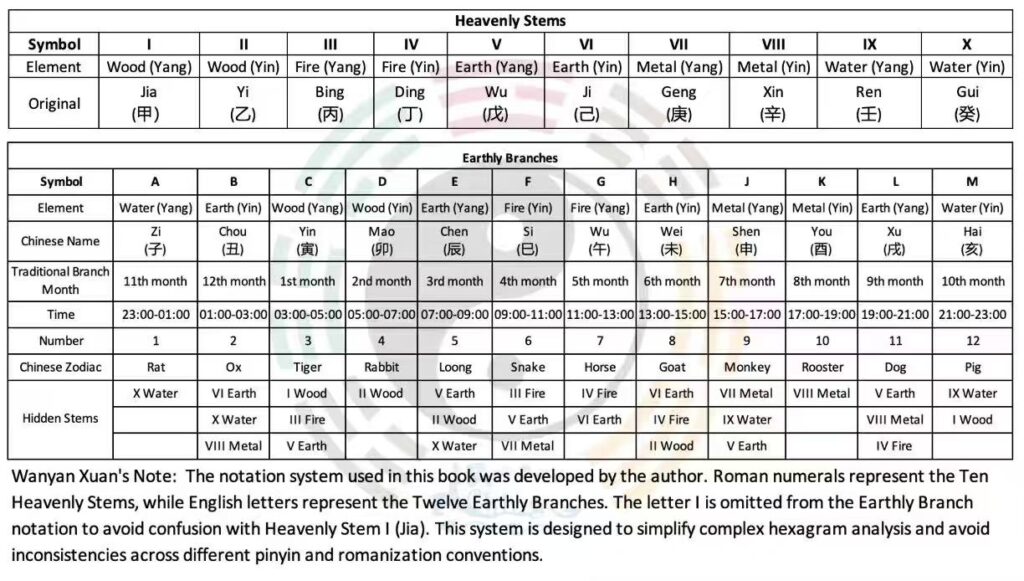
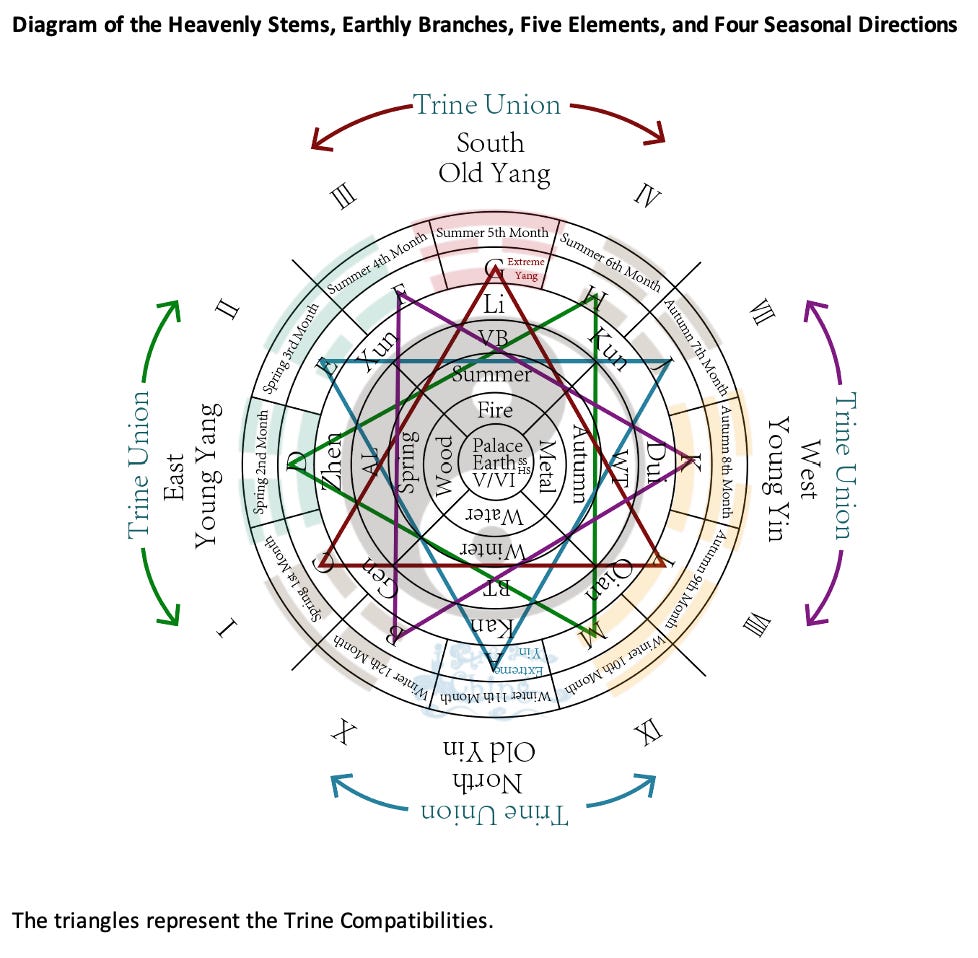
Third, the Na Jia framework itself is preserved in a clear, systematic notation, so that readers can see at a glance how Heavenly Stems, Earthly Branches, and the Five Phases are embedded in each hexagram.
Fourth, the visual infrastructure that traditional readers would already know by heart is made explicit. The English edition includes:
line structure diagrams showing Six Relationships, Five Elements, and Na Jia assignments for each hexagram
charts of the Six Clashes and Six Compatibles with directional correspondences
a Ten Heavenly Stems and Five Elements Growth Cycle chart
a Seasonal Prosperity and Decline of the Five Elements chart
visual mnemonics such as the palm diagram of the Twelve Life Stages, which help readers see why a line is considered prosperous, resting, constrained, or in the tomb in a given month
Finally, the case examples are kept complete. The English edition includes 465 cases, numbered in one-to-one correspondence with the internal numbering of the book.
8. Conclusion
I Ching Divination – Complete and Restored (Zengshan Buyi 增删卜易) stands at an important junction in the history of Chinese divination.
For scholars, it provides a dense snapshot of how technical knowledge, empirical observation, and critique of precedent interacted within one strand of late imperial divination culture.
The English edition aims to open this material to a wider readership and to invite further research on Six Lines divination within global conversations about divination, knowledge, and practice. For more information on the English edition and related study resources, readers may consult the I Ching Stream project at ichingstream.com.