I Ching Stream: The First Systematic Entry of Classical Chinese I Ching Divination into the English World
Xuan Wanyan
I Ching Stream
Translation Methodology Essay
Abstract
For a long time, the English-speaking world has understood the I Ching mainly through the Judgment and Line statements, philosophical interpretation, symbolic meaning, psychological analysis, and reflections on life. These studies, translations, and interpretations are important, and they have allowed more non-Chinese readers to encounter and reflect on the I Ching. Yet in the Chinese tradition, the I Ching is not only a philosophical classic. It has also long developed into a practical divination system used to judge real-world matters. Six Lines Divination, Wen Wang Gua, the Na Jia method, and historical verified cases are important parts of this practical tradition.
This paper discusses why translating Six Lines Divination is not simply a matter of translating words, but of rebuilding a complete classical Chinese I Ching divination knowledge system in English. This work involves not only the conversion between classical Chinese and English, but also the systematic handling of terminology, the Heavenly Stems and Earthly Branches, Five Elements relationships, case reasoning, textual variants, cultural context, translator’s notes, learning pathways, and practical feedback. What I Ching Stream is doing is to organize these core materials, which have long not been systematically presented to English readers, into an English knowledge system that can be studied, compared, practiced, and continuously expanded.
Keywords: I Ching divination, Six Lines Divination, Liu Yao, Wen Wang Gua, Na Jia, Chinese divination, classical Chinese texts, translation methodology, divination studies, Zhouyi, Yijing, I Ching
1. From Learning Divination to Understanding the I Ching: The Core Path of I Ching Stream
For a long time, the English-speaking world has understood the I Ching mainly through the Judgment and Line statements, philosophical interpretation, symbolic meaning, psychological analysis, and reflections on life. These studies, translations, and interpretations are important, and they have allowed more non-Chinese readers to encounter and reflect on the I Ching. The most widely circulated English translations, most notably Richard Wilhelm’s (translated into English by Cary F. Baynes) and James Legge’s, have shaped this understanding. In terms of divination procedure, these translations present the three-coin method for casting a hexagram, and then direct readers to consult the Judgment and Line statements for interpretation. Notably, Wilhelm was aware that another system existed. In his appendix on the coin oracle, he wrote that there is “yet another kind of coin oracle, employing, besides the hexagrams of the I Ching, the ‘five stages of change,’ the cyclic signs, etc.,” and described it as an oracle “used by Chinese soothsayers, but without the text of the hexagrams of the I Ching.” He characterized it as a perpetuation of the ancient tortoise oracle that was “gradually supplanted by the I Ching.” In reality, this system, known as the Na Jia method, was never supplanted. It has remained the mainstream framework of Chinese I Ching divinatory practice to this day. In Chinese practice, the same three-coin method is used to cast the hexagram, but the interpretation is carried out through this Na Jia system, a structured analytical framework involving the Five Elements, Six Relationships, Heavenly Stems, Earthly Branches, and time factors. It was this entire interpretive framework that was excluded from the widely circulated English translations, leaving non-Chinese readers with the casting method and the Judgment and Line statements, but not the analytical system that Chinese practitioners actually rely on for practical divination. Yet in the Chinese tradition, the I Ching is not only a philosophical classic. It has also long developed into a practical divination system used to judge real-world matters.
In the ancient Chinese tradition of I Ching learning, there is a saying: “Before learning the I Ching, first learn divination.” There are also higher-level expressions such as “one who knows the I Ching does not divine” and “one who is truly skilled in the I Ching does not need to divine.” I Ching Stream concretizes these two layers of logic into our core learning path:
Before learning the I Ching, first learn divination; one who knows the I Ching does not divine, and one who is truly skilled in the I Ching does not need to divine.
This expresses a path from practice into understanding. The purpose of learning divination is not divination itself, but to understand, through divinatory practice, the laws of change revealed by the I Ching, and gradually internalize this logic of judgment into one’s own way of thinking. Through real questions, learners first observe how the Judgment and Line statements, hexagram images, line positions, time factors, Five Elements relationships, Six Relationships, and processes of change work together. As this understanding deepens, divination is no longer merely a tool for seeking answers. It becomes a method for understanding timing, grasping opportunity, remaining composed, correcting action, and moving in accordance with circumstances.
Ultimately, those who truly understand the I Ching do not cling to divining every matter. Rather, they are able to perceive the principles of change in reality and achieve effortless action, leaving nothing undone.
What I Ching Stream completes is precisely this full path from “learning divination” to “understanding the I Ching.” What we bring into the English world is not merely a certain divination technique, but an entire Chinese traditional I Ching divination knowledge system that has long not been systematically presented: from the Judgment and Line statements, hexagram images, and image-number thinking, to the Six Lines system centered on Wen Wang Gua and the Na Jia method, and further to verified cases, timing judgment, image interpretation logic, classical texts across history, and practical feedback.
2. Six Lines and Na Jia: From Symbolic Interpretation to Structural Judgment
Today, people usually refer to this mainstream practical system of I Ching divination as Six Lines Divination. Six Lines Divination developed on the foundation of the I Ching divinatory tradition over more than two thousand years, and was continuously refined by generations of I Ching scholars. Jing Fang played a key role in the development of the Na Jia system. Later scholars such as Guo Pu and Shao Yong also enriched and advanced image-number learning, divination, and I Ching practice from different angles.
Six Lines Divination may refer to the Judgment and Line statements, and it may also incorporate image-number thinking, such as forms of image-number interpretation associated with Plum Blossom Numerology. Yet in practical divination, its main analytical framework is usually Wen Wang Gua and the Na Jia method.
The importance of the Na Jia method lies in the way it concretizes the more abstract Judgment and Line statements and symbolic judgments of I Ching divination into a structure that can be operated, inferred, and verified. By bringing categories of matters, the Five Elements, the Heavenly Stems and Earthly Branches, time factors, line positions, relationships between movement and stillness, and changing lines into the hexagram structure, the Na Jia method turns the act of judgment from symbolic interpretation into a system with explicit rules, hierarchical relationships, and paths of inference.
In modern language, it has a structure similar to algorithmic logic: a question and casting information are entered, and through fixed structures and rules of judgment, the development, obstacles, relationships, timing, and outcome of the matter are analyzed.
Therefore, Six Lines Divination is not simply the reading of a Judgment or Line statement followed by a symbolic interpretation. It asks how a concrete matter develops in reality: what the outcome will be, when it will happen, where the obstacles lie, how the two sides relate to each other, which factor is active, which factor is restrained, and whether the final feedback verifies the original judgment. For this reason, translations of such classical texts must preserve the method.
If a translation only conveys the literal meaning, but does not allow the reader to see how Six Lines Divination synthesizes the Judgment and Line statements, image-number thinking, and the Na Jia method, nor the judgment path, time factors, and image interpretation space within the cases, then even if the English is fluent, it is not a usable technical translation.
Readers interested in this kind of integrated application may refer to Studies on Ancient I Ching Divination Cases (Zhouyi Gushi Kao, 《周易古筮考》), translated and organized by I Ching Stream. This book is based on ancient I Ching divination cases organized in Shang Binghe’s original work, and is further supplemented and organized by the translator, Xuan Wanyan, with reference to Shang Binghe’s other related writings. It ultimately includes about 170 real divination cases from Chinese history. It is also one of the very few large-scale English case collections that systematically organizes ancient Chinese I Ching divination cases.
The time span of these cases extends from the Spring and Autumn period, 770 to 476 BCE, and the Warring States period, 475 to 221 BCE, to later historical eras. Preserved in historical documents across dynasties, they cover war, national affairs, official career, illness, marriage, travel, and other scenarios. They also include classic records related to Confucius divining his own fate, rulers divining military situations and state affairs, and analyses and viewpoints from later scholars. Through these cases, readers can see that I Ching divination is not an abstract concept, nor merely a form of private spiritual reflection. It is a practical method system that was actually used, continuously interpreted, repeatedly verified, and developed throughout Chinese history.
3. Why This System Had Not Systematically Entered the English World
As shown above, the Na Jia method, despite being the mainstream of Chinese I Ching divinatory practice, was not included in the most widely circulated English translations. I Ching Stream completes this gap: bringing the Na Jia system into the English world for the first time in a form that is systematic, technically accurate, and usable for serious study and practice.
Bringing this system into the English world requires more than linguistic conversion. It requires the cross-cultural reconstruction of an entire knowledge system. To complete this work, the translator must simultaneously possess the ability to read classical Chinese, a Chinese cultural background, an understanding of I Ching philosophy and the ancient divinatory tradition, practical experience in I Ching divination, knowledge of Wen Wang Gua and the Na Jia system, an understanding of the Heavenly Stems, Earthly Branches, and Five Elements structure, the ability to reason through divination cases, the ability to conduct cross-textual verification, and the ability to rebuild an expressive system for non-Chinese readers. If any one of these elements is lacking, the translation may appear fluent on the surface, but it will not be able to carry the original system’s logic of judgment.
This is why, before I Ching Stream, the English world had never seen a systematic translation framework for Six Lines classical texts. It is not that no one had ever attempted scattered translations or introductions. Rather, the combination of conditions required by this work is extremely difficult to satisfy within a single translator or team.
In other words, this is not a matter of translating one book. It is a question of how an entire knowledge system enters another language and culture. Only when the knowledge system, terminology, classical language, cases, annotations, cross-textual verification, and learning path are handled within one system can non-Chinese readers truly enter Six Lines Divination itself. This is why I Ching Stream views this work as a form of systematic knowledge engineering.
The value of this work can also be understood from another angle. If a non-native Chinese learner wishes to bypass this English system and begin directly from the Chinese originals, that person would first need to spend years learning Chinese, then years learning classical Chinese, and then still more years understanding Six Lines terminology, rules of judgment, the Heavenly Stems and Earthly Branches system, and the reasoning logic of divination cases. Even then, the learner would still need to find the correct classical editions, handle textual variants, build the ability to compare texts across sources, and work without a systematically verified terminology system as a foundation for study.
This is not an exaggeration. It is the real path that Chinese learners themselves have walked, except that they have accumulated many of the prerequisites from childhood within a Chinese-language environment. What I Ching Stream does is to compress the core content of this entire path into a system that English readers can enter directly.
4. Terminology, Stems and Branches, and Image Interpretation Must Be Treated as a System
In the Six Lines system, many terms are not ordinary nouns. They are part of the method of judgment. They involve the positions of the subject and object within the hexagram, the core reference point for the matter, the movement and stillness of the lines, the classification of matters, time states, prosperity and decline, clashes and compatibilities, and the conditions for judging auspiciousness, inauspiciousness, success, and failure. These terms are not isolated vocabulary items. They perform specific functions within case judgment.
If terminology is translated casually, with one term rendered one way in one book and another way in another book, readers cannot connect the knowledge across different classical texts. More seriously, some English renderings that appear “easy to understand” may actually narrow the technical meaning of the original, or even lead readers into misunderstanding.
A typical example is the translation of shi yao (世爻) and ying yao (应爻). In some English materials, these are simply rendered as Self and Other. This appears intuitive, but it easily leads readers to assume that they refer merely to the psychological “self” and “other.” In reality, in Six Lines Divination, shi yao and ying yao function as structural positions in the hexagram, representing host-guest relationships, the standpoint of the matter, and reference points for judgment.
I Ching Stream uses host line and corresponding line precisely to preserve their technical roles in case judgment. The former indicates the querent, the subject position, or the primary bearing position of the matter. The latter indicates the corresponding object, external relationship, or structural position opposite the host side.
Similarly, the Six Relationships cannot simply be understood as six parallel categories of persons. Strictly speaking, the concrete relationship categories in Six Lines Divination mainly include five types: parents line, siblings line, descendants line, wife and wealth line, and officials and ghosts line. Together with the “self” or subject reference within the hexagram, they form a complete set of dimensions for judging persons, matters, resources, obstacles, outcomes, and relational structures. If these terms are translated only as ordinary kinship terms, readers will overlook their functional role in divination. They are not merely labels for persons. They are core coordinates for classification of matters, Five Elements relationships, and case reasoning.
Beyond individual terms, the Six Lines system also contains many fixed judgment expressions. These expressions use highly condensed forms to express complete analytical logic. For example, the classical expression 贪生忘克 describes a common judgment situation in Five Elements relationships: when the line that a given line generates becomes active, the given line is drawn toward generating that active line, and therefore temporarily neglects its original function of overcoming another line. In some cases, this may also form a layered chain of generation among several lines. I Ching Stream renders this as greedy for generating and forgetting to overcome, preserving the technical relationship between generation and overcoming within the original judgment logic.
Similarly, the classical expression 动冲逢合 describes a layered dynamic situation within the hexagram: a line is active and receives a clash, while also encountering the force of compatibility. I Ching Stream renders it as activation and clash meet compatibility, so that English readers, like Chinese readers, can immediately recognize it as a fixed judgment combination rather than an improvised description. Such fixed expressions are used consistently across all books, allowing readers to establish connections immediately when they encounter the same judgment terms in different classical texts.
The goal of I Ching Stream is not only to give non-native Chinese readers a learning experience close to that of Chinese readers, but also, through systematic terminology design, symbolic optimization, and an annotation system, to provide in some dimensions a clearer learning path than direct reading of the Chinese originals.
Such terminological corrections may appear small, but they directly determine whether readers can truly enter the Six Lines system. If a word is translated incorrectly, the entire judgment path that follows will deviate. If a term is made overly colloquial, readers may feel that it is easy to understand, but they lose the structural sense needed for further study of classical texts and real cases.
The Heavenly Stems and Earthly Branches provide another key example. They are not merely traditional names or calendrical symbols within Chinese culture. They carry multiple functions: time, direction, the Five Elements, clashes and compatibilities, punishments and harms, image interpretation, and the time of fulfillment. Translating them directly through pinyin may appear faithful, but in practice it creates many problems. Non-Chinese readers have difficulty quickly recognizing sequence and structure. Certain Heavenly Stems and Earthly Branches appear in the same or similar pinyin forms, creating confusion. In hexagram charts and case presentation, pinyin also lengthens the layout and lowers information density.
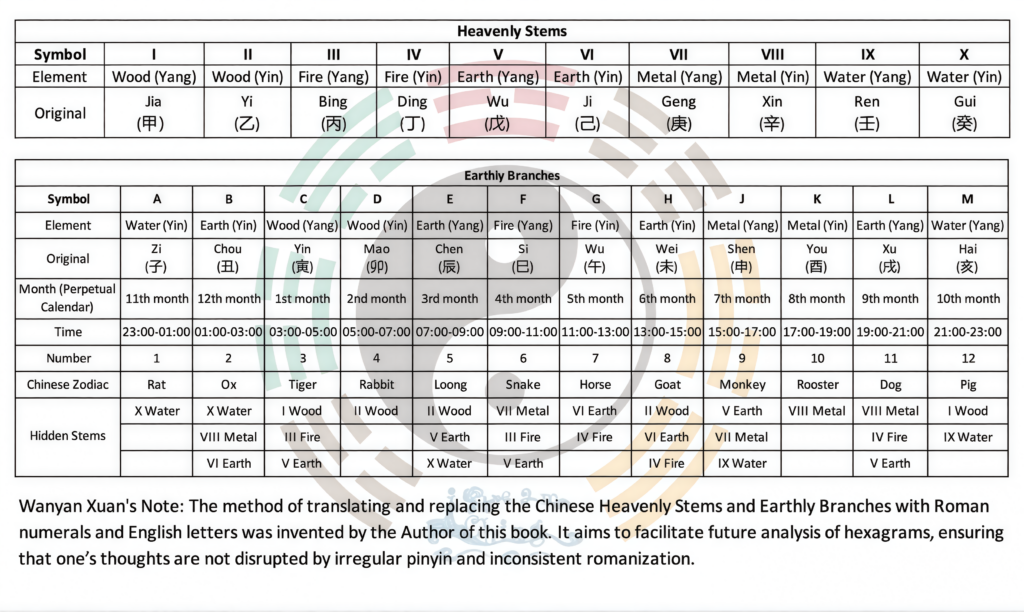
Figure 1 I Ching Stream’s symbolic replacement system for the Heavenly Stems and Earthly Branches.
If the Earthly Branches are simply replaced by zodiac animals, the problem becomes greater. The zodiac animal is only one image associated with an Earthly Branch. It is not the Earthly Branch itself. In Six Lines Divination, Earthly Branches carry multiple structural functions, including time, direction, the Five Elements, relationships, clashes and compatibilities, image interpretation, and timing. Directly replacing them with zodiac animals leads readers to understand the Earthly Branches too early as animal symbols, thereby narrowing the original system’s range of meaning.
I Ching Stream’s approach is to strictly follow the traditional Chinese Six Lines charting rules in hexagram presentation, without altering the information structure of the original system. It uses systematic symbolic replacement to achieve one-to-one correspondence, rendering the Heavenly Stems with Roman numerals and the Earthly Branches with letters, so that non-Chinese readers can quickly identify sequence, position, and relationship while preserving the original technical meaning and image interpretation space of the Heavenly Stems and Earthly Branches. This symbolic replacement system, together with its complete presentation within the sixty-four hexagrams, is an original encoding system independently designed and completed by I Ching Stream.
The point of this approach is not to simplify the original system, but to lower the entry threshold for non-Chinese readers. Chinese learners usually spend a long time memorizing the sequence, pronunciation, relationships, and usage of the Heavenly Stems and Earthly Branches. For non-native Chinese readers, if pinyin is used throughout, they must both memorize unfamiliar pronunciations and handle repetition, confusion, and lengthy layouts in hexagram charts. Symbolic replacement allows readers to enter Six Lines charts and case analysis directly without losing the original structure. They do not need to be blocked first by pinyin and zodiac labels, and can instead more quickly understand how these symbols operate within the hexagram.
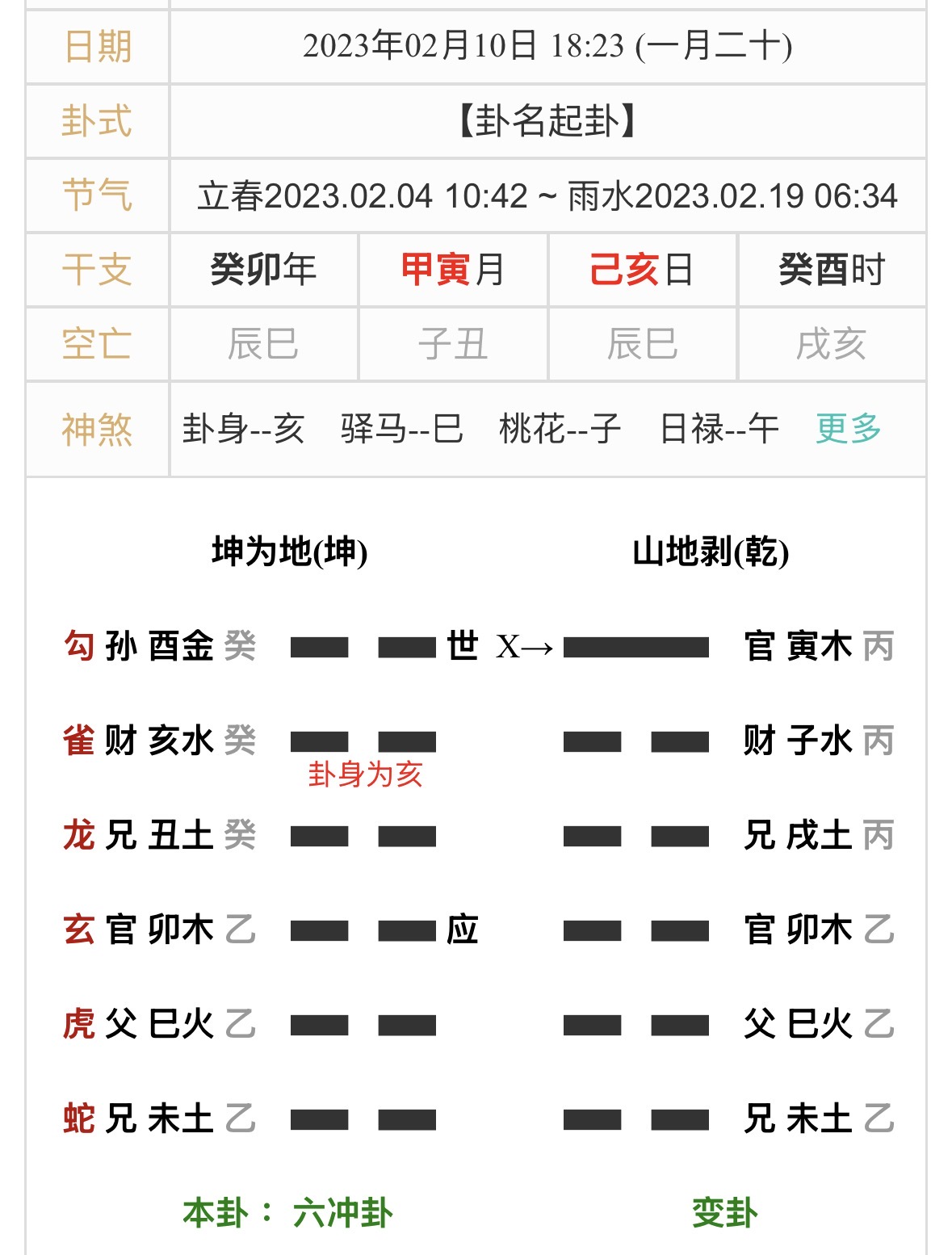
Figure 2 Example of a traditional Chinese Six Lines chart, showing the original charting structure.
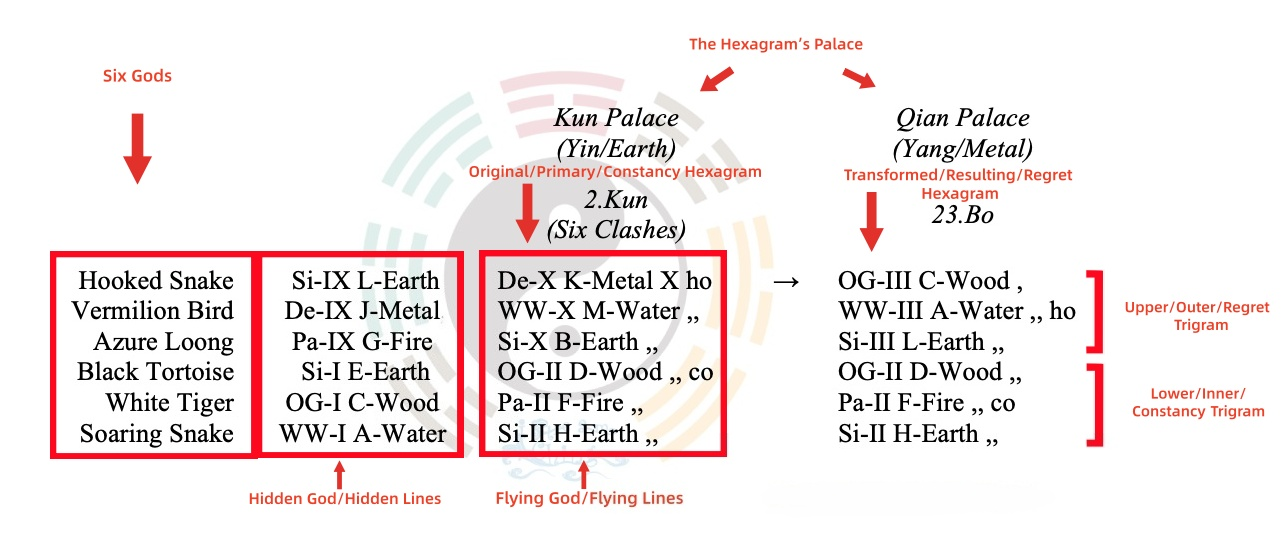
Figure 3 Example of an I Ching Stream Six Lines chart, preserving the traditional charting structure through English-readable symbolic replacement.
This design also preserves the openness of later image interpretation. Six Lines Divination does not fix every symbol into one single meaning. Often, the same category, the same Earthly Branch, the same Five Element, or the same auxiliary symbol may manifest different images in different questions. Good translation must not only allow readers to understand the literal meaning, but also preserve the space for reasoning and image interpretation contained in the original text.
Therefore, I Ching Stream’s terminology design is not an ad hoc choice made book by book. It is a systematic design made from the standpoint of the entire classical Chinese divination system. Every core term must be able to maintain a stable technical function across different classical texts, different cases, and different judgment scenarios. The expression used in one book must be able to connect with other classical texts. The way a concept is understood in Six Lines Divination must also be compatible with the larger Chinese mantic knowledge structure.
5. Translating Classical Chinese Requires First Decoding the Technical Logic
The language of Six Lines classical texts is often highly condensed. Much of the material is not modern explanatory prose, but a combination of classical language, mnemonic verses, judgment formulas, annotations, and case judgments. Ancient Chinese literati and scholars valued concision, parallelism, rhyme, and rhythm. Many verses and judgment formulas, in order to aid memorization and transmission, compress complex rules into extremely short sentences, often omitting many prerequisite conditions. Original authors often do not unfold every basis for judgment one by one. They assume that the reader already understands hexagram structure, the function of terms, time relationships, Five Elements generation and overcoming, image interpretation logic, and specific rules of divination.
For example, a common verse in the classical texts is: “When the parents line holds the host line, it indicates bodily labor.” At the literal level, it may seem to mean only that when the parents line occupies the host line position, the person will experience labor, burden, or fatigue. Yet the logic behind these seven Chinese characters goes much deeper. In Six Lines Divination, the parents line overcomes the descendants line, while the descendants line represents joy, freedom, ease, vitality, and relief from pressure. Therefore, when the parents line holds the host line, the querent is placed in a position of pressure, responsibility, or labor. At the same time, this structure suppresses the factor in the hexagram associated with ease, enjoyment, and vitality.
If the translator only renders this as “the parents line on the host line means hard work,” the reader receives only a conclusion, but does not know where that conclusion comes from, nor can the reader use the same reasoning in other cases. I Ching Stream’s translation preserves the concision of the original while using notes to unfold the Five Elements relationship, line-position function, and reasoning basis behind the statement, so that readers can both remember the formula and understand why it holds.
Therefore, translating these texts cannot be merely word-for-word correspondence. The translator must first correctly understand the original at the technical level, determining what a sentence has omitted, what it points to, and what layer of logic it connects to before and after. Only then can it be rendered clearly in English. If the translator does not understand Six Lines Divination itself, even if every character can be looked up, the translator still cannot correctly judge the function of the sentence within the case or rule system as a whole.
This is also why I Ching Stream emphasizes cross-textual consistency in translation. Different classical texts can verify one another in terms of terminology, rules, case judgments, and timing logic. An expression that appears obscure in one book may be explained more clearly in another. A method of judgment in one case may also be corroborated by rules in other classics. Only by treating these texts as one system can the translation avoid becoming an accumulation of isolated sentences and instead present a complete and consistent logic of judgment.
In addition to understanding classical language and technical logic, the editions of the classical texts themselves must be handled carefully. Many I Ching divination classics passed through long processes of hand-copying, woodblock printing, reprinting, and modern editing. Different editions may contain variant readings, omissions, scribal errors, punctuation differences, paragraph division differences, or editorial differences. For such classical texts, textual variation itself is part of the textual tradition, and it may also affect the reader’s understanding of sentence meaning, rules, and case judgment.
I Ching Stream’s translations of classical texts are grounded in the Chinese classical textual tradition. In handling these texts, we refer to publicly available ancient editions, transmitted texts, textual collation information, and related research, comparing differences among versions. For differences that do not affect I Ching divination and Six Lines theory itself, and do not change case reasoning or technical judgment, I Ching Stream handles them according to context, common transmitted texts, and majority usage, so that the translation remains clear, stable, and readable.
For key differences that affect sentence meaning, rule understanding, case reasoning, or technical judgment, we explain different readings through translator’s notes where necessary, and interpret them in light of the original context, mantic logic, cross-textual relationships, and case structure.
These comparisons are not mechanical copying from any single modern edited edition. Rather, they respect the real conditions of textual transmission and help English readers understand the complexity formed through the transmission, editing, and interpretation of classical texts. The final English translation, terminology system, translator’s notes, case explanations, and learning structure are all independently organized by I Ching Stream according to original textual content, mantic logic, cross-textual verification, and an English learning system.
This is another reason why I Ching Stream does not treat the translation of classical texts as simple linguistic conversion. A truly reliable translation must handle language, mantic logic, and textual versions simultaneously. It must read the original, understand its technical function, and recognize the textual variations formed through long transmission. Only then can English readers access layers of the text closer to what Chinese researchers and practitioners see when facing the originals, rather than only seeing the surface wording of a single edition.
6. Case Translation Must Preserve the Chain of Reasoning
For a book such as I Ching Divination: Complete and Restored (Zengshan Buyi, 《增删卜易》), one of its core values lies in more than 460 real divination cases. A case is not a story, nor is it simply “someone asked a question, and there was an outcome.” It is a record of a judgment process.
In a case, the reader needs to see why a certain line becomes the core of the judgment, why the movement of a certain line matters, why the month and day affect the judgment, why a certain state changes the outcome, why the author judges that the matter will succeed or fail, why the time of fulfillment may fall at a certain time, and why the final feedback supports, corrects, or challenges the original judgment.
Take a common type of case as an example. Someone asks whether the pursuit of wealth will succeed. In the hexagram, the wife and wealth line represents the wealth being sought. If this line is in a prosperous and supportive state, receives support from the monthly branch or daily branches, and is not restrained or scattered by overcoming or clash, the original author may complete the judgment with only one sentence: “The wealth line is prosperous and supportive; if it is sought, it can be obtained.” Yet the actual chain of reasoning is far more complex than this sentence. The wealth line holding the host line indicates that the querent is directly connected with the wealth being sought. The wealth line is active and transforms into an advancing god, meaning that the wealth is increasing and that the direction of change is favorable. The monthly branch generates and aids it, and the daily branches do not overcome it, confirming that the external time conditions are supportive. There is no active obstacle god in the hexagram, and no interference from opposing forces. All of these conditions together support the conclusion that “if it is sought, it can be obtained.”
The time of fulfillment is then inferred according to the line’s Five Elements attribute, the direction of movement and transformation, and time relationships, and may fall in a certain month or day. This is the real value of the case: not the conclusion, but the complete path by which the conclusion is reached.
If a translation only handles the surface of the sentences, without preserving a clear chain of reasoning, the reader can only obtain a conclusion after reading, but cannot truly learn the method. The translation of case-based texts must preserve two layers: what the author said, and how the author reasoned. For serious learners, practitioners, and researchers, the latter is often more important.
Therefore, I Ching Stream’s translator’s notes pay particular attention to the reasoning process within cases. Many judgment steps in classical texts are highly compressed, because original authors assume that readers already have the relevant foundation. Our notes unfold these omitted or compressed layers of logic, allowing non-Chinese readers not only to understand the conclusion, but also to understand how the judgment is formed step by step.
7. Translator’s Notes and Cultural Judgment: A Bridge for Cross-Cultural Understanding
For Chinese readers, much of the historical background, social institutions, family structure, ritual customs, linguistic implication, and mantic terminology in classical texts can be naturally understood through long-term cultural experience. For non-native Chinese readers who lack a Chinese cultural background, these elements create significant gaps in understanding. More importantly, this cultural understanding is not optional background knowledge. It is a necessary foundation for studying and practicing I Ching divination. Many judgments in cases are based precisely on an understanding of ancient social relationships, concepts of time, kinship ethics, official institutions, linguistic habits, and modes of image interpretation.
For example, ancient cases often involve divination about official career. The original author may assume that readers understand the Chinese imperial examination system, the distinction between local and capital officials, the difference between waiting appointment and actual appointment, and promotion rules in specific dynastic contexts. If the translation does not provide this background, readers may understand every English word and still fail to understand why the author judges in a certain way. This is because the basis of judgment lies not only in the hexagram itself, but also in the social reality mapped by the hexagram. I Ching Stream’s notes fill in this assumed background knowledge, allowing non-Chinese readers to have conditions of judgment closer to those available to Chinese readers when facing the original text.
Understanding these cultural and historical contexts is not for the purpose of remaining in the ancient context, but for truly mastering the logic of judgment. Only by understanding how ancient practitioners connected human relationships, family structure, social circumstances, time changes, linguistic implications, and hexagram images can learners more easily extend the method by analogy and transform the methods in ancient cases into tools for modern questions.
Therefore, I Ching Stream includes detailed translator’s notes according to the needs of each book. These notes are not decoration. They help readers cross the distance of culture, history, and technical knowledge by explaining ancient social background, traditional calendars, technical terminology, case reasoning, judgment steps omitted by the author, the real meanings of ancient words, and relationships of quotation, inheritance, and discussion among different classical texts.
At the same time, translator’s notes also use actual modern Six Lines application experience to point out learning priorities and levels of usage for readers. The classical texts preserve a large amount of mantic material. Some of it belongs to the core of the mainstream judgment framework, such as the significator god, line positions, Five Elements generation and overcoming, monthly and daily branches, six relationships, movement and stillness, clashes, compatibilities, punishments, harms, and timing judgment. Some material, however, has many different explanations across books, is more disputed, or has relatively lower priority in modern mainstream Six Lines practice, such as certain judgments involving gods and omens.
I Ching Stream’s notes help readers distinguish which content should be prioritized and which content is more suitable as advanced reference or auxiliary material, rather than allowing beginners to spend large amounts of energy from the start on secondary or highly disputed branches.
This is not a deletion or reduction of the classical texts. It is the establishment of a clear learning order for non-Chinese readers. The classics should be presented in full, but learners also need to know how to enter them: first mastering the mainstream judgment framework, then understanding auxiliary rules, special usages, and differences of opinion among classical texts. In this way, readers can both respect the complexity of the originals and avoid being distracted too early by excessive side branches.
Such notes require the translator to possess judgment formed through long immersion in Chinese cultural contexts. Many classical I Ching divination texts assume that readers already understand Chinese social life, family relationships, generational order, kinship ethics, official institutions, traditional calendars, historical allusions, sacrificial language, classical Chinese expression, and the way Chinese people naturally connect images, words, time, and real events. This understanding cannot be replaced by dictionary lookup. It comes from long-term experience accumulated within Chinese cultural circles, family environments, and social relationships.
Our goal is to use clear explanations and systematic translator’s notes to unfold the background and logic that the original text omits, compresses, or assumes that readers already know, so that non-Chinese readers can approach the context and conditions of judgment that Chinese readers possess when facing the originals, and can thereby truly understand cases, grasp the logic, and use these materials in serious study and practice.
8. Why These Classics Deserve to Enter the English World First
The classical texts that I Ching Stream prioritizes for translation are not randomly selected. They are core classics in the Chinese I Ching divination tradition that have been verified by time, remained influential, and continued to be cited, discussed, and inherited by later generations.
Our translation order is not simply based on the chronological order of the ancient texts. It is arranged according to learning value, practical value, transmission influence, and systemic completeness. We prioritize those classics that are closer to mature practical forms, repeatedly cited by later generations, and most able to help non-Chinese readers establish a modern mainstream I Ching divination judgment framework.
Take I Ching Divination: Complete and Restored (Zengshan Buyi, 《增删卜易》) as an example. This book is prioritized not only because of its classical position in the Chinese Six Lines learning tradition, but also because it provides a large number of real cases across different matters and scenarios. Each case contains casting conditions, judgment process, reasoning basis, and actual feedback. For beginners, it is the closest text in the English world to a learning path of “learning the method through cases.”
The Orthodox Method of I Ching Divination (Bushi Zhengzong, 《卜筮正宗》) focuses more on systematic organization of rules and annotated collections of classical verses, complementing the case-oriented nature of Zengshan Buyi. Encompassing I Ching Divination (Yi Mao, 《易冒》) explains in greater depth the logic behind Six Lines judgment at the level of principle, helping readers understand why the rules are as they are, not merely what the rules are. Together, these three books allow readers to learn method from cases, grasp systematic rules, and understand the principles behind the rules, forming a complete learning path from practice, to rules, to principle.
This does not mean that other classics are unimportant. For example, Fire Pearl Forest: I Ching (Six Lines) Divination Classical Text (Huo Zhu Lin, 《火珠林》) is extremely concise in style and omits a great deal of judgment logic and reasoning detail. It is more suitable as an advanced reference for readers who already possess a foundation in Six Lines Divination, rather than as an introductory text. Likewise, Jing Fang’s Commentary on the Zhouyi (Jingshi Yizhuan, 《京氏易传》) is important for understanding Han dynasty image-number learning, the Na Jia tradition, and later I Ching development. Yet for readers who wish first to master modern mainstream I Ching divination practice, it is better suited as auxiliary material for understanding the origins and theoretical background of the system, rather than as the core introductory entry.
Therefore, I Ching Stream first presents the classics that can directly support learning and practice, and then gradually supplements earlier source texts and advanced texts.
In this way, readers can first establish a usable judgment framework, and then gradually return to earlier source texts to understand how this system developed step by step into its present form.
9. How Readers Can Enter the I Ching Stream Learning System
For readers who are just beginning to encounter classical I Ching divination, I Ching Divination: A Practical Study Roadmap can first be used to establish an overall map, helping them understand the relationships among Six Lines Divination, Wen Wang Gua, the Na Jia method, case study, and classical texts.
For readers who wish to systematically learn methods of judgment, I Ching Divination: Complete and Restored (Zengshan Buyi, 《增删卜易》) is the most important case-based entry point, because it uses a large number of real cases to show how rules operate in concrete questions. The Orthodox Method of I Ching Divination (Bushi Zhengzong, 《卜筮正宗》) is more suitable for establishing a rule framework, while Encompassing I Ching Divination (Yi Mao, 《易冒》) helps readers understand the principles behind these rules.
For readers who wish to understand how ancient I Ching divination was actually used in history, Studies on Ancient I Ching Divination Cases (Zhouyi Gushi Kao, 《周易古筮考》) provides a unique path. It brings readers back to real divination cases preserved in historical documents, allowing them to see how this method was used for war, national affairs, official career, illness, marriage, travel, and major real-world decisions.
These classics do not exist in isolation. Case books help readers see how judgment happens. Rule books help readers establish structure. Principle books help readers understand the basis behind the rules. Historical cases help readers see the real usage contexts of this method in Chinese tradition. I Ching Stream presents these texts in the form of a library precisely so that different classics can connect with one another, explain one another, and lead readers step by step into deeper study.
Therefore, I Ching Stream’s books are not isolated products. They are a gradually unfolding learning system: first establishing the map, then learning cases, then mastering rules, then entering principles, and finally completing practical training through ongoing cases, tools, and courses.
10. The Platform and Tools of I Ching Stream
I Ching Stream is not merely a website that publishes translations of classical texts. It is a learning platform built around this knowledge system. It connects classical translations, real cases, study notes, case studies, online reading, tool resources, a Chinese Perpetual Calendar, AI-assisted divination features, and future systematic courses, allowing readers to gradually enter the complete knowledge structure of traditional Chinese I Ching divination.
The tools and AI-assisted features here are not intended to replace learning and judgment. They are designed to assist charting, understanding, and practice. The real core remains the classical texts, terminology system, case reasoning, and systematic learning. AI tools can support the process of charting, reference, and pattern recognition, but they cannot replace the learner’s own judgment. In Six Lines Divination, the same hexagram may lead to different interpretations depending on the specific question, context, and the practitioner’s reasoning. This is not a limitation but a core feature of the system. The ability to make independent judgments through one’s own understanding of the rules, cases, and image interpretation is ultimately what separates a learner from a practitioner. Moreover, classical I Ching divination involves elements such as external responses (外应), where the practitioner’s real-time perception of the surrounding environment, intuition, and situational awareness become part of the judgment. These are embodied human capacities that AI fundamentally cannot replicate. AI can assist your learning, but it cannot replace your thinking.
In addition to historical cases from classical texts, I Ching Stream also continuously provides analysis and explanations of modern real cases, helping readers apply classical methods of judgment to contemporary practical questions and complete the transition from reading to practice.
In the past, non-native Chinese learners found it difficult to stand on a cognitive and material plane comparable to that of Chinese learners when studying I Ching divination systematically. They often had access only to scattered explanations, second-hand introductions, simplified concepts, or English materials lacking technical structure. They could not, like Chinese learners, gradually enter this system through classical texts, terminology systems, real cases, historical annotations, charting tools, and practical feedback.
What I Ching Stream does is to integrate these core elements into a complete system that can be entered, studied, compared, and practiced in English. This allows non-native Chinese learners to stop remaining at the periphery of explanation, and instead truly approach the knowledge structure and practical logic that Chinese learners have when facing the original texts.
11. About the Founder and Translator
The translation work of I Ching Stream has long been led by its founder, Xuan Wanyan. Xuan Wanyan grew up in a Chinese family environment that valued scholarship, traditional culture, and practices of self-cultivation. She encountered the I Ching, I Ching divination, and Chinese traditional culture at an early stage. Elders in her family have long paid attention to classical learning, cultivation of body and mind, and Daoist cultivation practices, allowing her from childhood to understand this knowledge within an environment that was serious, systematic, and close to the internal context of Chinese traditional culture.
She later graduated from Columbia University in the United States, obtained the qualification of Certified Public Accountant (CPA), and has long-term experience living, studying, and working in both China and the United States. Her professional background includes work at Big Four accounting firms and major multinational corporations.
This background enables her to understand classical texts and divinatory logic from within Chinese culture while also being familiar with the comprehension habits of English readers and the requirements of cross-cultural expression. At the same time, professional training as a CPA and long experience in auditing and finance bring another layer of assurance to the translation work: strict requirements for terminological consistency, step-by-step verification of logical chains, sensitivity to the correspondence between evidence and conclusion, and the ability to build traceable and verifiable structures within complex systems.
These working methods are highly aligned with the terminology verification, restoration of reasoning chains, cross-textual comparison, and system-building required in the translation of Six Lines classical texts.
12. Conclusion: Translation Is Not the End, but the Path into the System
For classical Chinese I Ching divination texts, the accuracy of translation depends not only on whether the English is fluent, but also on whether the translation preserves the judgment logic of the original system.
An English sentence may be fluent and still not be a usable technical translation. A term may seem easy to understand and yet damage later learning. A case may be translated as a story and lose the reasoning process. A cultural concept may be quickly replaced by a word familiar to the reader, while the original space for image interpretation is thereby narrowed.
Translating the I Ching Divination system means transforming terminology, structure, time, image interpretation, cases, feedback, and historical context together into a learning system that English readers can enter. The goal of I Ching Stream is not to replace the Chinese originals, but to establish a path through which non-Chinese readers can enter the original system. Our goal is not to make Six Lines Divination look more like divination systems already familiar in the English-speaking world, but to allow English readers to truly enter Six Lines Divination itself.
Choosing an unreliable translation involves more than a financial loss. It may cause learners to establish an incorrect terminological framework and judgment path at an early stage. Learning incorrectly is harder to correct than not learning at all. Once a learner has already used an incorrect terminological framework to understand dozens of cases, starting over is not simply a matter of relearning. It is a struggle against cognitive habits already formed.
If you believe that this work is valuable for I Ching studies, Chinese divination, historical divination practice, or cross-cultural understanding of Chinese traditional knowledge systems, please share I Ching Stream with readers, researchers, and practitioners who may need these resources.
Appendix I: Classical I Ching Divination Library
The classical I Ching divination library of I Ching Stream includes core texts that have already been published and are being continuously organized:
• I Ching Divination: Complete and Restored (Zengshan Buyi, 《增删卜易》)
• The Orthodox Method of I Ching Divination (Bushi Zhengzong, 《卜筮正宗》), also known as Golden Strategy
• Fire Pearl Forest: I Ching (Six Lines) Divination Classical Text (Huo Zhu Lin, 《火珠林》)
• Undersea Eye: The Core Principles of I Ching (Six Lines) Divination (Haidi Yan, 《海底眼》)
• Hidden Principles Ode: A Classic of I Ching (Six Lines) Divination (Chan Ao Ge Zhang, 《阐奥歌章》)
• Studies on Ancient I Ching Divination Cases (Zhouyi Gushi Kao, 《周易古筮考》)
• Encompassing I Ching Divination (Yi Mao, 《易冒》)
• The Complete Book of Divination (Bushi Quanshu, 《卜筮全书》)
• Supplement to the I Ching Forest (Yi Lin Bu Yi, 《易林补遗》)
• I Ching Forest (Yi Lin, 《易林》)
• I Ching Divination Guide (Bushi Yuangui, 《卜筮元龟》)
• Celestial Secrets of I Ching Divination (Duanyi Tianji, 《断易天机》)
• The Concealed Dimensions of I Ching Divination (Yi Yin, 《易隐》)
• Jing Fang’s Commentary on the Zhouyi (Jingshi Yizhuan, 《京氏易传》)
• and more.
Appendix II: Modern Learning Materials
In addition to translations of classical texts, I Ching Stream is also building modern learning materials that integrate classical principles, operational rules, image interpretation methods, and case analysis into a system more suitable for non-Chinese readers:
• I Ching Divination: A Practical Study Roadmap
Appendix III: Further Study and Resources
• Books and classical translations: https://www.ichingstream.com/books/
• Case studies and study notes on Substack: https://substack.com/@ichingstream
• Author profile, sample materials, and related papers: https://columbia.academia.edu/XuanWanyan
• I Ching Stream community on Reddit: https://www.reddit.com/r/ichingstream/
• Structured learning program, I Ching Divination Foundations: https://www.skool.com/i-ching-divination-group-9696/classroom
References
Wilhelm, Richard. The I Ching or Book of Changes. Translated by Cary F. Baynes. 3rd ed. Princeton: Princeton University Press, 1967. pp. 723–724.
Revised version, May 2026. This version adds a reference to Richard Wilhelm’s acknowledgment of the Na Jia system in his appendix on the coin oracle.
Ready to Begin?
Browse the Classical Library → Try the Divination Tools → Start Your First Course →