
Disclaimer:
All personal information in this case study has been anonymized or omitted. This case study is provided for learning and reference only. It is not intended as medical, veterinary, legal, financial, investment, or other professional advice.
III. Arranging the Six Lines Chart
Part 3.2. Installing the Hexagram Components
Part 3.2.3. Installing the Host and Corresponding Lines
After identifying the hexagram name, palace, and generation position, the next step is to install the host line. Next, you install the corresponding line.
In Six Lines divination, the host line is one of the most important positions in the chart. It often represents the querent, the main side of the matter, or the central position.
The corresponding line represents the opposite side, the other party, the object being asked about, or the external side of the matter.
Why is it called the corresponding line? The word “corresponding” means that the line responds to, faces, or matches another line in the opposite trigram. The first, second, and third lines of the lower trigram correspond respectively to the fourth, fifth, and sixth lines. These are the lines of the upper trigram.
In other words:
The first line corresponds to the fourth line.
The second line corresponds to the fifth line.
The third line corresponds to the sixth line.
The first line is the first position of the lower trigram, while the fourth line is the first position of the upper trigram. The second line is the middle position of the lower trigram. Meanwhile, the fifth line is the middle position of the upper trigram. The third line is the upper position of the lower trigram. Similarly, the sixth line is the upper position of the upper trigram.
The intermediary lines stand between the host line and the corresponding line. In practical judgment, they often represent people, matters, conditions, obstructions, procedures, or mediating factors. They may also represent intermediate links standing between the two sides.
For example, in a relationship reading, the intermediary lines may sometimes represent a matchmaker or a third party. In a transaction reading, they may represent an intermediary, a contract, or the movement of funds. They can also represent other intermediate links between the buyer and the seller. In readings about documents, lawsuits, or applications, they may also represent procedures, administrative institutions, or approval processes. In addition, they may represent intermediate obstructions.
Therefore, the host line, corresponding line, and intermediary lines form a basic relational framework within the Six Lines chart.
The host line represents the self-side, the querent, or the main position.
The intermediary lines represent the intermediate factors standing between the host and corresponding positions.
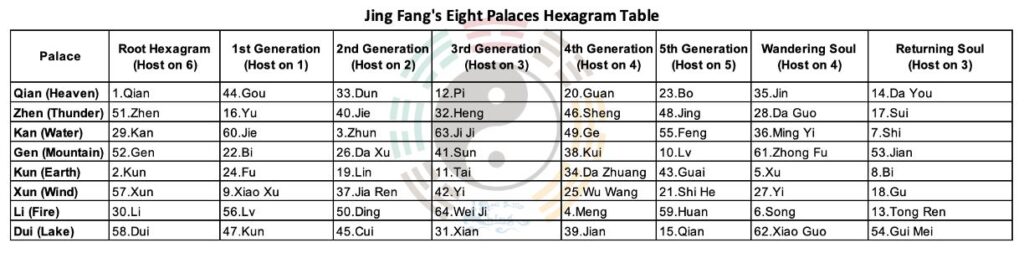
As explained in the previous section, each palace contains eight hexagrams:
Eight Pure Hexagram → 1st Generation Hexagram → 2nd Generation Hexagram → 3rd Generation Hexagram → 4th Generation Hexagram → 5th Generation Hexagram → Wandering Soul Hexagram → Returning Soul Hexagram
Once we know which position the hexagram occupies in its palace, we can determine where the host line is located.
The rule is as follows:
An Eight Pure Hexagram is also called a sixth-generation hexagram. As the name implies, its host line is on the sixth line, that is, the top line.
A 1st Generation (Host) Hexagram has the host line on the first line.
A 2nd Generation (Host) Hexagram has the host line on the second line.
A 3rd Generation (Host) Hexagram has the host line on the third line.
A 4th Generation (Host) Hexagram has the host line on the fourth line.
A 5th Generation (Host) Hexagram has the host line on the fifth line.
A Wandering Soul Hexagram has the host line on the fourth line.
A Returning Soul Hexagram has the host line on the third line.
Therefore, the palace position tells us where to place the host line.
The corresponding line is then determined by line pairing:
If the host line is on the first line, the corresponding line is on the fourth line, and the second and third lines are the intermediary lines.
If the host line is on the second line, the corresponding line is on the fifth line, and the third and fourth lines are the intermediary lines.
If the host line is on the third line, the corresponding line is on the sixth line, and the fourth and fifth lines are the intermediary lines.
If the host line is on the fourth line, the corresponding line is on the first line, and the second and third lines are the intermediary lines.
If the host line is on the fifth line, the corresponding line is on the second line, and the third and fourth lines are the intermediary lines.
If the host line is on the sixth line, the corresponding line is on the third line, and the fourth and fifth lines are the intermediary lines.
Installing the host and corresponding lines is not a minor charting step. It establishes the basic relational structure of the entire chart.
These include installing the Six Relationships, identifying the significator line, and judging generation, overcoming, clash, compatibility, void, break, tomb, movement, and transformation.