Disclaimer: This article is intended solely for academic discussion and methodological analysis of Yi principles and divination interpretation. We encourage rational judgment and respect for modern science. In any real emergency, missing-person case, medical crisis, rescue situation, or life-threatening event, always contact professional emergency services, rescue teams, medical personnel, law enforcement, or other qualified authorities immediately.
Recently, a reader asked an important question: if Chinese practitioners today use the Great Expansion (Dayan or yarrow stalk) method less often, is it simply because the yarrow-stalk casting procedure is too complicated?
The issue is not only the casting method.
A casting method is only the way to obtain a hexagram. What truly determines the quality of a divination is the interpretive system that follows. Many readers easily confuse “how to cast a hexagram” with “how to interpret a hexagram.” The Great Expansion method has not been completely preserved as a full historical system. What has mostly survived is the yarrow-stalk procedure for obtaining a hexagram. In actual interpretation, the textual path based on the hexagram statements and line statements is relatively clear, but the other, more important half of the Great Expansion tradition — its image-number interpretive method — gradually divided, dispersed, and was partly absorbed into later traditions such as Plum Blossom Divination, image-based interpretation, and other branches of Yi divination.
If a divination method preserves only the casting procedure but lacks a complete corresponding interpretive system, it is difficult to call it a fully preserved tradition. The effectiveness of divination does not depend only on “how a hexagram is obtained.” It also depends on whether one can systematically interpret the images, texts, positions, transformations, timing, and real-world matter shown in the hexagram. Without image-based interpretation and structural judgment, the analysis naturally becomes incomplete.
Of course, no matter which method one studies, the key is not to mechanically apply a few isolated rules. The key is to understand the entire structure of the system, grasp its underlying principles, and apply them flexibly according to the actual hexagram and the real situation. True divination ability comes from the integration of system, principle, and practice.
For this reason, if one wants to study a relatively complete, operable, and trainable system of I Ching divination today, Na Jia Six Lines and Plum Blossom Divination remain two of the more systematically preserved branches in Chinese tradition. Na Jia Six Lines, in particular, is supported by many classical works, including I Ching Divination: Complete and Restored (Zengshan Buyi, 《增删卜易》), The Orthodox Method of I Ching Divination (Bushi Zhengzong, 《卜筮正宗》), Encompassing I Ching Divination (Yi Mao, 《易冒》), and Supplement to the I Ching Forest (Yi Lin Bu Yi, 《易林补遗》). It also has a large number of cases that can be repeatedly studied, verified, and reviewed.
For those interested in ancient Great Expansion divination, ancient divination cases, and image-based interpretation, Studies on Ancient I Ching Divination Cases (Zhouyi Gushi Kao, 《周易古筮考》) is also worth studying. Its author, Shang Binghe, made an important contribution to organizing ancient divination cases and restoring image-based interpretive reasoning. We will also publish related academic research on this subject in the future, further discussing the relationship between ancient image-based divination and later Yi divination traditions. However, Shang Binghe’s work is better understood as an important attempt at recovery and reconstruction. It does not mean that the full ancient interpretive system of Great Expansion divination has already been completely restored.
Today’s house-purchase case happens to show how three approaches can work together:
Hexagram text sets the broad situation.
Image-based interpretation reads the details.
Na Jia analyzes funding and timing.
The main hexagram, Da You, sets a generally favorable overall trend. The transformed hexagram, Bi, shows the image of decoration, furnishing, and later beautification of the property. Multiple parents lines in the hexagram show that there were several property options. Meanwhile, the funding gap, the likely purchase years, and the final timing needed to be judged through the Six Relationships, void and break, movement and transformation, and returning generate within Na Jia.
Therefore, the value of this case is not only whether the house purchase would succeed.
Time of divination: October 18, 2025.
Stem and branch time: II F year, III L month, VII J day (void: A and B).
Hexagram obtained: Da You to Bi.
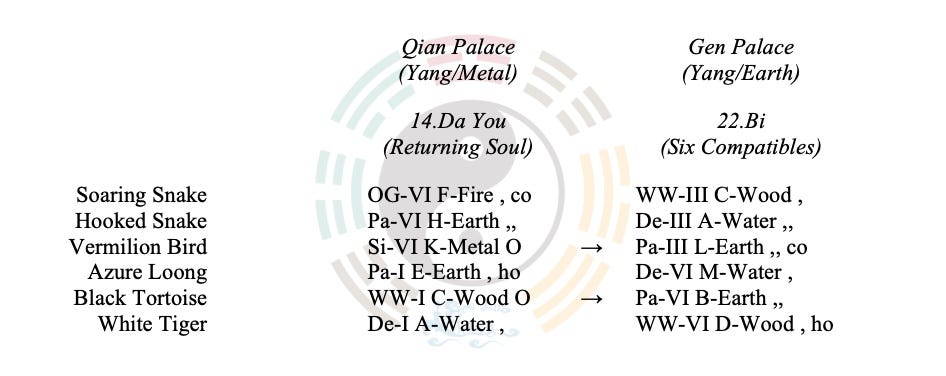
Judgment: The broad image of the hexagram was favorable. The main hexagram was Da You, which carries the image of abundance, possession, and things being broadly available. This showed that the overall trend of the house-purchase matter was not poor.
The property situation was also shown clearly through the parents lines. In Six Lines divination, the parents line represents houses, property, contracts, documents, and real estate paperwork. In this hexagram, the four parents lines E, L, B, and H were all present. This showed that there were multiple property options or house-related possibilities. The third-line parents E earth held the host line, remained still, and aligned with the auspicious spirit Azure Loong. This indicated that the querent had the opportunity to purchase a relatively suitable property in a stable way.
The funding issue was shown by the wife and wealth line. The second-line wife and wealth C wood represented money and available funds. This showed that the current funding for the house purchase had not yet been fully resolved. Therefore, the key timing for the funds becoming available could be seen in the B year or H year.
The purchase timing was shown through movement and returning generate. The fourth-line siblings K metal was active, showing that the querent was already actively planning, comparing options, and pushing the matter forward. K metal moved and transformed into parents L earth, forming returning generate. Since the parents line represents houses, property, and contracts, and the transformed L earth was also the Planning Star[1] of the day, this further showed that the house purchase already had a clear plan and direction. According to the rules of prosperity, movement, and transformation, the theoretical timing for the formal purchase could be seen in the K year or L year.
Conclusion: The house-purchase matter was ultimately likely to succeed.
Feedback: Awaiting further verification.
The key point of this case is not the isolated use of one method. It is the integrated judgment. The hexagram text first sets the general trend of auspiciousness or difficulty. Image-based interpretation then adds details about the property condition and later decoration. Na Jia Six Lines further refines the funding situation, progress of action, and timing. Only when these three are considered together can the reading form a more complete interpretive loop.
Note: [1] The Planning Star is determined by the earthly branch of the day. A common method is as follows: for J, A, and E days, the Planning Star is in L; for F, K, and B days, the Planning Star is in H; for C, G, and L days, the Planning Star is in E; for M, D, and H days, the Planning Star is in B.
The Planning Star governs planning, arrangements, preparation, and strategic intention.
In this hexagram, the day was VII J. The earthly branch was J, and J belongs to the J-A-E structure, so the Planning Star was in L. The fourth-line K metal moved and transformed into parents L earth, exactly producing the Planning Star. Therefore, it could be taken as an image of an existing house-purchase plan and a clear direction of action.
If there are certain themes you would like to see in future case studies, welcome to leave a comment and share what kinds of divination cases interest you most.