Disclaimer: This article is intended solely for academic discussion and methodological analysis of Yi principles and divination interpretation. We encourage rational judgment and respect for modern science. In any real emergency, missing-person case, medical crisis, rescue situation, or life-threatening event, always contact professional emergency services, rescue teams, medical personnel, law enforcement, or other qualified authorities immediately.
🎉😄A quick note before today’s content: our charting feature can now provide simple case analysis to help users interpret hexagrams. It is not a replacement for systematic study, but it can assist beginners in identifying basic structures, line relationships, movement, transformation, void, and other key points in a reading.
Background:
A female querent worked as an insurance sales agent. She asked whether a client would ultimately sign an insurance policy with her.
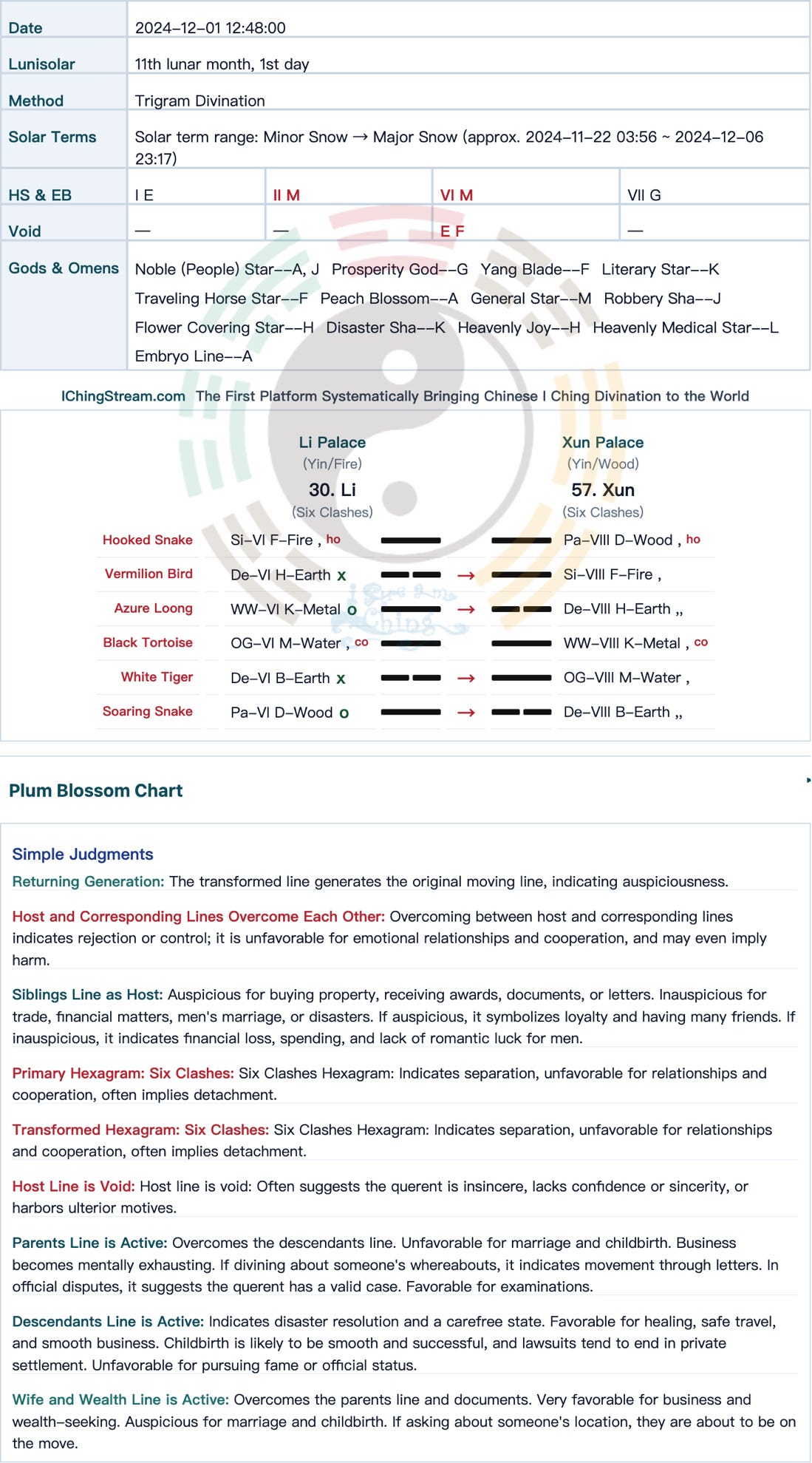
Hexagram obtained: Li to Xun.
Judgment:
This hexagram contained multiple active lines and showed that the matter would not proceed smoothly. The structure revealed a process in which the client did not truly accept the querent, while disagreements over the premium and rebates ultimately caused the policy to fall through.
1. Lack of basic trust: the host line was void and heavily clashed and overcome
The host line representing the querent was siblings F fire, which was void in the cycle.
The corresponding line representing the client was officials and ghosts M water. It coincided with both the II M month and the VI M day and was therefore extremely prosperous and supportive.
M water directly clashed and overcame the host line F fire. Since the host line was already weak and void, this clash broke the host line.
This objectively showed that the client did not strongly recognize or trust the querent. The basic relationship between the two sides was unfavorable.
Although the parents D wood line was active and could theoretically function as a bridging line, creating a chain in which the corresponding line generated parents and parents then generated the host line, the host line was too weak and void to receive this generation.
The bridging structure therefore existed only in form and could not function effectively.
2. The policy contract was attacked: clear disagreement over money and benefits
In an insurance-policy reading, the parents D wood line represented the policy and contract.
However, the active wife and wealth K metal directly clashed and overcame parents D wood, because K and D clash and metal overcomes wood.
The fourth-line wife and wealth K metal was generated by two active descendants lines in the main hexagram. It also transformed into descendants H earth, forming returning generate. The wife and wealth line was therefore strong.
However, K metal did not generate or support the host line. Instead, it generated the corresponding line, officials and ghosts M water, because metal generates water.
The wife and wealth line generating the corresponding line showed that the client wanted money or financial benefit.
At the same time, the wife and wealth line clashed and overcame the parents line representing the policy. This indicated serious disagreement over money and the terms of the policy.
In practical terms, the client may have considered the premium too high, or the two sides may have failed to reach agreement over the insurance rebate. As a result, the policy could not be finalized.
3. The potential commission was high, but the querent could not obtain it
The wife and wealth line was strong. If the policy had been successfully completed, the commission would have been substantial.
However, the wife and wealth line had no generating relationship with the host line, while the host line itself was extremely weak.
The weak host line had no ability to overcome and obtain such a strong wife and wealth line.
This showed that although the potential commission looked attractive, the querent would ultimately be unable to secure the business and receive the money.
Conclusion:
The client would not ultimately complete the insurance purchase with the querent.
The host line was weak, void, and strongly clashed and overcome by the corresponding line, showing that the client did not have sufficient trust or acceptance of the querent.
The parents line representing the insurance policy was directly attacked by the active wife and wealth line, while the wife and wealth line instead generated the corresponding line representing the client. This showed that money, premium costs, rebates, and financial benefit were central to the disagreement.
Although the policy appeared valuable and potentially profitable for the querent, the transaction would ultimately fall through.
Feedback:
On December 10, the querent reported that the client’s policy had already been entered into the system, and the client had verbally promised to deposit the money on December 9.
However, the money did not arrive. The client later told the querent that they wanted to keep the money to help their child purchase a home, and the transaction was not completed.
The querent also reported that the client had asked for substantial rebates during their discussions.