Start Here
Your First I Ching Divination, Clear, Practical, Verifiable
Make one real decision with structure, not vague spirituality.
You do not need to believe in anything.
You do not need to study ancient texts first.
You only need one real question you care about.
This Quick Start is designed to help you complete your first practical I Ching reading in about 10 minutes, focused on clarity, timing, and next actions, not abstract symbolism.
Step 1: Choose the Right Kind of Question (1 Minute)
Your question matters more than anything else.
Good questions are:
- Specific
- Time-bound
- About a real situation you are currently facing
Examples:
Will I receive this job offer?
Is this relationship likely to move forward?
Should I wait or take action now?
Will this deal go through this month?
Is there a hidden obstacle I am missing?
What is my destiny?
Will I be happy in life?
Is everything going to be okay?
One reading equals one question.
See real questions cast and resolved
If you're unsure what a "good question" looks like in practice, these published case studies walk through actual readings — the question, the hexagram analysis, and what happened next.
Can He Reconcile with His Ex-Girlfriend?
InvestmentCould He Profit From the Project?
CareerJob Interview: Why a Promising Interview Still Failed
TravelCould He Secure a Ticket Home for the May Day Holiday?
WeatherHow to Judge Rain, Sunshine, and Wind in I Ching Divination
BiddingBidding: Could They Still Take First Place?
Step 2: Cast a Hexagram (Three Coins, 3 Minutes)
Using three coins is the fastest practical way to begin.
It is simple, repeatable, and ideal for beginners. Use three identical coins if possible.
Before You Start (Do Once, Do Not Change Mid-Casting)
- Prepare three coins.
- Set one fixed rule: decide which side is yang and which side is yin, then keep it consistent for all six throws.
A common rule is: the simpler side is yang, the more detailed side is yin.
If you are using a U.S. quarter, you may treat Heads (Washington portrait) as yang and Tails as yin.
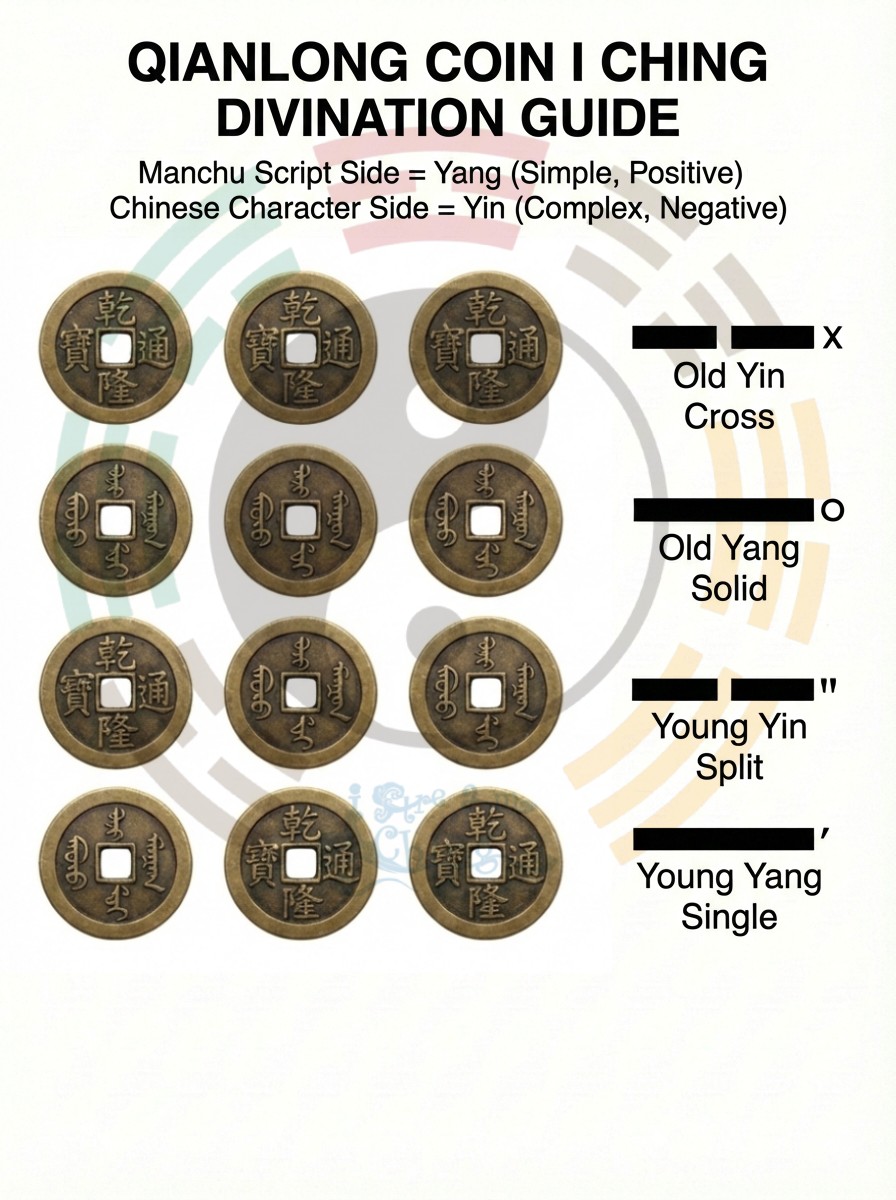
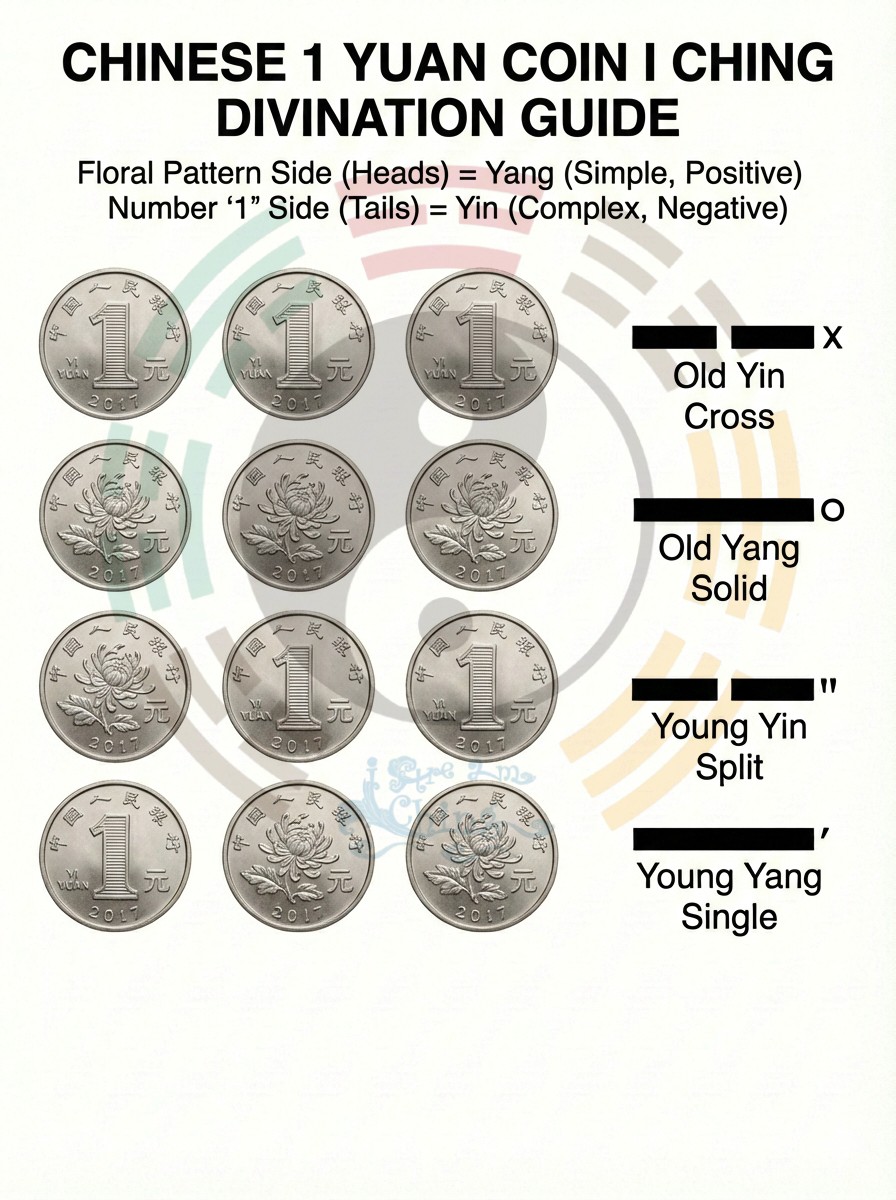
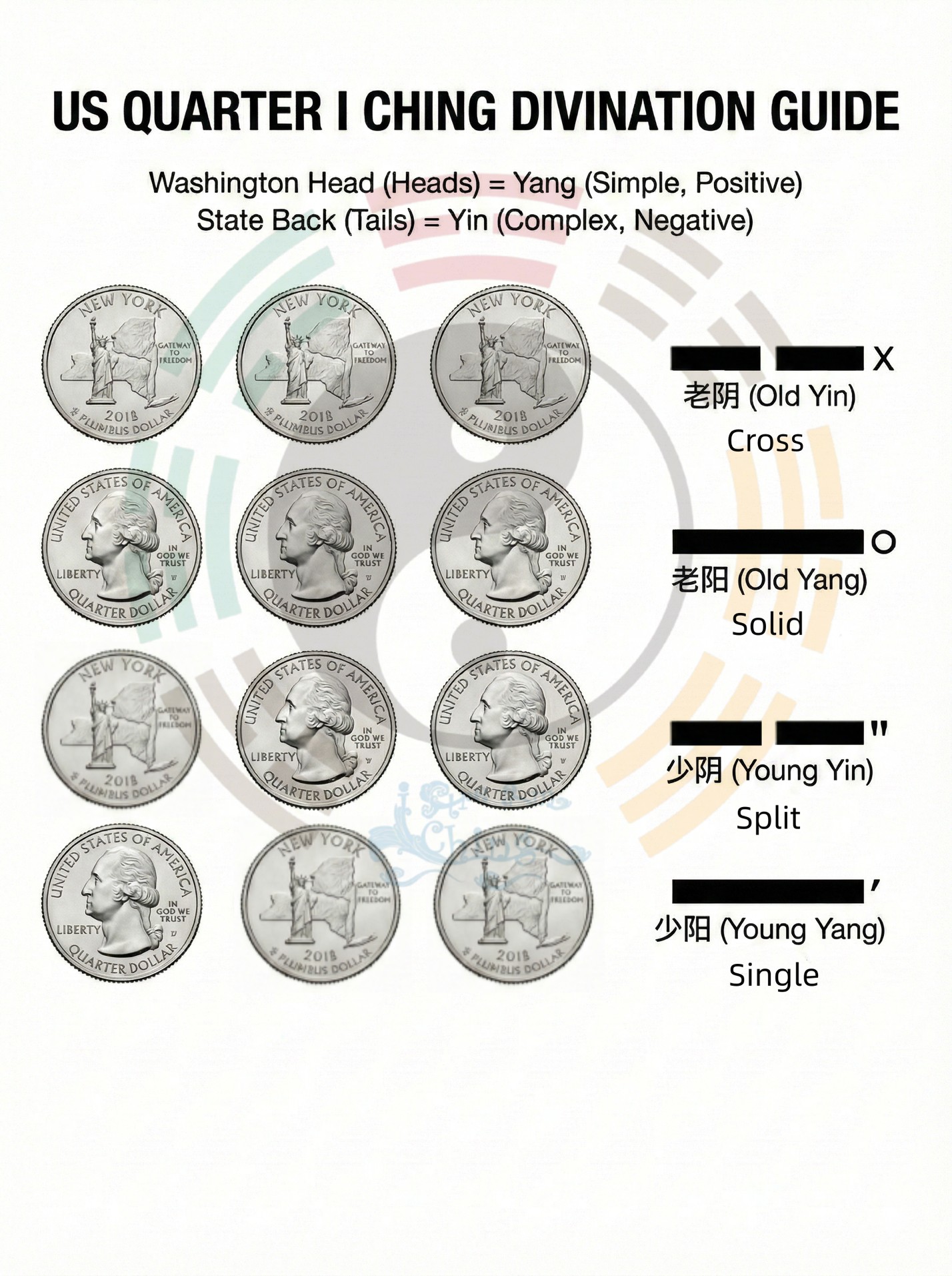
Casting Procedure (Six Throws, Record Bottom to Top)
- Write down your question and record the exact casting time.
In Na Jia analysis, timing is an essential input. One divination should focus on one question. - Hold the three coins, focus on the question, gently shake, then toss onto a flat surface.
- Record the result immediately.
- Repeat until you complete six throws.
The first throw is the bottom line, and the sixth throw is the top line.
Note: Avoid repeated casting on the same matter in a short time. It increases noise and makes clean verification difficult.
Identify the Line Type (Count the Yang Sides)
For each throw, count how many coins show the yang side, then record the line like this:
Tip for beginners: mark active lines only: O for old yang, X for old yin. Static lines do not need a special mark.
- Primary hexagram: arrange the six lines from bottom to top.
- Transformed hexagram: reverse only the active lines. Static lines remain unchanged.
If you cannot cast immediately, you may use a time-based method instead. See the Time Method tool at ichingstream.com/divination.
Use the Manual Casting Setting on this site to generate your hexagram in a structured, repeatable way.
Follow the on-screen steps carefully. Once completed, you will receive:
- A hexagram
- Line information
- Structural indicators used for interpretation
This is your raw data.
Step 3: Focus on Three Core Outputs
For your first reading, ignore everything else.
You are looking for three things only:
Yes or No Direction
Is the situation moving toward success, delay, or blockage?
Timing Clues
Is this happening soon, later, or not at all under current conditions?
Next Action Guidance
Should you wait, prepare, adjust, or actively intervene?
You are not expected to understand everything yet.
You are training your ability to extract usable signals, not mastering the entire system.
Step 4: Record Your Reading (This Is Important)
Write down:
- Your question
- The date and time
- The core judgment you reached
- Any timing indicators you noticed
This turns divination into a verifiable practice, not a belief system.
Many beginners skip this step.
Those who keep records improve dramatically faster.
Step 5: Wait and Verify
Some readings verify quickly.
Others unfold over days or weeks.
Verification does NOT always mean:
- A dramatic event
- A perfect prediction
Verification often looks like:
- A delay you were warned about
- An obstacle appearing exactly where indicated
- A decision becoming clearly right or wrong in hindsight
This is how confidence is built.
A Simple First-Time Example
Will I receive a response after my job interview?
- Overall direction shows movement
- Timing suggests delay, not rejection
- Next action indicates waiting, not pushing
- No response for two weeks
- Follow-up email sent at the indicated time
- Interview process resumed
This is a successful reading, even without immediate results.
What to Do If You Feel Confused
Confusion is normal.
You are not failing.
You are encountering a structured system for the first time.
If you want:
- Clearer explanations
- Step-by-step judgment logic
- Common beginner mistakes
- Real annotated cases
Continue with the Foundations Path below.
I Ching Divination Foundations
A beginner-friendly course on orthodox Chinese Six Lines divination — for serious learners who want to go beyond ordinary I Ching readings.
Expected release: July 2026
- Early access during build-out
- Access to the completed version after full release
- Skool community access and case-based discussion
- Priority notice for future advanced training
One Final Note
This practice has survived for centuries not because people believed in it,
but because it worked well enough to be kept, refined, and verified.
Your first reading does not need to be perfect.
It only needs to be honest, focused, and recorded.
Start there.