Disclaimer:
All personal information in this case study has been anonymized or omitted. This case study is provided for learning and reference only. It is not intended as medical, veterinary, legal, financial, investment, or other professional advice.
II. Understanding Six Lines Divination
Part 2.5. The Static Hexagram
A static hexagram refers to a hexagram in which no line changes. In the yarrow-stalk method, the numbers seven and eight form young yang and young yin. Since these lines do not transform, if all six lines are young yang or young yin, the result is a static hexagram.
In Studies on Ancient I Ching Divination Cases (Zhouyi Gushi Kao, 《周易古筮考》), I give a detailed explanation of the Great Expansion Method in Volume One: Divination Rituals. Especially from Part 1 to Part 4, these chapters explain the actual divination procedure. Furthermore, they describe how the trigrams are formed and how the numbers six, seven, eight, and nine arise from the ritual process.
In divination, a static hexagram has a special meaning. It does not mean that nothing will happen. Instead, it means that, within the present time and space of the question, the matter has no further internal line transformation. The situation has already settled into its present structure. Therefore, it will continue to develop according to the pattern of the hexagram.
The hexagrams discussed in the I Ching itself are also static hexagrams. For example, the Sequence of Hexagrams explains the order by which Heaven, Earth, and all things arise and develop. Therefore, a static hexagram does not mean that the matter is frozen. It means that the matter follows an established pattern.
Because there is no changing line, a static hexagram usually does not show an immediate turning point of auspiciousness or ominousness in the ordinary line-based sense.
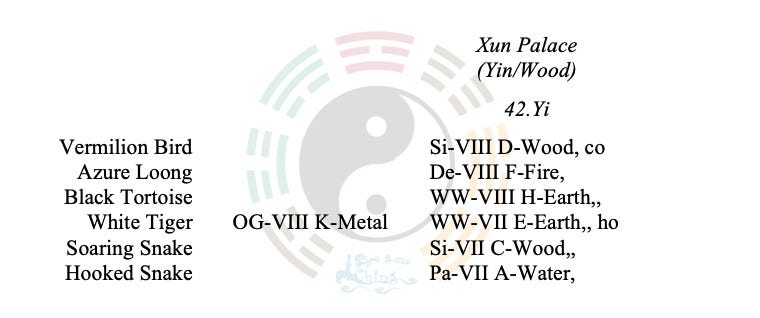
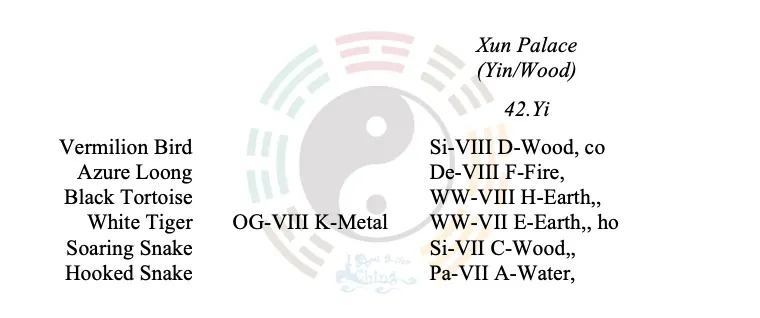
For example, if the question concerns marriage, partnership, or cooperation, a static hexagram may indicate that the relationship cannot easily move forward. This is because there is no changing hexagram showing further development between the two sides.
If the question concerns work, it may indicate that the current work situation is about to change. That is because the present structure has already reached a point with no further internal development.
In some special cases, a static hexagram may also represent a future sign. If the question concerns a long-term matter, such as the future development of a company, then the time span represented by the static hexagram is longer. It should, therefore, be judged over years.
The key point is this: a static hexagram is not truly still. It shows that the matter has entered a fixed structure. As a result, its future movement must be understood through the larger pattern of the hexagram itself.