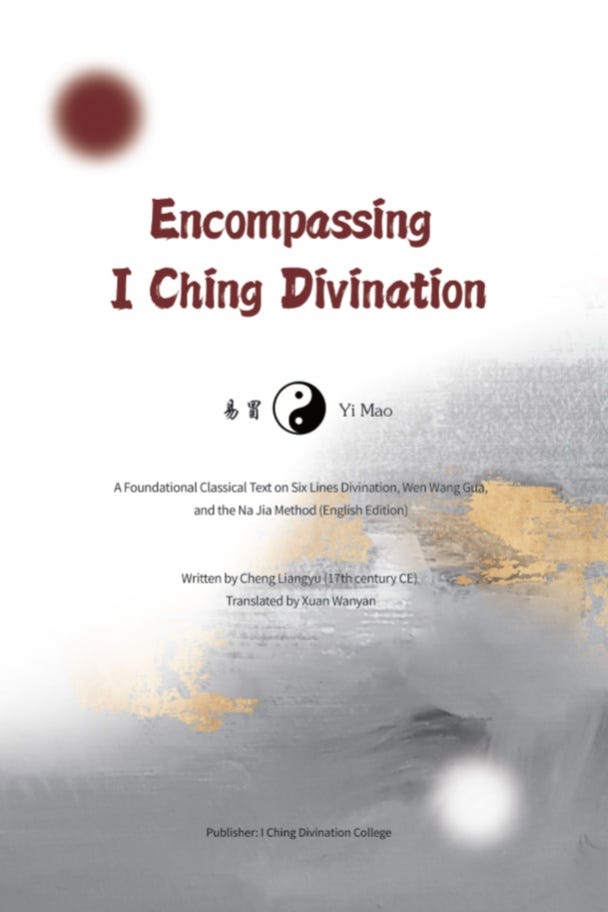
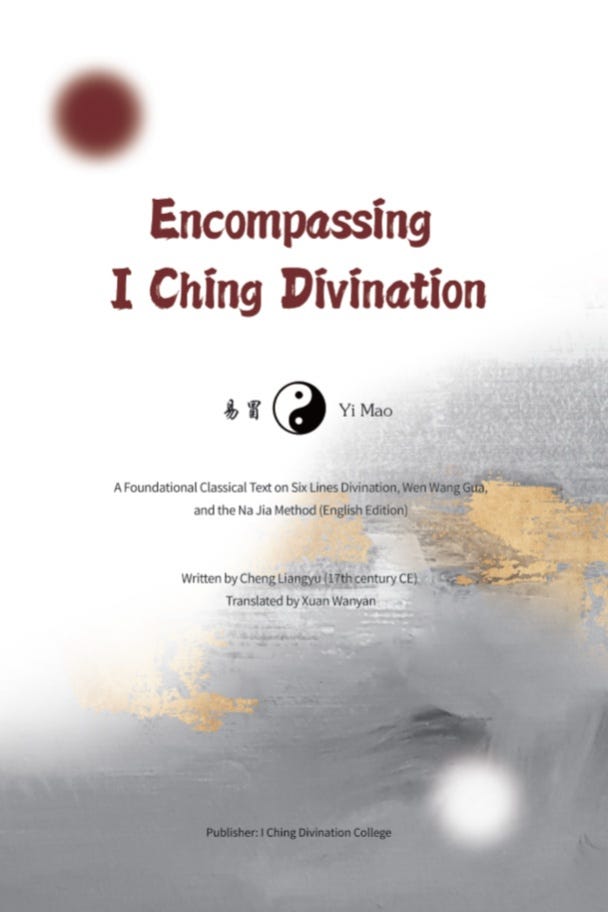
In the previous post, we shared Cheng Liangyu’s own Author’s Preface to Encompassing I Ching Divination (Yi Mao, 《易冒》).
That preface allowed us to hear Cheng Liangyu speak in his own voice. He told us how he lost his sight at the age of five, turned from medicine to I Ching divination, studied under Zhang Xingyuan, received further instruction from the Kupao Elder, compared earlier works, verified methods through practice, and finally began writing because he feared that the deeper reasoning of I Ching divination might not be transmitted clearly to later generations.
Today, I would like to share another preface, one that moves the story into a deeper and more painful place.
This is Wang Zehong’s Preface to Yi Mao.
Before entering the preface itself, it is worth noting who wrote these prefaces. They were not casual admirers, ordinary clients, or anonymous readers. Wang Zehong was a Qing dynasty official and scholar who passed the imperial examination in 1655 and later served as Minister of Rites. Gu Baowen was also a Qing official and scholar, a successful imperial examination candidate who later served as Censor of the Henan Circuit. Lu Jin was a scholar and poet associated with the Xiling literary circle.
For readers unfamiliar with classical Chinese society, this background matters. The imperial examination system was one of the main paths through which educated men entered official service and the scholarly elite. A preface written by such figures was not merely a polite introduction. It could function as recognition, endorsement, testimony, and transmission. The fact that men of this background wrote for Yi Mao shows that Cheng Liangyu’s work was not treated as ordinary fortune-telling, but as a serious contribution to Yi learning and practical divination.
This also reflects an important cultural background in classical China. Loyalty, righteousness, friendship, and moral obligation were not abstract ideals. When a friend entrusted a work before death, fulfilling that wish became a matter of honor.
To write a preface in such a context was not merely to praise a book. It was to bear witness, to keep faith, and to help carry a life’s work into the world.
Wang Zehong’s preface should be read within this moral world. Cheng Liangyu entrusted the book to his friends. Hu Lütang helped revise and arrange it. After Cheng Liangyu’s death, his son came in mourning dress to fulfill his father’s final command. Wang Zehong accepted the task because he understood that this was no ordinary request. It was an act of trust, and therefore it required an answer worthy of that trust.
If Cheng Liangyu’s own preface shows the life behind the book, Wang Zehong’s preface shows how the book became a final wish.
We also see the grief of his son, who came in mourning dress after his father’s death, holding a copy of Yi Mao, and asking Wang Zehong to fulfill his father’s final instruction.
This is one of the most moving moments in the entire set of prefaces.
Below is the full Wang Zehong’s Preface to Yi Mao from the upcoming I Ching Stream English edition.
Wang Zehong’s Preface to Yi Mao
When I[1] was in Chang’an, I had already heard of Master Cheng Yuanru’s virtue. Only ten years later did I finally have the chance to visit him at his home. Yuanru declined, citing illness. Through Hu Lütang’s introduction, I visited twice more, and only then did Yuanru come out to receive me. Listening to his discourse, I realized he belonged to the same company as the likes of Junping[2] of old. From that time on, I visited his home often. Although Yuanru lay ill in bed, he would always force himself to rise, sit with me, and talk at length without fatigue.
One day he said to me: “At five, I lost my sight from smallpox and could not pursue the examination path. I studied medicine but failed, and only then began studying the Yi. At first I studied under Master Xingyuan. Later in life I encountered the Kupao Elder. We tested and verified matters with each other and gained insight. I had someone write down notes, and over the years it became a book. I only worry that the wording is too verbose and that the meaning may at times repeat. So I have entrusted Lütang to consult with you for revision. When the book is finished, please write a preface for me.” I agreed.
Not long after, Lütang died. Yuanru’s grief deepened. He wept in mourning, and his illness worsened day by day. I went to inquire after him. He could not come out, yet I still marveled at his insistence on rising.
Before long, Yuanru also passed from this world. Alas, how painful. Barely ten days later, someone came in mourning dress, his face dark with grief, holding a copy of Yi Mao. He knelt for a long time, tears streaming, and said: “When my father was near death, he held my hand and solemnly instructed me. I have therefore faithfully followed his final command and come to seek you. I beg you, sir, do not refuse.” How could I bear to decline?
I privately lament that Yi learning today does not perish because people do not study the Yi, but perishes because so many who study it ruin it. Yet those who do not truly study the Yi steal heterodox techniques and call them the Yi. Of all forms of cutting it off, what could be worse? When Chengzi (程颐) transmitted the Yi, he based it on Wang Bi (王弼). Wang Bi derived it from Fei Zhi (费直). Zhu Xi’s (朱熹) Original Meaning was based on Lü Bogong (吕伯恭). The ancient Yi traced back to Tian He (田何). None ever used what is not the Yi to explain the Yi.[3]
Each time he divined a hexagram, he examined the line images, constancy and regret, yin and yang, movement and stillness, and a person’s lifelong good and ill fortune, along with remorse and humiliation, became as clear as fire seen in full view. Because of this, his reputation spread widely. Some even traveled a thousand li[4] to seek a single sentence and then left. Yet Yuanru never dared to think highly of himself. Day after day, he only contemplated images and practiced divination to verify matters through lived experience.
Alas. Among our contemporaries, some achieve prominent position and public renown, and arrogantly style themselves men of letters. Yet when others ask them about the central meaning of the classics they claim to have studied, they cannot even silently recall the chapters and lines, much less grasp their subtle essentials. How could they compare to Yuanru? Moreover, today’s affliction is that scholar officials regard mastering the classics and studying antiquity as pedantic, and instead chase ornate rhetoric and empty acclaim, taking pride in display. None have truly attained meaning, speaking of what lies beyond images and numbers.
As the book neared completion, Lütang and Yuanru died one after the other. Some say that profound meanings and secret principles cannot remain hidden as Heaven and Earth’s private store, or that the disclosure of the mechanism went too far. I say that studying the Yi reduces error. When reflection reaches its utmost, it connects with spirits and the divine.
I have never heard that the Way of Heaven forbids people to awaken deeply within principle and meaning. To hear the Way in the morning and die in the evening is sufficient. If not, then consider Yuanru’s end. His words did not turn to private matters. He held fast to this book alone. Was that love of fame? Rather, he feared later generations might not receive its transmission. So he did not worry for himself, but worried for others. In that case, the earnest intention with which Yuanru repeatedly entrusted this to me is, at last, consoled.
Written in the Middle Autumn Month, the Third Year of the Kangxi Reign (1664 CE)
Wang Zehong of the Anshi clan, Chujiang
Notes
[1] Wang Zehong (王泽弘), courtesy name Juanlai (涓来) and literary name Haolu (昊庐), was a Qing dynasty official and scholar from Huanggang, Huguang. He passed the imperial examination in 1655 CE and later served as Minister of Rites. In Yi Mao, he appears as the author of one of the prefaces. According to his preface, he came to know Cheng Liangyu through Hu Lütang and later wrote the preface at the request of Cheng Liangyu and his family.
[2] Junping refers to Yan Junping (严君平), a Han dynasty I Ching scholar who once practiced divination in the marketplace and was highly respected by later generations. Gongming refers to Guan Gongming, namely Guan Lu (管辂), a famous I Ching scholar and diviner of the Three Kingdoms period, known for his extraordinary skill in divination.
[3] Chengzi (程子) refers here to Cheng Yi (程颐, 1033 to 1107 CE), one of the major founders of Song dynasty Neo-Confucianism and the author of an influential commentary on the I Ching. Wang Bi (王弼, 226 to 249 CE) was a Cao Wei philosopher whose commentary on the Zhouyi became one of the most important interpretive works in the history of Yi learning. Fei Zhi (费直) was a Han dynasty Yi scholar associated with the Fei school of I Ching transmission, which later became an important textual lineage.
Zhu Xi (朱熹, 1130 to 1200 CE) was the central figure of Song Neo-Confucianism and the author of Zhouyi Benyi, or Original Meaning of the Zhouyi. Lü Bogong (吕伯恭), also known as Lü Zuqian (吕祖谦, 1137 to 1181 CE), was a Southern Song scholar closely associated with Zhu Xi and the scholarly transmission of the classics. Tian He (田何) was an early Han scholar traditionally regarded as a key transmitter of ancient I Ching learning into the Han dynasty.
In this passage, Wang Zehong invokes these figures to emphasize that legitimate Yi learning always developed through recognized textual and scholarly lineages, rather than by using teachings outside the Yi to explain the Yi.
[4] Traditional Chinese distance units varied by period and context, so modern equivalents should be understood as approximate references rather than exact conversions. In the modern standardized system, one li (里) is generally taken as 500 meters, or about 0.31 miles. One zhang (丈) equals ten chi (尺), about 3.33 meters. One chi is about 33.3 centimeters, and one cun (寸) is one tenth of a chi, about 3.33 centimeters. In many premodern texts, these units may not correspond exactly to modern measurements, but they provide a useful sense of scale for the reader.
Reading Wang Zehong’s preface, one can see how Yi Mao entered the world not merely as a manuscript, but as a trust.
Hu Lütang helped revise and arrange the work. Cheng Liangyu held fast to the book at the end of his life. His son came in mourning dress to fulfill his father’s final command. Wang Zehong accepted the task because he understood that this was not an ordinary request, but a responsibility.
This is how an enduring classic is born.
Not only through rules, methods, and technical insight, but through people who believe that a body of knowledge must not disappear.
Wang Zehong’s preface also reveals a deeply Chinese ideal of transmission. A book could be more than a text. It could be a trust between friends, a son’s duty to his father, a scholar’s moral obligation, and a gentleman’s promise to help carry worthy learning into the future.
As I Ching Stream prepares to bring Encompassing I Ching Divination (Yi Mao, 《易冒》) to English readers, we feel deeply honored to continue this line of transmission.
More than three centuries ago, Cheng Liangyu wished that this work be given to the world.
Today, across languages and cultures, we are honored to help carry that wish forward.
May this flame continue to be passed from hand to hand.
A Brief Note for Readers
Encompassing I Ching Divination (Yi Mao, 《易冒》) is scheduled to be added to the I Ching Stream package in early June. Before it is added, the current package remains available at $699 before applicable taxes.
Once Yi Mao is added, the package will expand from 7 to 8 major classical works and collections, and the package price will increase to $849 before applicable taxes. Future additions to this specific package are also planned, including Supplement to the I Ching Forest (Yi Lin Bu Yi, 《易林补遗》), the important classical work traditionally associated with Zhang Xingyuan, Cheng Liangyu’s teacher.
👉 Lock in the current package price before Yi Mao is added:
https://www.ichingstream.com/bundle/