
Disclaimer:
All personal information in this case study has been anonymized or omitted. This case study is provided for learning and reference only. It is not intended as medical, veterinary, legal, financial, investment, or other professional advice.
III. Arranging the Six Lines Chart
After a hexagram is cast, the next step is to install the necessary components onto the Six Lines chart. One of the most important steps is installing the Heavenly Stems and Earthly Branches onto each line.
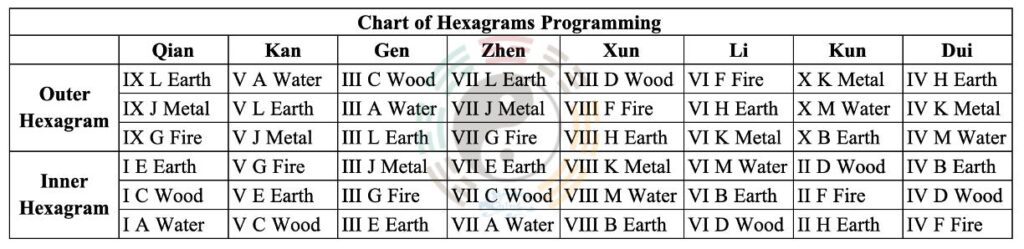
In Six Lines divination, each trigram has a fixed pattern of Stems and Branches. The assignment changes depending on whether the trigram appears as the inner trigram or the outer trigram. Specifically, the inner trigram refers to the lower three lines of the hexagram. In contrast, the outer trigram refers to the upper three lines.
The rules are as follows.
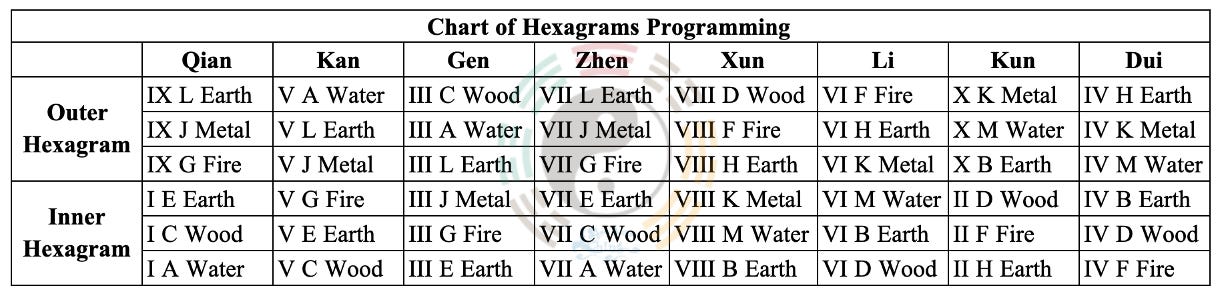
When Qian is the inner trigram, the first line begins with I A, the second line is I C, and the third line is I E.
When Kun is the inner trigram, the first line begins with II H, the second line is II F, and the third line is II D.
When Kan is the inner trigram, the first line begins with V C, the second line is V E, and the third line is V G.
These assignments are not optional decorations. Instead, they form the technical foundation for later steps in the Six Lines chart.
Therefore, before judging a hexagram, one must first identify the inner and outer trigrams correctly. After that, install the corresponding Stems and Branches line by line.
For the complete practical reference charts used in hexagram interpretation, including key tables for Six Lines divination, please visit https://www.ichingstream.com/reference-charts/.
You may also bookmark this page and the Chinese Perpetual Calendar at https://www.ichingstream.com/perpetual-calendar/ for convenient reference during future practice.