Disclaimer: This article is intended solely for academic discussion and methodological analysis of Yi principles and divination interpretation. We encourage rational judgment and respect for modern science. In any real emergency, missing-person case, medical crisis, rescue situation, or life-threatening event, always contact professional emergency services, rescue teams, medical personnel, law enforcement, or other qualified authorities immediately.
This case study is provided for learning and reference only.
Learning I Ching divination requires studying a large number of cases. Although all things in the world change according to underlying patterns, their outward forms are infinitely varied. Only through repeated study and deduction from real cases can we gradually calibrate our judgment.
In this sense, the process is similar to the training of modern large AI models. Through theory combined with extensive case analysis, we continuously train our own model-like understanding of how things develop and change. Studying I Ching divination also helps us think about problems from more angles.
The I Ching describes the patterns of change in all things.
In Chinese tradition, Yi learning includes the Three Yi: Lian Shan, Gui Cang, and Zhou Yi. The Zhou Yi is the best-preserved and most continuously used system today.
Within our current textual and cognitive range, Yi learning gives us a way to observe, model, and interpret change.
Today’s case is a solemn one. It concerns a rescue team’s search for a missing elderly woman and the question of her life-or-death condition.
Time of divination: August 24, 2013.
Stem and branch time: X F year, VII J month, IX L day (void: A and B).
Question: A rescue team asked about the current condition of the missing person they were searching for, a 93-year-old woman. Hexagram obtained: Qian to Jian.
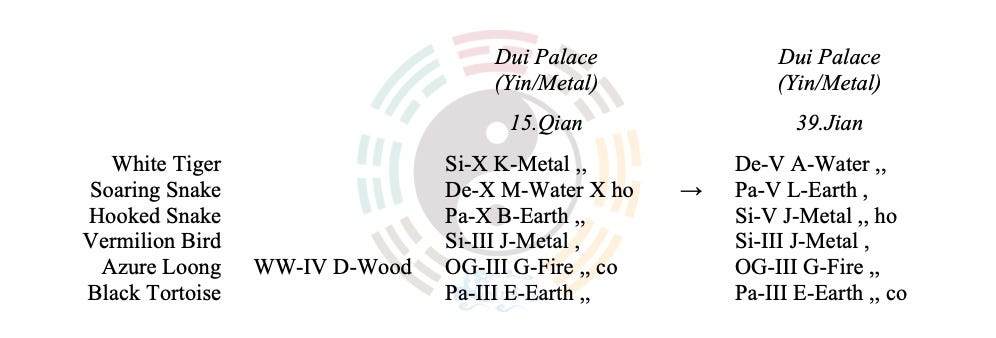
Judgment: In a divination about a specific missing person, the corresponding line can be taken as the significator. In this hexagram, the corresponding line was G fire, representing the missing elderly woman. G fire was extremely weak in both the J month and the IX L day. More importantly, it directly entered the tomb of the daily branch L earth.
The obstacle god was active and directly overcame the already powerless significator. In this hexagram, M water was the only active line, and it directly overcame the significator G fire. The transformed L earth could not fully restrain it.
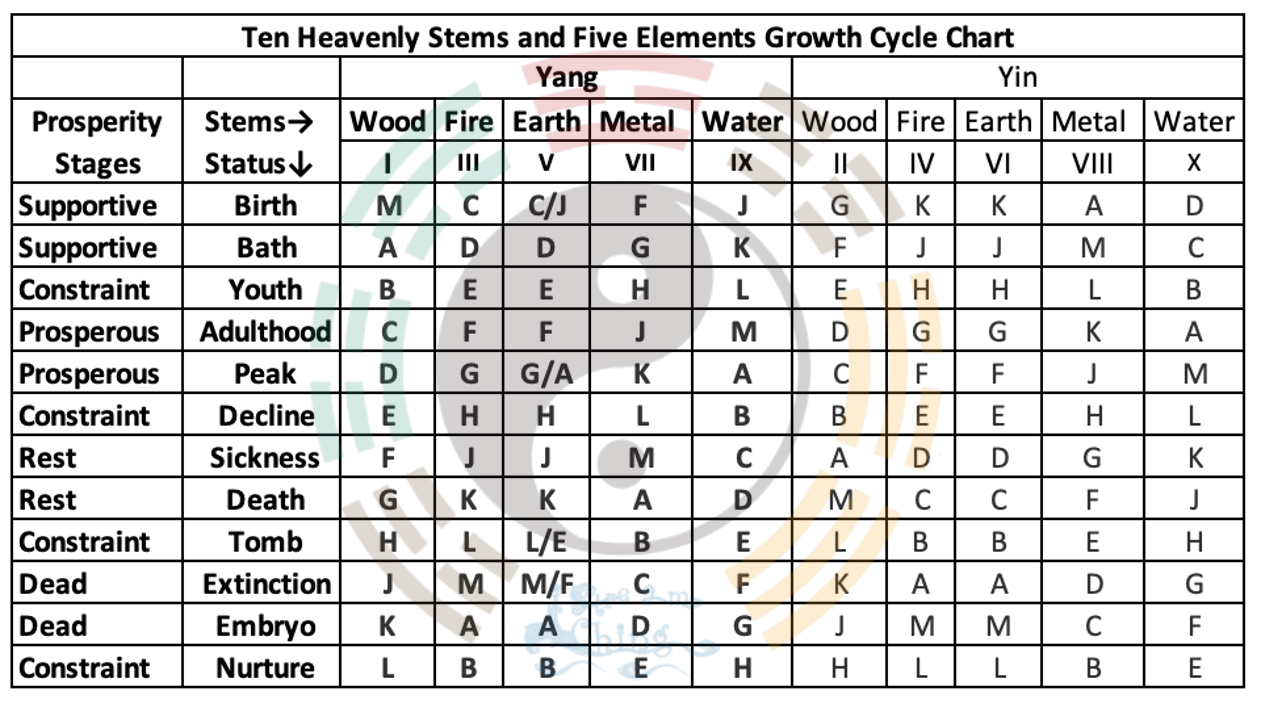
After learning that the missing person was a 93-year-old woman, the parents line was also examined for further confirmation. In this case, the parents line B earth could represent an elder. Although B earth received some support from the daily branch L earth, the relationship between B and L was punishment. More critically, B earth was void in the cycle, because A and B were void. In this context, the void image suggested that the person was no longer present.
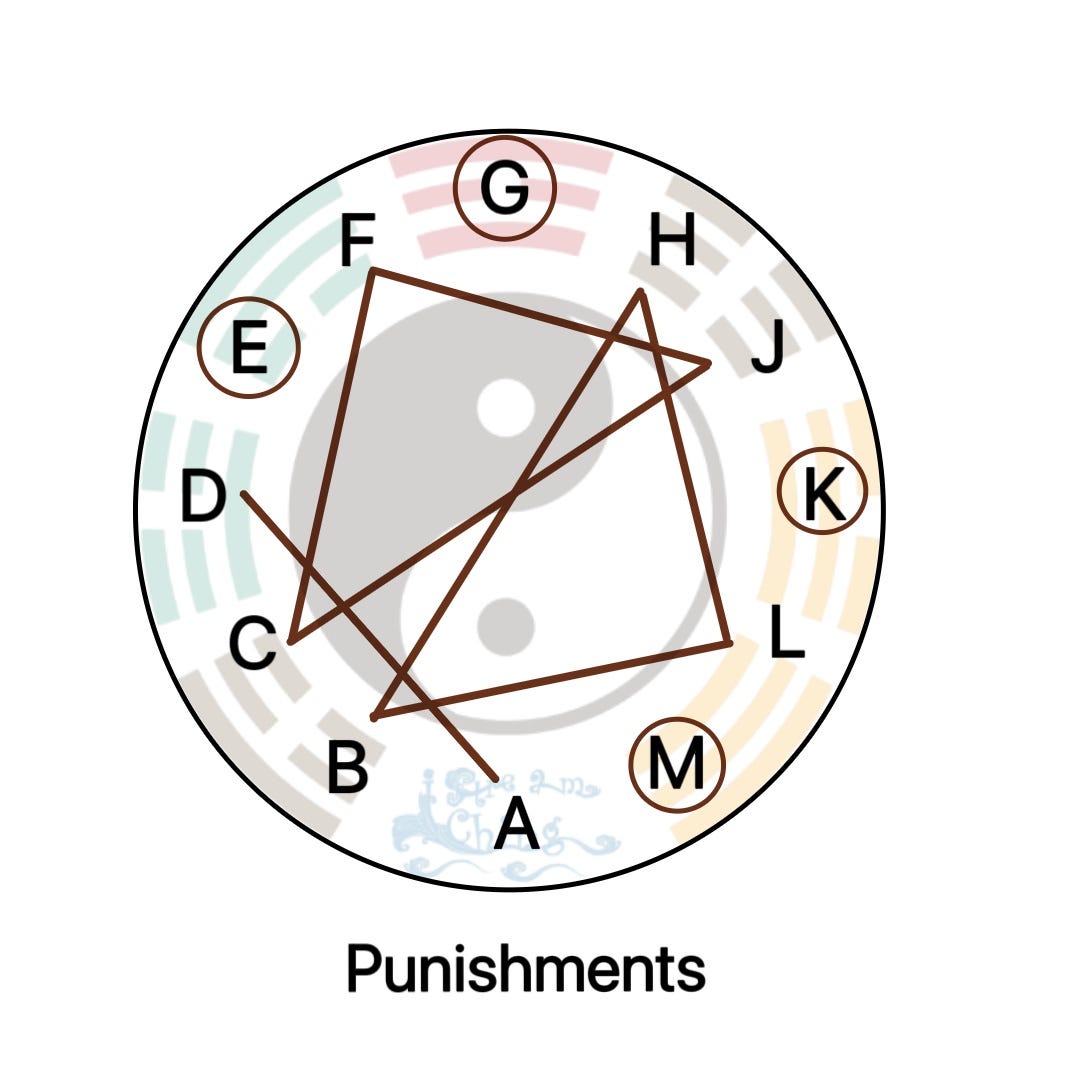
The parents line also encountered Growth in the Twelve Stages of Life, which became a further ominous image in this specific context. In ordinary contexts, Growth may be positive, but in a reading about the survival of a very old missing person, it may suggest that this life has ended and another cycle is beginning.
The Six Gods also gave concrete images related to death and burial. The significator G fire aligned with Azure Loong. In auspicious cases, Azure Loong often represents celebration, vitality, or fortunate signs. But in this extremely ominous life-and-death structure, Azure Loong was taken more concretely as “paper money” burned for the deceased.[1]
The parents B earth aligned with Hooked Snake. Hooked Snake belongs to the earth image and can indicate accumulation, mounds, and earth formations.
Conclusion: The judgment was extremely unfavorable.The parents line was void, encountered Growth in a life-and-death context involving an elderly person, and the Six Gods produced concrete images of paper money and a grave mound. Taken together, these signs suggested that the missing elderly woman had most likely already passed away.
Feedback: Sadly, the actual result confirmed the grave signs shown in the hexagram. The rescue team eventually found the missing 93-year-old woman, but she had already passed away.
NOTE:
[1] Chinese Culture Note: Qingming, Burning Paper, and Crossroads
In Chinese folk culture, after a family member or loved one passes away, descendants often express grief and remembrance through rituals such as making offerings, burning paper money, and offering food. During the annual Qingming Festival, many families also visit graves, sweep tombs, worship ancestors, and burn paper offerings to remember deceased relatives and ancestors.
What is commonly called “paper money” is understood in folk belief as money or material support sent to the deceased or ancestors for use in the world of the dead. It may be burned at gravesites, cemeteries, or ancestral tombs, but it may also be burned at crossroads, roadsides, or other specific places. This is why some foreign visitors in China, especially around April, may wonder why people are burning paper on the street.
If someone is seen burning paper at a crossroads, it is not always related to Qingming ancestor worship. Sometimes it may be because someone in the family has recently passed away, and relatives are burning paper for the deceased at a specific place. It may also happen when the family cannot go to the gravesite, or when local custom requires offerings to be sent at a roadside or crossroads. In Chinese folk belief, crossroads are places where paths meet, and they are often viewed as places where the living and the dead, or different kinds of spirits, may pass through. Burning paper there symbolizes sending offerings and paper money to the place where the deceased can receive them.
There is also a Chinese folk belief called the “first seven days (头七),” referring to the seventh day after a person’s death. The details vary by region, but a common idea is that within a certain period after death, the spirit of the deceased may still be attached to family members or may return to familiar places. During this time, family members may hold rituals, burn paper, and make offerings to express farewell and comfort.
Many Chinese folk stories, supernatural tales, dramas, novels, and literary works draw from this system.
Pure Brightness (Qingming, 清明) itself is one of the Twenty-Four Solar Terms in China. It usually falls between April 4 and April 6 in the Gregorian calendar. However, its date in the Chinese lunar calendar changes from year to year.
The traditional Chinese calendar is a lunisolar system. It considers both the moon’s phases and the solar-term system formed by the sun’s movement.
For example, one must determine which stem and branch correspond to the year, month, day, and hour. The stem-branch system is not merely a set of ordinary date labels. It is closely related to ancient astronomical observation, seasonal timing, and calendrical calculation.
Therefore, in traditional Chinese divination, time is not a neutral number. It carries information about yin-yang, the Five Elements, solar terms, and the state of qi. The stem-branch system is also a foundational part of learning I Ching divination and the Six Lines Na Jia method. If you are interested in learning more, you can read our Basics column, especially this article and the surrounding lessons, to build a basic understanding of the Heavenly Stems, Earthly Branches, solar terms, and divination timing:
I Ching Divination Basics Part 4.4: The Sexagenary Cycle (Sixty Jia Zi) in Na Jia Timing
If there are certain themes you would like to see in future case studies, welcome to leave a comment and share what kinds of divination cases interest you most.