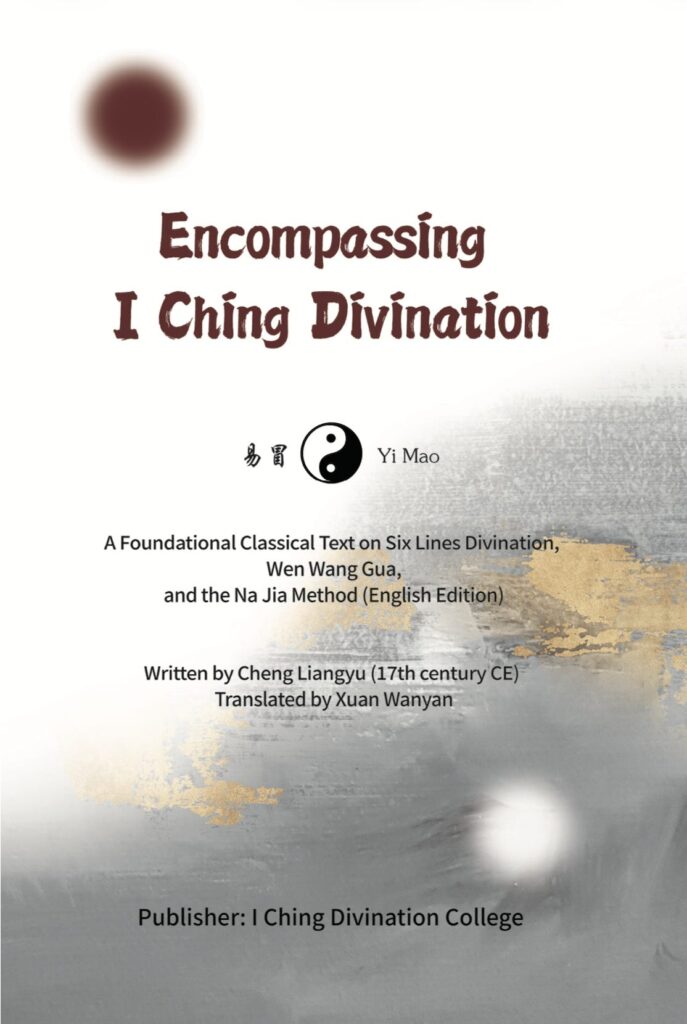
Encompassing I Ching Divination (Yi Mao, 《易冒》) is now officially available:
👉 https://www.ichingstream.com/books/?book_detail=1&id=1610
For better value, get it through the I Ching Stream Bundle before the price increases:
👉 https://www.ichingstream.com/bundle/
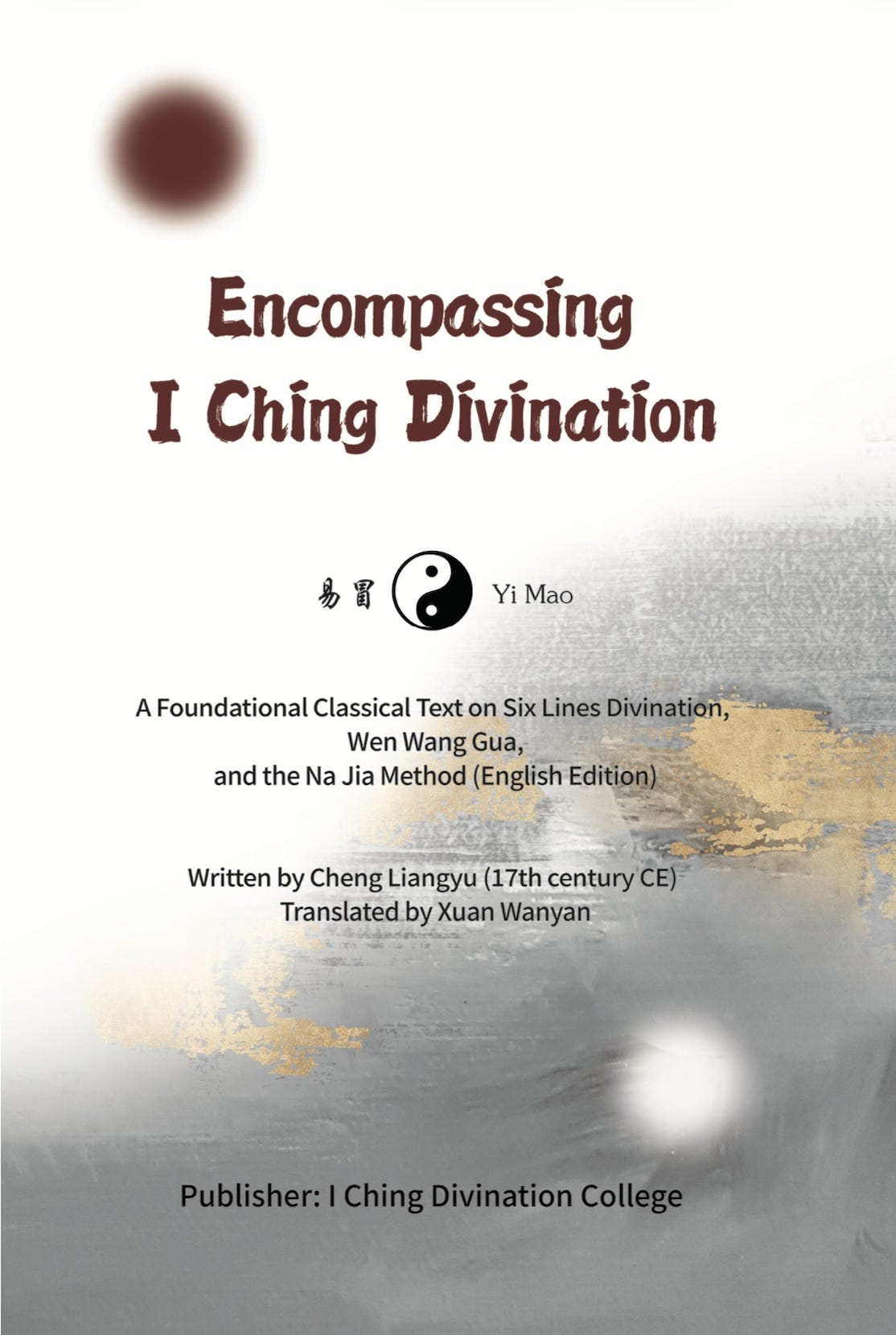
With this release, another major classical work of Six Lines Divination, Wen Wang Gua, and the Na Jia Method is now available to English-language readers.
For readers who have followed the previous posts in this series, Yi Mao is not only another old divination book. It is a text with a very special position in the classical Six Lines system.
It is neither a brief manual that only presents formulas, nor a simple collection of divination cases. Rather, it begins from the foundations and explains how the method is established, how its reasoning unfolds, and how it should be applied in actual judgment.
This is exactly where Yi Mao stands out.
In many classical Six Lines texts, the steps of reasoning are often omitted for the sake of brevity.
Yi Mao helps fill that gap.
It clarifies the key links, explains the basis of judgment, and uses examples to help the reader follow the logic.
A Classical Text with Recognized Authority
Yi Mao circulated in multiple engraved editions during the Qing dynasty, including editions from the Qianlong period and the Guangxu period. It was also preserved in the Wenyuan Pavilion copy of The Complete Library of the Four Treasuries (Siku Quanshu, 《四库全书》), the monumental imperial collection compiled under the Qing court to gather, classify, edit, and preserve the major works of Chinese textual tradition.
Its inclusion in this official collection reflects the recognized authority of Yi Mao and its importance as a base text for later research, compilation, and transmission.
For serious students of Six Lines Divination, Wen Wang Gua, and the Na Jia Method, the difficulty is often not only terminology. The deeper challenge is understanding the judgment logic behind the terms.
Yi Mao is valuable because it repeatedly explains that logic.
Cheng Liangyu and the Transmission Behind Yi Mao
The author of Yi Mao was Cheng Liangyu (程良玉), courtesy name Yuanru (元如), from Xin’an.
According to his own preface, Cheng Liangyu lost his sight due to illness in childhood and remained blind for the rest of his life. His family once encouraged him to study medicine, but he soon realized that medicine depends heavily on observation, discernment, and clinical judgment, all of which were extremely difficult for a blind person.
He therefore turned his attention fully to the study of the I Ching.
Cheng Liangyu studied under the well-known diviner Zhang Xingyuan (张星元). Zhang Xingyuan was also traditionally associated with Supplement to the I Ching Forest (Yi Lin Bu Yi, 《易林补遗》), another important classical text of I Ching divination that I Ching Stream also plans to publish.
This matters because Yi Mao did not emerge in isolation.
It belongs to a chain of learning: teachers, earlier texts, hidden transmitters, practical verification, and later correction. Cheng Liangyu also encountered the Kupao Elder (枯匏老人), received further instruction, and expanded his work into a more complete system combining principle, image, number, and divination in judgment and application.
He argued that the sages established methods in order to open the ignorance of later generations. If one receives the teaching and then hides it again, what benefit is there in obtaining it alone?
This reveals the deeper spirit behind Yi Mao.
Why Yi Mao Is Important
The value of Yi Mao lies especially in three areas.
First, it explains the foundations in detail.
Second, Yi Mao gives extensive attention to subtle distinctions. In actual Six Lines Divination, the most common difficulty is often not that the practitioner knows no rules at all, but that the relative weight, truth or falsity, sequence, and conditions of application among those rules are unclear. For example, among void in the cycle, monthly break, transformation into extinction, clash scatter, flying gods, hidden gods, mutual hexagrams, and transformed hexagrams, which conditions are genuine, which are partial, and which should be weighed lightly?
Yi Mao repeatedly addresses these questions.
Third, Yi Mao treats time factors in a concrete way. Cheng Liangyu emphasizes prosperity and decline, seasonal timing, the time of divination, and the time when the matter occurs. This is especially helpful for learners who only know how to apply the monthly command and daily branch mechanically.
In addition, Yi Mao includes a large number of divination topics and more than 110 verified cases. It is not only a theoretical work, but also a text with strong practical value.
Its angle of explanation differs from Golden Strategy (Huangjin Ce, 《黄金策》), I Ching Divination: Complete and Restored (Zengshan Buyi, 《增删卜易》), The Orthodox Method of I Ching Divination (Bushi Zhengzong, 《卜筮正宗》), and other classics. These works supplement one another.
The value of the classics lies in reading them together, comparing their methods, and testing their principles through practice.
Principle, Number, and the Missing Technical Dimension of the I Ching
In Lu Jin’s preface, Cheng Yuanru explains that the sages exhausted principle and number, using number to make principle manifest and using principle to guide number. He also points out that people today do not understand image and number, yet recklessly speak of the principles of the Yi.
This point is especially important for modern readers.
These dimensions are valuable, but they do not exhaust the living divinatory tradition of the I Ching.
This dimension has often remained incomplete or inaccessible in English.
That has created a long-standing gap.
It does not replace philosophical understanding.
In this sense, Yi Mao is not merely another old divination book.
It is a bridge between principle and technique, between the visible and the hidden, and between classical Chinese learning and readers who have long lacked access to this complete system in English.
How to Read Yi Mao within the I Ching Stream Series
From the perspective of a learning path, I recommend reading the major Six Lines texts in a connected order.
First, read I Ching Divination: Complete and Restored (Zengshan Buyi, 《增删卜易》) to establish the basic framework of Six Lines judgment.
Then read Yi Mao to supplement many concepts, reasons for distinction, and layers of detail.
Finally, read The Orthodox Method of I Ching Divination (Bushi Zhengzong, 《卜筮正宗》) to consolidate, deepen, and correct many common problems beginners encounter in actual judgment.
After these main works, readers will find it easier to integrate Fire Pearl Forest (Huo Zhu Lin, 《火珠林》), Undersea Eye (Haidi Yan, 《海底眼》), The Complete Book of Divination (Bushi Quanshu, 《卜筮全书》), Supplement to the I Ching Forest (Yi Lin Bu Yi, 《易林补遗》), and other texts.
Why This Translation Matters Now
One reason is that it is not a quick-start book. Its real value lies in its reasoning process, its detailed distinctions, and its explanations of concepts.
Through Yi Mao, readers can more clearly understand the principles behind many basic concepts, rather than merely memorize surface-level rules.
Today, across languages and cultures, this concern still has meaning.
If the classical technical tradition remains locked within difficult Chinese texts, many sincere students around the world can only approach the I Ching from the outside.
Yi Mao Is Now Live
The full English edition of Encompassing I Ching Divination (Yi Mao, 《易冒》) is now available here:
With this release, the I Ching Stream classical library adds another major layer to the English reconstruction of Six Lines Divination, Wen Wang Gua, and the Na Jia Method.
This is not only the release of one book.
It is another step toward making the classical technical tradition of I Ching divination available as a connected system for English-language readers.
Final Bundle Reminder
Because Yi Mao is now live and will be added to the I Ching Stream Bundle, this is the final opportunity to lock in the current bundle price.
The current Bundle price is still:
$699.99 before applicable taxes
Once Yi Mao is added to the Bundle, it will expand from 7 to 8 major classical works and collections, and the price will increase to:
$849.99 before applicable taxes
If you have been considering the Bundle, this is the last window to purchase at the current lower price.Bundle link:
https://www.ichingstream.com/bundle
If you have already purchased individual books and would like to upgrade to the Bundle, please contact us at:
We will calculate the difference so you only pay the remaining balance.
Thank you all for your support and patience.