Disclaimer: This article is intended solely for academic discussion and methodological analysis of Yi principles and divination interpretation. This case study is provided for educational purposes. We encourage rational judgment and respect for modern science. In any real emergency, missing-person case, medical crisis, rescue situation, or life-threatening event, always contact professional emergency services, rescue teams, medical personnel, law enforcement, or other qualified authorities immediately.
Yesterday, June 19, was the Dragon Boat Festival in China. Watching the exciting dragon boat races held across different regions reminded me of an old dragon boat divination case that had been discussed online many years ago.
This case is especially interesting because it is not about personal relationships, career, wealth, illness, lawsuits, house purchases, or investment. It is a very typical case of direct competition: Village A and Village B were going to compete in a dragon boat race. Would Village A win?
Many people assume that Six Lines divination is mainly used for personal matters, such as relationships, work, health, legal disputes, property, and money. In fact, as long as the question contains clear opposing sides, a win-or-lose structure, or a competitive relationship, Six Lines divination can also be used to judge matches, competitions, selections, examinations, bidding, and even certain election-like or camp-against-camp situations.
The key in this type of reading is not simply “which side looks stronger.” The core lies in the relationship between the host line and the corresponding line. Generally speaking, the host line represents one’s own side, while the corresponding line represents the opposing side. One must then compare the prosperity and weakness of both sides, their movement and transformation, void, break, tomb and extinction, the force of the Six Spirits, and whether the day of the event generates or overcomes either side.
Very often, neither side is in a perfect state. The real question is which side is more severely damaged, and which side is less able to perform at the critical moment.
The World Cup is also taking place recently, and I will later share more Six Lines cases related to the World Cup, sports matches, and win-or-lose judgments. Sports competition cases are excellent for training the ability to compare the host and corresponding lines, read the shifting strength between two sides, judge the influence of the event day, and weigh the relative severity of movement and transformation. They may look lively and entertaining, but they test very fundamental skills.
The following case was cast on the day before the race.
Time of divination: June 17, 2023.
Stem and branch time: X D year, V G month, III G day (void: C and D).
The question was: Tomorrow, Village A will compete against Village B in a dragon boat race. Will Village A win?
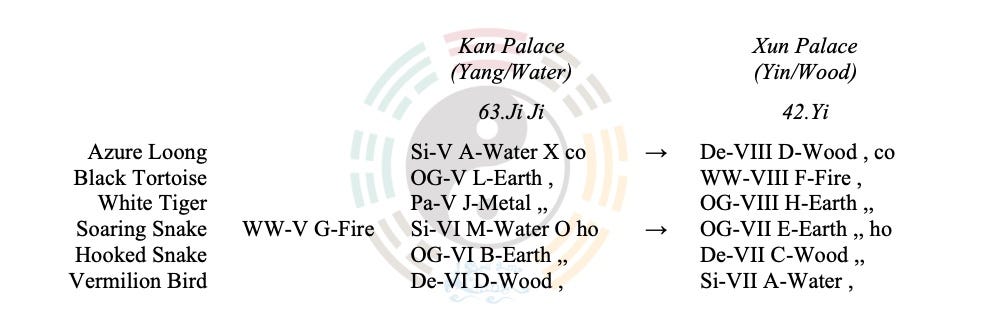
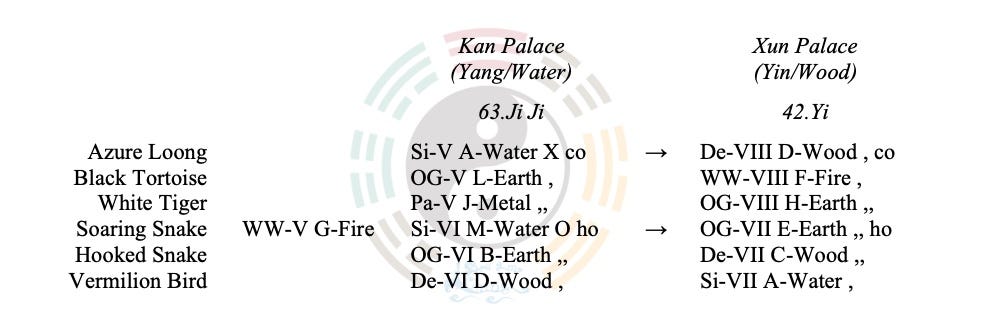
Hexagram obtained: Ji Ji to Yi.
Judgment: After a group discussion among several online participants, the core consensus was that Village A would lose.
1. Host and corresponding line positioning, and the force of the Six Gods
In a competition reading, the host line represents one’s own side, which in this case was Village A. The corresponding line represents the opponent, which was Village B.
In this hexagram, the host line was siblings M water and aligned with Soaring Snake. Soaring Snake can indicate panic, entanglement, abnormality, confusion, and unstable reactions. In a race, this can suggest unstable performance, loss of rhythm, disorder, or a failure to maintain composure.
The corresponding line was siblings A water and aligned with Azure Loong (aka:dragon). Azure Loong indicates joy, smoothness, elevated position, favorable momentum, and victory. In a race, this can be taken as a sign of better morale, smoother performance, and a stronger winning image.
Looking only at the Six Spirits, the opposing side, Village B, already had the upper hand.
2. The core negative image for Village A: returning overcome and movement into the tomb
This was the most decisive sign for judging that Village A would lose.
The host line, siblings M water, was active and transformed into officials and ghosts E earth. In the Five Elements, earth overcomes water. Therefore, the host line transformed into an element that overcame itself, forming returning overcome. In other words, once Village A’s own side became active, it produced a force that turned back to damage itself.
At the same time, E earth is the tomb of water. Therefore, the host line also had the image of moving and entering the tomb. In a race, this structure shows that one’s own side is not only being suppressed, but also likely to have its rhythm locked, trapped, or buried, making it difficult to perform.
This was not merely weak condition. It was self-damage through movement. For a win-or-lose judgment, the host line transforming with returning overcome and moving into the tomb is a very heavy losing image.
3. The event-day timing was also unfavorable to Village A
This hexagram was cast one day before the race, and the question specifically asked about “tomorrow’s” competition. The day of divination was a G day, so the next day was an H day.
The host line was M water, and H earth overcomes M water. Therefore, the H Earth day was an obstacle god that specifically overcame the water host line. This meant that on the actual day of the race, the external timing and objective environment were even more unfavorable to Village A.
Thus, the host line was not only structurally damaged within the hexagram. The day of the race itself further strengthened the pressure against Village A.
4. Both sides were weak, but Village A was more severely damaged
The interesting point in this hexagram is that the opponent’s corresponding line was also in poor condition.
The corresponding line A water was in monthly break and daily break under the G month and G day. It was already damaged. In addition, it was active and transformed into D wood, and D wood was void in the cycle. This showed that the opponent was also not strong or flawless. Village B may also have had weakness, mistakes, or unstable performance.
However, in a win-or-lose reading, one cannot judge only by whether one side has problems. One must compare the severity of damage on both sides.
Although the corresponding line suffered monthly break, daily break, and transformed into void, the host line suffered returning overcome and moved into the tomb. By comparison, the damage to the host line was more direct and more fatal. Both sides may have performed poorly, but Village A’s own damage was heavier, so it was still difficult for Village A to win.
Conclusion: Village A would lose.
The key to this hexagram was not a simple statement that “the corresponding line was good and the host line was bad.” Rather, the key was the comparison of damage between the two sides. The corresponding line was indeed seriously damaged by break and void, but the host line was active with returning overcome, entered the tomb, and was further overcome by the H day on the day of the race. Village A was more severely damaged, so it was unlikely to win this race.
Feedback: The final result confirmed the judgment. Village A lost the dragon boat race.
The value of this case is that it shows an important principle in Six Lines competition readings: victory is not determined by which side is completely undamaged, but by which side can better withstand the timing, which side is less damaged, and which side can still perform at the critical moment.
In sports matches, bidding competitions, exam rankings, selection processes, elimination rounds, and even certain election-like or camp-against-camp situations, this method of host-corresponding comparison and relative damage assessment is extremely important.
Note: Dragon Boat Festival, Qu Yuan, and Traditional Customs
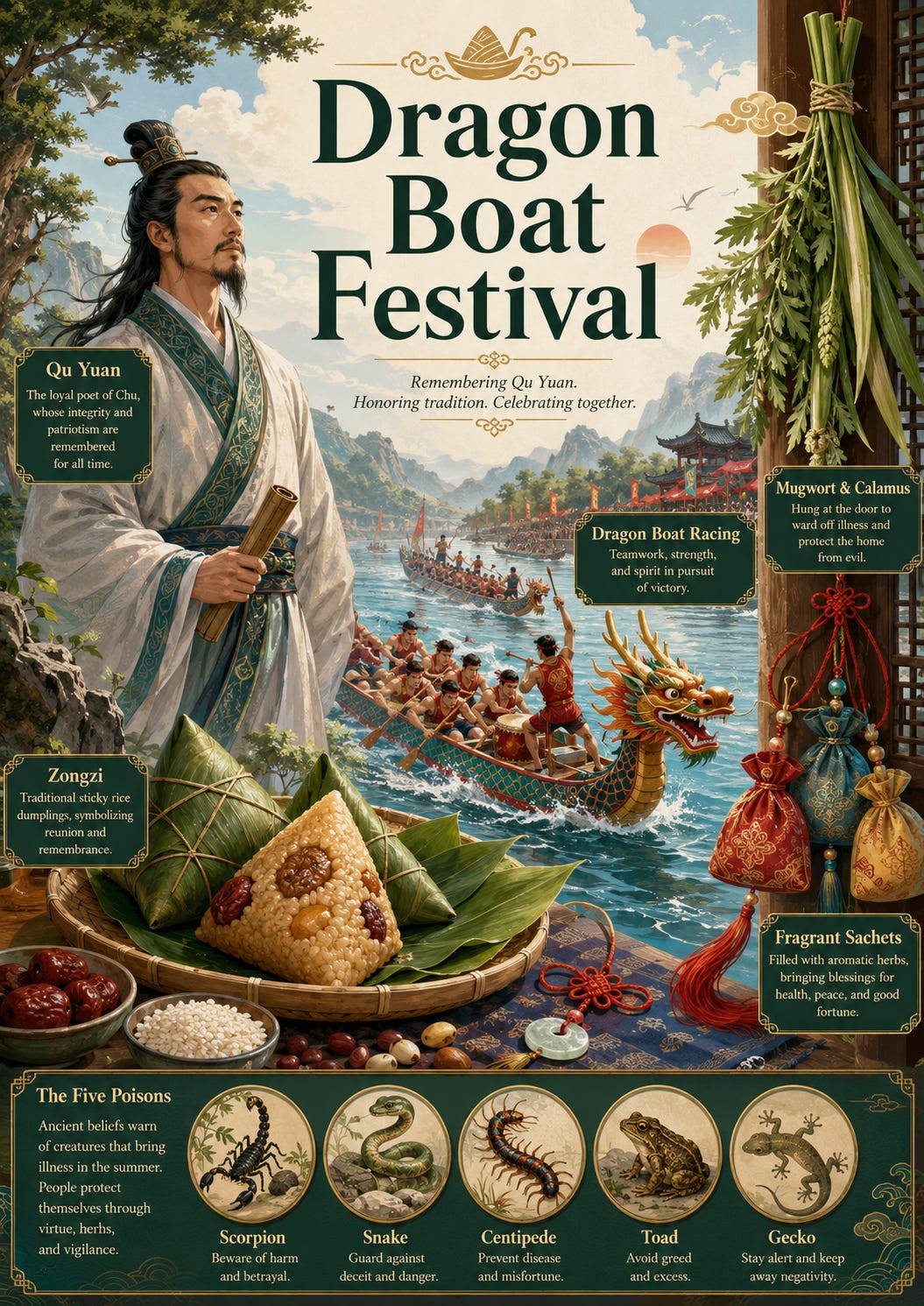
The Dragon Boat Festival is one of the major traditional festivals in China. It is not a festival with only one single origin. Rather, it is a composite festival formed through several thousand years of cultural development. It includes midsummer customs for avoiding illness and harmful influences, protection against the Five Poisons, beliefs connected with dragon and water spirits, water rituals, southern dragon boat traditions, and later commemorations of historical figures.
However, in later Chinese culture, Qu Yuan became the most representative symbolic figure of the Dragon Boat Festival. Today, when many people mention the Dragon Boat Festival, the first things that come to mind are Qu Yuan, dragon boat racing, and zongzi.
Qu Yuan, approximately 340–278 BCE, was a poet and political figure of the State of Chu during the Warring States period. He was loyal to Chu but was repeatedly pushed out of politics, and his political ideals could not be realized. In 278 BCE, Qin forces captured Ying, the capital of Chu, and the State of Chu suffered a major blow. According to tradition, Qu Yuan, devastated by the danger facing his country and the collapse of his ideals, drowned himself in the Miluo River on the fifth day of the fifth lunar month.
According to legend, when the local people heard that Qu Yuan had thrown himself into the river, they rowed out in boats to search for him, hoping to rescue him. This later became one of the most familiar explanations for the origin of dragon boat racing. People also threw rice dumplings into the river, hoping that fish and shrimp would not eat Qu Yuan’s body. This became one of the folk explanations for the custom of eating zongzi.
Qu Yuan came to be remembered not only as a major poet, but also as a cultural symbol of loyalty, moral integrity, and principled responsibility. In later Chinese historical memory, he became one of the most representative figures associated with this ideal personality.
Of course, Dragon Boat Festival customs go far beyond the story of Qu Yuan. In traditional Chinese thought, the fifth lunar month was associated with increasing heat, dampness, insects, and harmful seasonal influences. Therefore, the Dragon Boat Festival also includes customs such as avoiding the Five Poisons, hanging mugwort and calamus, wearing fragrant sachets, drinking realgar wine, and bathing with herbal water. These customs were used to pray for safety and to ward off illness and harmful influences.
The Five Poisons usually refer to poisonous or harmful creatures such as the snake, scorpion, centipede, toad, and gecko. Around the Dragon Boat Festival, the weather becomes warmer, and insects and reptiles become more active. Ancient people therefore developed many seasonal customs for protection and purification. Behind these customs are both folk beliefs and practical observations about season, illness, and environmental change.
Eating zongzi is one of the best-known Dragon Boat Festival customs. There are major regional differences between northern and southern China. Northern zongzi are often sweet, such as red date zongzi or red bean paste zongzi. Southern zongzi are often savory, such as pork zongzi, salted egg yolk zongzi, and braised pork zongzi. Different regions also developed their own festival food traditions based on local ingredients and taste.
On the Chinese internet, people often jokingly argue over whether sweet zongzi or savory zongzi are better. I am from northern China, a region where sweet zongzi are more common, so I originally belonged to the sweet-zongzi side. But after I grew up and tasted savory zongzi with salted egg yolk and braised pork, I converted to the savory-zongzi camp.
For readers who are curious, you can try both sweet and savory zongzi and see which side you belong to. You can also try making them yourself. Wrapping zongzi with friends and then eating them together is one of those small but very happy festival experiences.
Dragon boat racing has an especially strong collective and competitive character. It can be explained as a commemorative reenactment of the effort to rescue Qu Yuan, but it may also be traced to older water rituals, dragon totem beliefs, and customs of exorcism and blessing.
If there are competition, sports, or win-or-lose case topics that interest you, welcome to leave a comment and let me know.