I. Foundations
Part 4: Eight Trigrams (Bagua)
4.6. Na Yin in Na Jia Timing
How the Sixty Jia Zi Elemental Sound System Works, the Full 30 Pair Chart, and Why It Matters in Wen Wang Gua Interpretation
In Na Jia timing for Wen Wang Gua, you already track the stem branch time markers (year, month, day, hour). When studying topics like I Ching Divination, Na Yin adds a second layer of elemental quality and imagery that can sharpen interpretation, especially when you want a clearer feel for the “texture” of a time period rather than only its raw Five Element label.
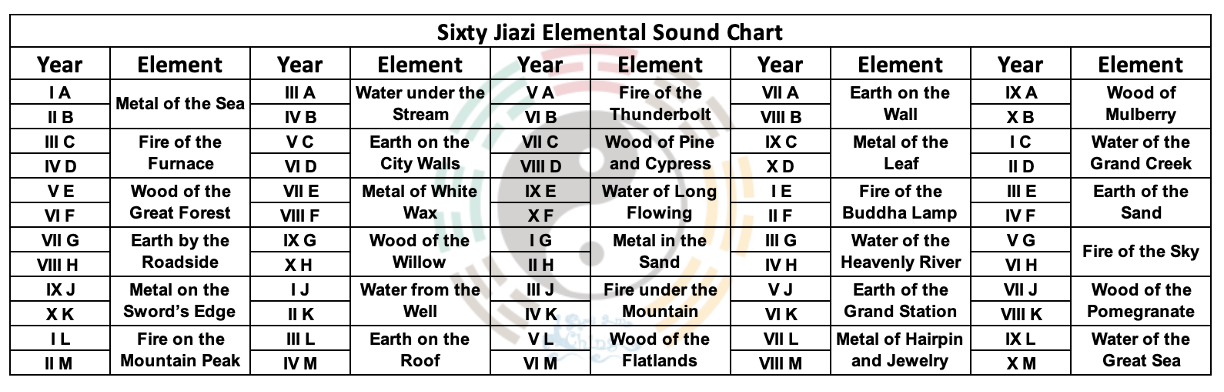
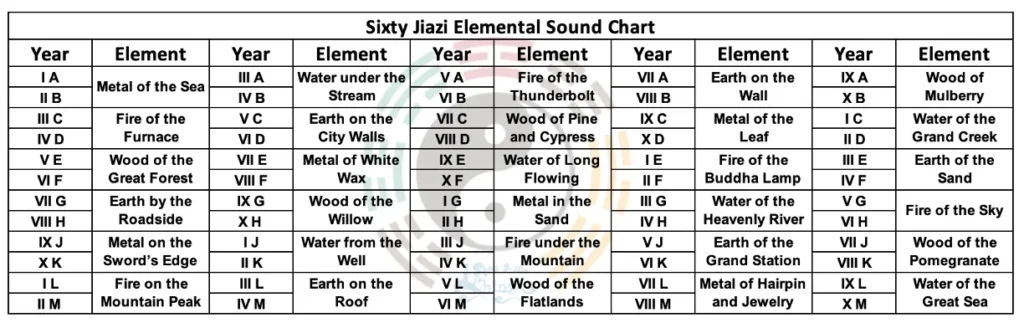
Na Yin (Elemental Sound System) is traditionally said to originate very early, and later became standardized as part of the Sixty Jia Zi system. In some traditional accounts it is attributed to Guiguzi, with the naming associated with Dongfang Shuo.
Early records show Na Yin used primarily as a Five Element assignment, without the later, richer imagery. In other words, you see statements like “jia zi, yi chou are metal” or “bing yin, ding mao are fire.” Later, especially by the early Song period, imagery labels such as “Metal of the Sea” or “Fire of the Furnace” became common, making the system easier to remember and more expressive for interpretive work.
Each Na Yin pair has both an element and an image, and the image is not decorative, it often hints at strength, quality, and behavior of that element. Below are compact interpretive notes aligned with your source material.
-
Metal of the Sea (I A, II B)
Water is strong here, metal is “stored” and submerged, so it can feel hidden, constrained, or contained, like metal concealed within deep water. -
Fire of the Furnace (III C, IV D)
Fire is well positioned and fed by wood, like a cosmic kiln at the beginning of creation, strong generative heat that initiates growth. -
Wood of the Great Forest (V E, VI F)
A lush, expansive wood in open terrain, vigorous and far reaching, but it dislikes being overwhelmed by strong stream or sea water forces. -
Earth by the Roadside (VII G, VIII H)
Soil that is trampled and shaped for passage, thick but not primarily for nurturing life, it can support certain woods but may not favor overly “wild forest” qualities. -
Metal on the Sword’s Edge (IX J, X K)
Metal in its true position, sharpened and hardened, decisive, cutting, and clear, like a blade with cold brilliance. -
Fire on the Mountain Peak (I L, II M)
Fire rising high at a “gate of heaven,” visible and far reaching, like sunset light across a ridge, intense but often more about illumination than warmth. -
Water under the Stream (III A, IV B)
Water that peaks then wanes, not a grand river, more like clear ravine flow among mountains, clean, swift, and contained. -
Earth on the City Walls (V C, VI D)
Earth piled into defensive structure, elevated and protective, with an imperial, fortified quality, solid containment and boundary. -
Metal of White Wax (VII E, VIII F)
Metal that is forming but not yet fully hard, delicate and pliable, like metal taking shape at twilight where yin yang meet. -
Wood of the Willow (IX G, X H)
Wood weakened by its position, softened but sustained by water support, flexible, fine, and continuous, like threads that do not break. -
Water from the Well (I J, II K)
Water born from metal strength, but not yet vast, quiet, steady, and inexhaustible in a contained way. -
Earth on the Roof (III L, IV M)
Earth shaped by rising fire, not ground soil but elevated earth, stronger through fire wood support, and it prefers quiet stability. -
Fire of the Thunderbolt (V A, VI B)
Fire within water and earth interplay, sudden, electric, and transformative, like lightning that can shift conditions rapidly when the environment supports it. -
Wood of Pine and Cypress (VII C, VIII D)
Wood at its strongest, towering, enduring, and resilient, with a “snow and frost” presence, steady power that outclasses softer woods. -
Water of Long Flowing (IX E, X F)
Reservoir water meets metal’s birth, a spring that does not run dry, quiet but continuous, favoring stillness and sustained flow. -
Metal in the Sand (I G, II H)
Fire is strong, metal is challenged, sand metal is granular and dispersed, not easily consolidated without the right conditions. -
Fire under the Mountain (III J, IV K)
Light that is concealed at a gate or setting point, stored brilliance, it may reemerge and brighten again with the right directional support. -
Wood of the Flatlands (V L, VI M)
Wood born in open fields, it prefers nourishment from rain and dew, and dislikes harsh frost or snow forces. -
Earth on the Wall (VII A, VIII B)
Earth mixed with abundant water into mud, enclosing and concealing, it stores and hides substance, but can feel blocked or internally sealed. -
Metal of the Leaf (IX C, X D)
Metal weakened in strong wood terrain, thin like foil or leaf metal, light, delicate, and easily shaped, not forceful. -
Fire of the Buddha Lamp (I E, II F)
Fire at a bright threshold, refined light that illuminates what ordinary sunlight misses, a clear, focused radiance. -
Water of the Heavenly River (III G, IV H)
Water drawn from fire positioning, elevated and vast like a celestial river, it can nourish widely when strong, and should be able to rise and fall in movement. -
Earth of the Grand Station (V J, VI K)
Earth of transport and storage, heavier and more substantial than thin soil, a gathering and resting place where qi returns and things are collected. -
Metal of Hairpin and Jewelry (VII L, VIII M)
Metal already shaped into ornament, soft but valuable, it favors conditions that strengthen and preserve it, and it benefits from supportive growth. -
Wood of Mulberry (IX A, X B)
New wood emerging in water territory, meeting metal “cutting,” it implies shaping, pruning, and the early stage before full expansion. -
Water of the Grand Creek (I C, II D)
Water flowing in the true eastern direction, gathering streams and pools into a coherent current, more forceful than small ravine water. -
Earth of the Sand (III E, IV F)
Earth stored then depleted, fire returns to generate it again, granular, shifting, needing consolidation to become truly stable. -
Fire of the Sky (V G, VI H)
Fire blazing upward, radiant and expansive, a strong yang flame quality that is broad, visible, and hard to contain. -
Wood of the Pomegranate (VII J, VIII K)
Wood reviving in metal season, quiet, focused, gradually producing treasure, with autumn fruit maturity as its image. -
Water of the Great Sea (IX L, X M)
Deep, vast water power, expansive and oceanic, it can be restrained when supported properly, and it behaves differently from lesser waters.
How to apply Na Yin in Na Jia timing for Wen Wang Gua
Use Na Yin as a secondary timing lens that refines the “quality” of a time marker after you already identify the standard stem branch element relations. A clean workflow looks like this:
- Identify the year, month, day, or hour Jia Zi used in your reading.
- Look up its Na Yin pair and record the Na Yin element and image.
- Compare that Na Yin element against the structure you are already judging (support, overcome, generation patterns).
- Use the image label as a narrative constraint, it helps you avoid overgeneralizing a plain “water, fire, wood” reading.
In practice, Na Yin is most helpful when multiple factors look mixed and you need an extra “tie breaker” to describe what kind of wood, what kind of water, or what kind of metal the time is expressing. For example, “Water of the Great Sea” and “Water from the Well” are both water, but they imply very different scale, behavior, and containment.
Where stem branch imagery fits in the bigger system
Na Yin is only one part of building strong timing intuition, and the imagery logic of stems and branches themselves also matters.