Disclaimer:
All personal information in this case study has been anonymized or omitted. This case study is provided for learning and reference only. It is not intended as medical, veterinary, legal, financial, investment, or other professional advice.This case study involves I Ching Divination as a tool for reflection and understanding.
II. Understanding Six Lines Divination
Part 2.3. The Upper Trigram and the Lower Trigram
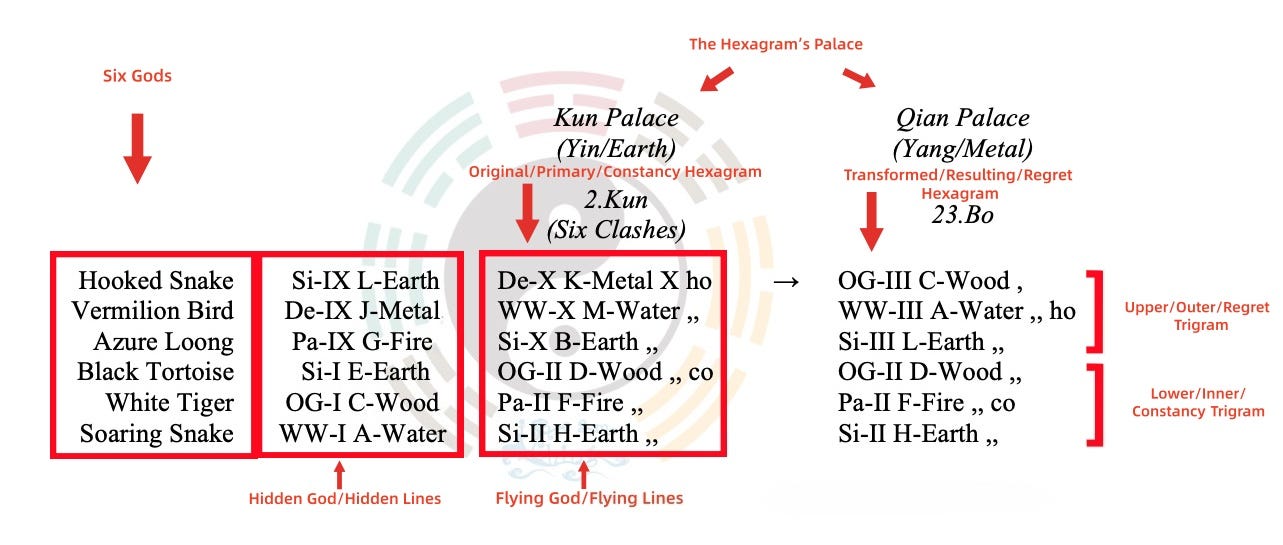
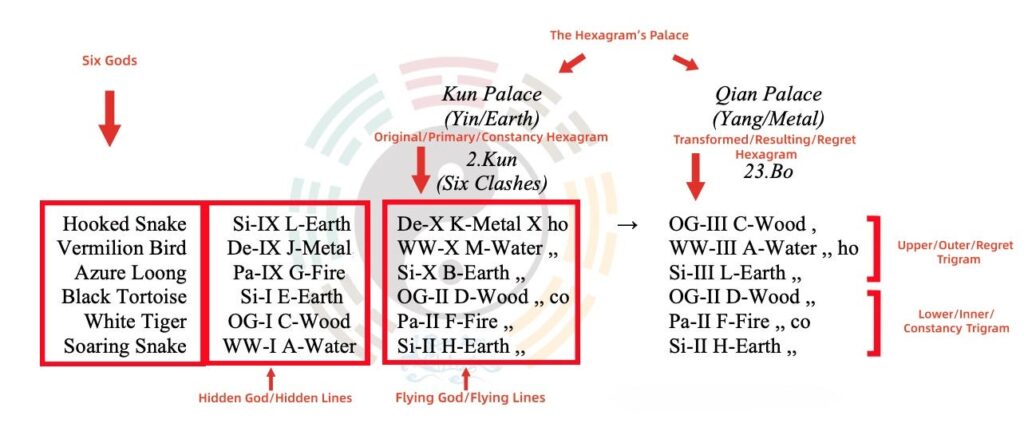
The Inner Trigram represents the internal condition of a matter and symbolizes its beginning. The Outer Trigram represents the external condition of a matter and symbolizes its ending.
For example, in Tai, the lower body is Qian and the upper body is Kun, so the Tuan Commentary says: “The inner is yang and the outer is yin; the inner is strong and the outer is compliant; the inner is the noble one and the outer is the small person.” This is an example of distinguishing inner and outer from the upper and lower bodies.
Because in the Tai hexagram the lower trigram is Qian, which represents yang, and the upper trigram is Kun, which represents yin, yang is below and yin is above. This arrangement indicates that the energies of above and below can circulate and connect with one another. In the Na Jia method, Tai is also classified as a Six Compatibles hexagram.

The opposite of Tai is the Pi hexagram. Pi is also a Six Compatibles hexagram, but its arrangement is exactly the reverse: Qian yang is above, while Kun yin is below. The energies have each returned to their respective places and can no longer circulate between above and below. Therefore, the Tuan Commentary says: “This means Heaven and Earth do not interact, and all things have no free passage; the high and the low do not interact, and there are no states in the world. The inner is yin and the outer is yang; the inner is soft and the outer is hard; the inner is the small person and the outer is the noble one. The way of the small person is growing; the Way of the noble one is fading.”

In Chinese culture, many common idioms come from the Yijing (I Ching). One well known example is When Pi reaches its limit, Tai comes (否极泰来,pi ji tai lai), which comes from the contrast between Pi and Tai. It means that when things have become bad to the utmost extreme, the energy will begin to reverse, and better conditions will arrive. So when one is going through a difficult period, this phrase can serve as a reminder: if you hold on a little longer, better days may already be on the way.
Of course, when better days do arrive, one should not become complacent or carried away. It is still important to remain modest and maintain a humble attitude, so that favorable circumstances can continue for longer rather than quickly turning again.