
Disclaimer:
All personal information in this case study has been anonymized or omitted. This case study is provided for learning and reference only. It is not intended as medical, veterinary, legal, financial, investment, or other professional advice.
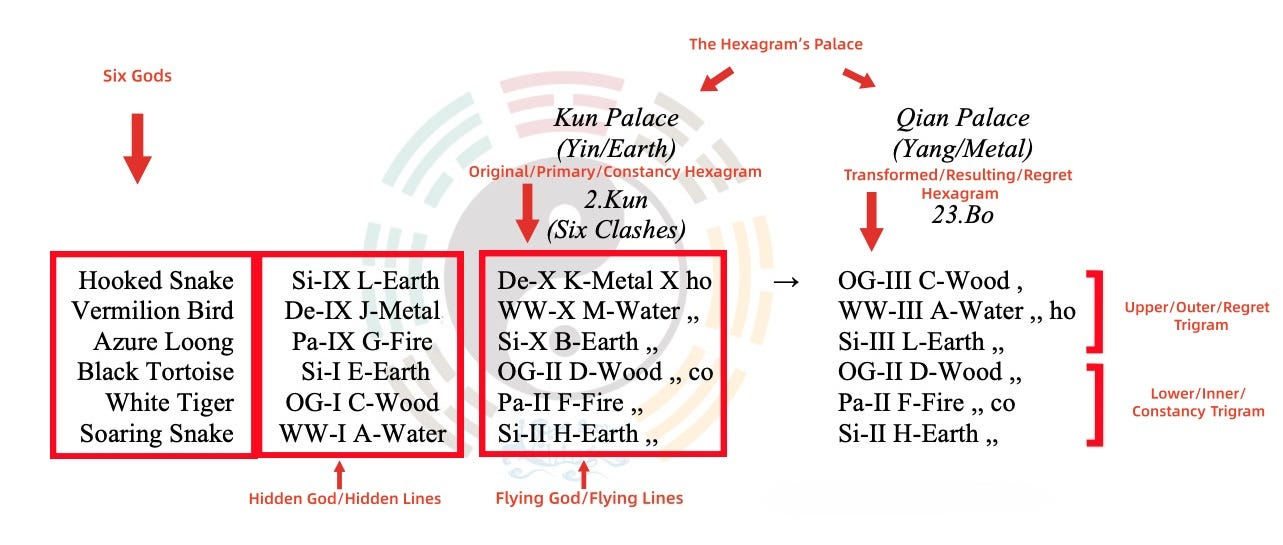
In I Ching divination, the terms Constancy and Regret have two technical meanings.
In this structure, the inner trigram represents the main side of the matter, usually the self or the querent.
The main hexagram represents the present state of the matter. The transformed hexagram represents the result or later development after transformation.
In other words, when the divination produces a static hexagram, Constancy and Regret refer to the inner and outer trigrams. When the divination produces a transformed hexagram, they refer to the main hexagram and the transformed hexagram.
This is why early divination records sometimes use expressions such as:
Constancy Zhun, Regret Yu.
This means that the Constancy hexagram is Zhun, while the Regret hexagram is Yu. In modern terms, this is Zhun changing to Yu.
To make this rule clearer, let us look at one of the most famous historical I Ching divination cases: Case 84: Spring and Autumn (Jin), Chong’er Divines for Gaining the State, 3. Zhun to 16. Yu, from Studies on Ancient I Ching Divination Cases (Zhouyi Gushi Kao, 《周易古筮考》).
This case was not an ordinary private divination. It concerned Prince Chong’er’s return to the state of Jin and his future political destiny. Later, Chong’er became Duke Wen of Jin, one of the great hegemons of the Spring and Autumn period. For this reason, the case was studied and discussed by generations of Chinese literati and Yijing scholars.
Below is the full case analysis.
Case 84: Spring and Autumn (Jin) – Chong’er Divines for Gaining the State – 3. Zhun to 16. Yu
He obtained “Constancy Zhun, Regret Yu.”
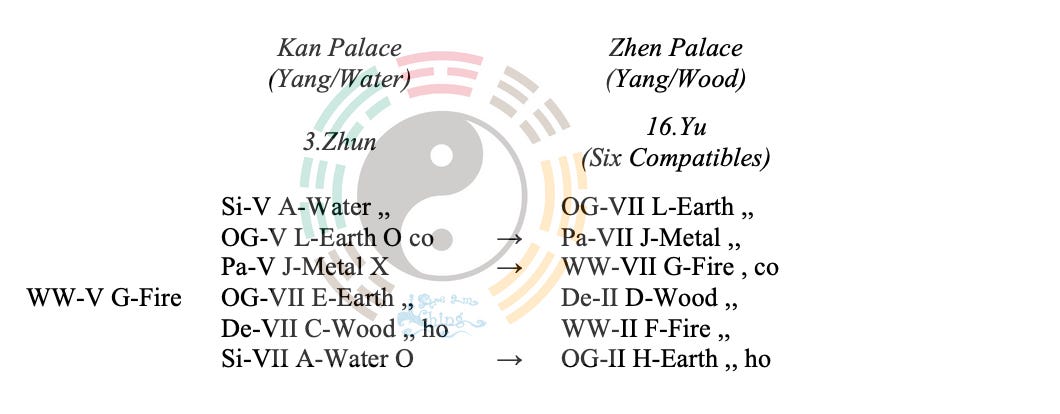
All were “eight” [2] {(Wei Zhao’s note says) Zhen in Zhun is constancy, in Yu is regret. The divination scribes interpreted it, and all said, “Not auspicious. Closed and not communicating [3], the lines do nothing” {Zhen signifies movement; when movement meets Kan, Kan signifies pit and obstruction, so it is blocked and not open, and nothing can be accomplished}.
Sikong (Minister of Works) Jizi said, “Auspicious. In the Zhouyi both say ‘benefit or advantage in appointing marquises’ {in Zhun the Initial-Nine says ‘benefit or advantage in appointing marquises’; in Yu the Great Image says ‘Benefit or advantage in appointing marquises and mobilizing the army’ [4]}. If there were not the state of Jin to assist the royal house, how could one appoint marquises? What greater good could there be!”
Zhen is the chariot {in the Yi, Kun is the great carriage [5] and Zhen is thunder; now we call it a chariot, and even an old chariot still moves, its sound resembling thunder, thus it is a small chariot; according to the Zuo Commentary, Xin Liao said “Zhen is the earthen cart following horses,” which likewise takes Zhen as a vehicle; the image of the Zhen resembles a cart, and a cart is a moving thing, which accords with Zhen as movement}, Kan is water, Kun is earth, Zhun is thickness [6], and Yu is delight [7].
The chariot is arrayed within and without, and it is taught by compliance [8] {the chariot is Zhen; “arrayed” means everywhere; everywhere within and without means within Zhun there is Zhen and outside Yu there is also Zhen; Kun is compliance, with Kun inside Yu, and lines two to four of Zhun are also Kun}.
The earth is thick and enjoys its fruits; if there were not the state of Jin, how could one bear this {both Zhun and Yu contain Kun; double Kun is thickness; Yu signifies delight}.
Zhen is thunder and also a chariot; Kan is toil [9] and also the multitude {in the Yi, Kun is the multitude, and Kan is water, and water also belongs to the category of the many}. The inner governs thunder and chariot {the inner acts as the master}, while the upper esteems water and the multitude {the images of Kan lie above, therefore above are water and the multitude (people)}. The chariots display the martial power of Zhen {to spread awe; the resounding of the chariots signifies might}, and the multitude compliantly takes on culture {Kun is the multitude (people), the earth, and culture; the image possesses civil virtue and is where the multitude (people) turn}.
Its statement says: “Origin, smoothness, Benefit or Advantage, Constancy. Do not use to have a direction to go. Benefit or Advantage in appointing marquises.” [10] {this is the hexagram statement; “smoothness” means access, “constancy” means correctness, “direction” means where, and “to go” means to proceed; do not use it to go somewhere, but for the gentleman there is benefit in appointing marquises and in moving the army}.
Governed by Zhen, Thunder, the eldest, therefore it says “Origin” {the inner serves as the ruler; Zhen is the eldest son and is Thunder; Thunder signifies the feudal lords, hence “Origin.” “Origin” means “the chief of the good” [11]}. Being many (multitude) yet compliant is commendable, therefore it says “Smoothness.”
With the chariots above and water below, there is surely overlordship [12] {the chariot is Zhen and Kan is water; when the chariot moves there is awe above, and when the water moves there is compliance below, therefore one knows it is surely overlordship}. The people are compliant and there is martial majesty, therefore it says “Benefit or Advantage in appointing marquises.”
These two are the hexagrams by which one gains the state.
Do not use to have a direction to go.
The Shasui Divination Method (《沙随筮法》) says: Duke Wen of Jin divined Constancy Zhun, Regret Yu [13], with the first, fourth, and fifth lines active; the Initial-Nine without position yet gaining the people [14] is the image of Chong’er being outside. In Yu, the nine at the fourth is the one whom the many yin follow [15]; Zhen signifies the lords and Kun the land, which is the image of Chong’er gaining the state. The text says, “Friends gather like a clasp holding hair together” [16]. A clasp orders the hair to adorn the head, which is the image of leading the lords to honor the Zhou [17], and the Tuan Commentary [18] says “benefit or advantage in mobilizing the army,” which is the image of achieving hegemony in a single battle.
[Annotation from the Translator]
[1] Source: This case is cited from Discourses of the States: Discourses of Jin (Guoyu, Jin Yu, 《国语·晋语》).
Historical Background:
When Duke Hui died, his son Duke Huai briefly took the throne amid factional turmoil. In 636 BCE, Qin’s Duke Mu backed Chong’er with troops and a marriage alliance and prepared to escort him east.
[2] All were eight: the ancients offered many explanations of this phrase, and many seem unconvincing; modern scholars also find it hard to resolve.
This explanation can also be referenced in Volume One, Divination Rituals; Part 2, Detailed Explanation of the Divination Procedure, [Annotation from the Translator], [5].
Dividing by four (to represent the Four Symbols), a single line (yao 爻) is thus determined:
· 36 ÷ 4 = 9 (this is the number of old yang, represented by “O”);
· 32 ÷ 4 = 8 (this is the number of young yin, represented by “–”);
· 28 ÷ 4 = 7 (this is the number of young yang, represented by “—”);
· 24 ÷ 4 = 6 (this is the number of old yin, represented by “X”).
[3] Closed and not communicating: in Zhun, Zhen is below Kan; in Yu, Zhen is above Kun. Zhen is a chariot, Kan is peril, Kun is earth.
[4] “Benefit or advantage in appointing marquises and mobilizing the army” is the Hexagram statement of Yu, not the Image (Xiang Commentary). It means it is suitable to enfeoff marquises and to use troops in warfare.
[5] Kun is the great carriage: Shuo Gua says Kun “is the great carriage,” therefore Kun is taken as a great cart.
[6] Zhun is thickness: Zhun’s basic sense is the sprouting of plants. It commonly extends to the ideas of fullness and accumulation, and from fullness and accumulation it further extends to thickness.
[7] Yu is delight: the hexagram Yu carries the meanings of ease and enjoyment.
[8] Taught by compliance: the inner trigram of Yu is Kun, and in Zhun the mutual body from the second to the fourth lines is also Kun.
[9] Kan is toil: this is not stated in Shuo Gua. Kan is water, and water flows without cease, so it may by extension signify toil.
[10] “Origin, Smoothness, Benefit, Constancy. Do not use to have a place to go. Benefit in appointing marquises.”
[11] “Origin” means “the chief of the good”: together with “therefore it is called Smoothness, a gathering of what is commendable,” “Benefit is the harmony of righteousness,” and “Constancy is the trunk of affairs,” these quotations come from Qian, Wenyan. Only when a gentleman practices these four virtues can he hold fast and accomplish his work. This also supports the claim that Chong’er could gain the state.
[12] Surely overlordship: “overlordship” (伯) interchanges with “to moor” (泊) in early usage. Hence the text later says “small matters do not succeed,” for obstruction must be present.
[13] Constancy Zhun, Regret Yu: For the discussion of this pair of hexagrams, see Case 84: Jin – Chong’er Divines for Gaining the State – 3. Zhun to 16. Yu, and Case 169: Spring and Autumn – Discourses of the States: Chong’er Divines for Gaining the State – 3. Zhun to 16. Yu.
[14] The Initial-Nine without position yet gaining the people: the first line is the line of the “original officer,” occupying the very lowest place of the hexagram and signifying the common people, which images Chong’er being outside and out of office yet winning the people.
[15] The nine at the fourth is the one whom the many yin follow: in Yu only the fourth line is yang while the other five are yin, so the nine at the fourth is the one whom the yin masses follow and who leads the whole hexagram.
[16] “Friends gather like a clasp holding hair together”: Yu Hexagram, Nine-Four line statement.
[17] It evokes the hegemon’s role: a powerful lord rallying vassal states to uphold the Zhou king, convene alliances, enforce rites, coordinate campaigns, and restore order, legitimizing collective action under Zhou authority and stabilizing interstate politics in the Spring and Autumn era.
[18] It should be the Hexagram Statement of Yu here.
This allows the diviner to read both the present condition and the later result.
This is also why historical cases are so important.
For readers who wish to compare this case with the pre-Han image-number method and another textual tradition, please refer to Case 169: Spring and Autumn, Discourses of the States: Chong’er Divines for Gaining the State, 3. Zhun to 16. Yu, also included in Studies on Ancient I Ching Divination Cases (Zhouyi Gushi Kao, 《周易古筮考》).