
Disclaimer:
All personal information in this case study has been anonymized or omitted. This case study is provided for learning and reference only. It is not intended as medical, veterinary, legal, financial, investment, or other professional advice.
Time of divination (Hexagram One, outcome): May 10, 2026, at 11:29 AM.
Stem and branch time: III G year, X F month, I J day (void: G and H), VII G hour.
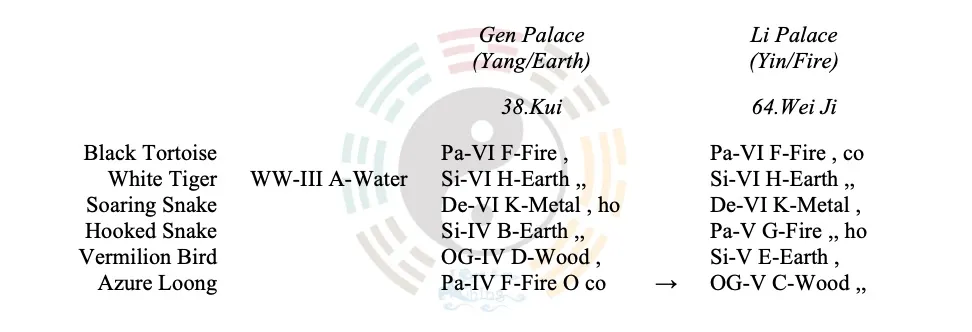
A querent asked about a doctoral dissertation after an appeal in the blind review process had led to the addition of two more reviewers. The question was whether the additional review would pass. She obtained Kui to Wei Ji.
Judgment: This case was divined through two separate hexagrams: the first for auspiciousness or inauspiciousness, and the second for timing. However, when a matter is truly complex, it can be broken into separate questions, as in this case. The two results can then also verify each other.
The significator: In matters concerning dissertation review, documents, diplomas, and written academic evaluation, the parents line is uniformly taken as the significator.
Could the additional review pass?: In this hexagram, the significator, parents F fire, aligned with the monthly command in the F month, and its own state was extremely prosperous and supportive. In addition, the first line parents F fire was active and transformed into officials and ghosts C wood, forming active transformation into return generation, since wood generates fire. The significator was prosperous and supportive through the monthly command, and also received return generation from the transformed line. Its force was therefore extremely strong. This was a very obvious and pure auspicious sign.
Time of divination (Hexagram Two, timing): May 12, 2026, at 9:51 AM.
Stem and branch time: III G year, X F month, III L day (void: G and H), X F hour.
The querent obtained Yu.
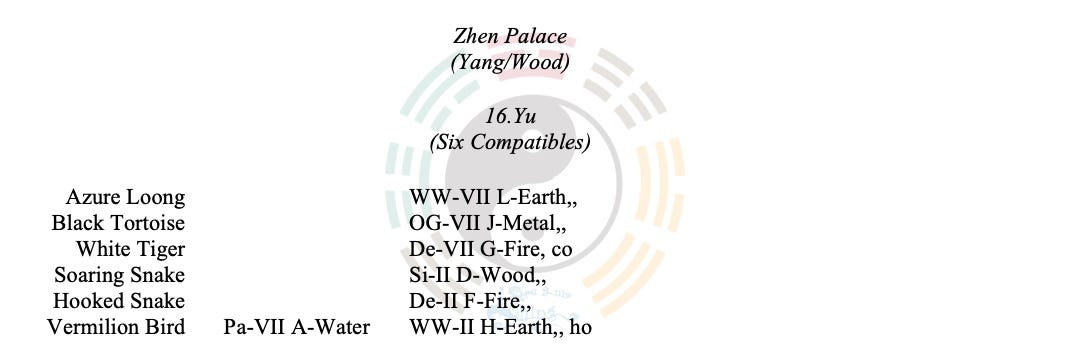
Timing judgment, on what date would the result appear?: In this hexagram, the significator parents line did not appear openly in the hexagram, but rather the parents A water was hidden beneath the first line wife and wealth H earth, which served as the flying god. According to the core rule for judging timing from a hidden line, namely that what is hidden responds when it coincides with the daily branch or encounters clash, the theoretical timing could be locked onto the following branch days.
First, it could respond on a day when the hidden line itself coincide with the daily branch, namely an A day. This corresponded to May 14, a V A day.
Second, it could respond when the hidden line itself was clashed into movement. Since A and G clash, this pointed to a G day, corresponding to May 20, an I G day.
Third, it could respond when the flying god above it was clashed open. This corresponded to May 15, a VI B day.
Conclusion: The first hexagram showed that the dissertation would definitely pass the additional blind review.
Feedback: The querent later reported on May 18 that the dissertation had already passed the additional review smoothly.
Note:
How to Use the ichingstream Perpetual Calendar to Judge Timing
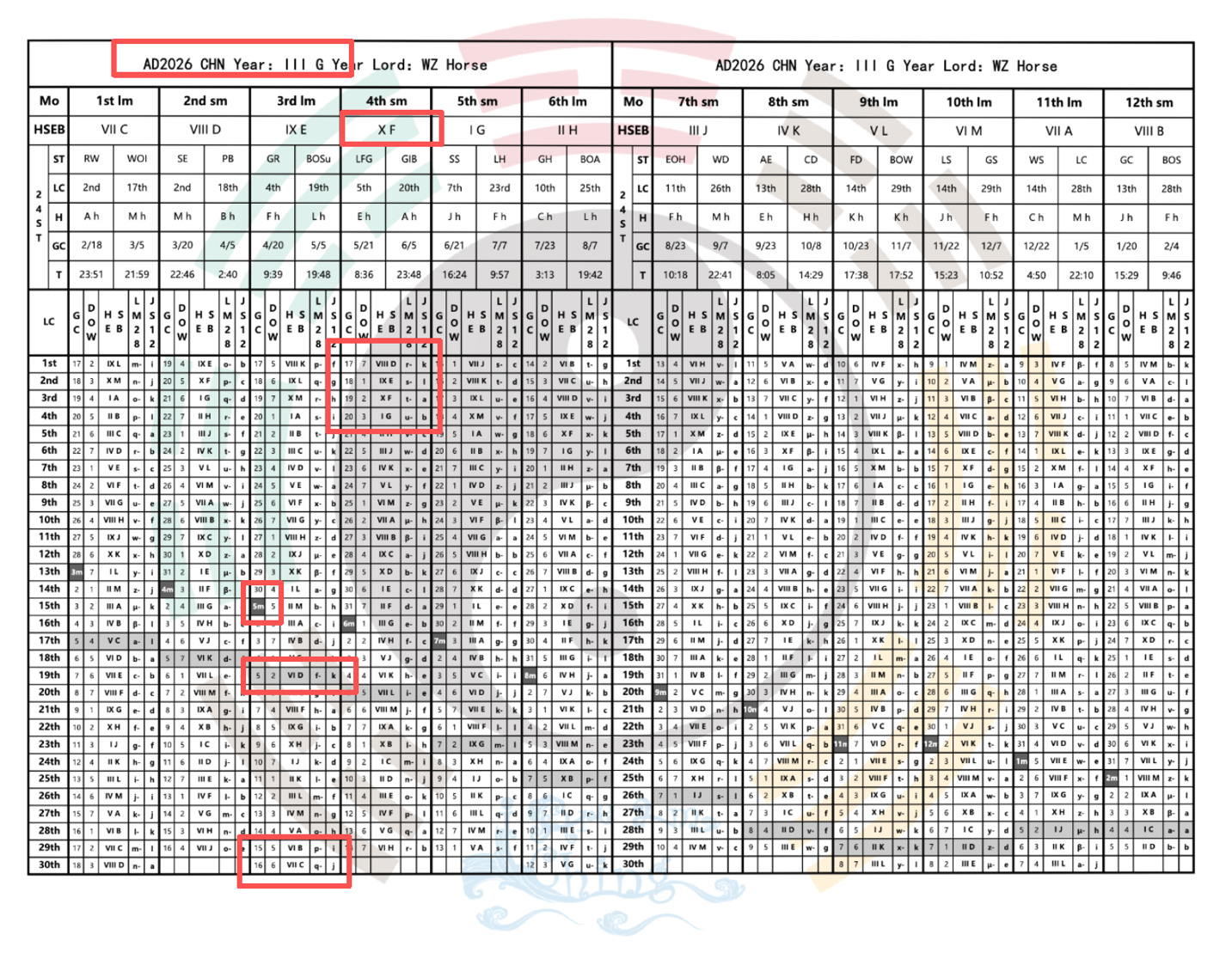
For this kind of timing judgment, the first step is to confirm the year. In this case, the year is 2026. Then, based on the Gregorian date of divination, one uses the perpetual calendar to trace the corresponding stem-and-branch date progression.
This is crucial, because many people make mistakes in timing judgment precisely by overlooking the transition of the monthly command.
This is the format that appears most often in our case studies.
The second is a numbered lunar date format, which is closer in appearance to the Gregorian style of writing dates. For example, for the Gregorian date May 12, 2026, at 9:51 AM, the corresponding numbered lunar time would be: III G year, 3rd month, 26th day, X F hour.
In this case, the divination date was May 12 in the Gregorian calendar.
In most cases, timing judgment points forward into the future rather than backward into dates that have already passed.
When the hidden line coincide with the daily branch, one looks for the nearest future A day after the divination date. That corresponds to May 14, V A day.
When one wants to clash open the flying god, one looks for the day that can clash H. Since B clashes H, that corresponds to May 15, VI B day.
When one wants to stir the hidden significator by clash, one looks for the day that clashes the hidden line itself. Here, since G clashes A, that corresponds to May 20, I G day.
It depends on one’s sense of how quickly the matter in question is likely to fulfill.
In other words, timing judgment is not about mechanically applying a rule.
If there are certain themes you would like to see in future case studies, welcome to leave a comment and share what kinds of divination cases interest you most.