I. Foundations
Part 4: Eight Trigrams (Bagua)
4.4. The Sexagenary Cycle
The Sexagenary Cycle is the core calendrical framework behind all traditional Chinese time notation in I Ching divination.
In Na Jia (Wen Wang Gua) practice, every divination is anchored in time, and that time is recorded through the combination of Heavenly Stems and Earthly Branches.
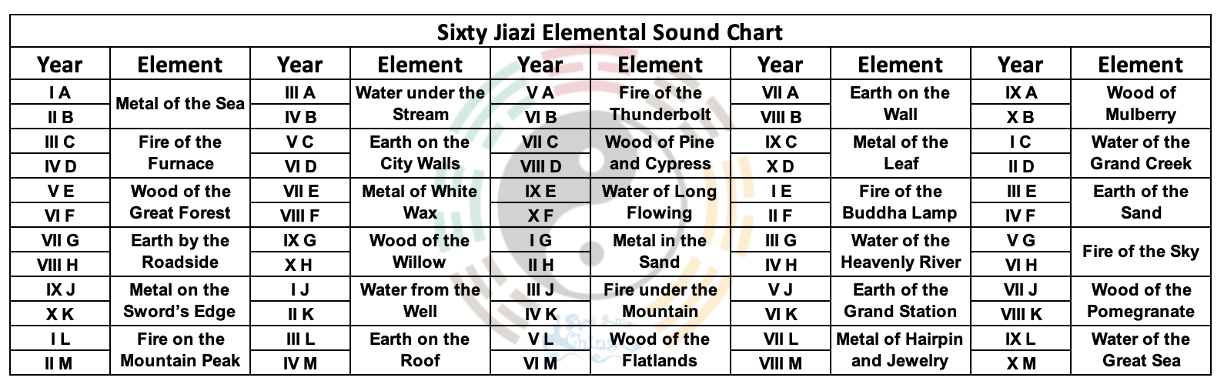
This system is known as the Sixty Jia Zi (I A), or the Sexagenary Cycle, and it forms the fundamental cycle used for:
- year designation
- month designation
- day designation
- double-hour designation
In other words, it is the backbone of Chinese metaphysical timing.
1. What Is the Sexagenary Cycle?
The Sexagenary Cycle consists of sixty unique Stem-Branch combinations formed by pairing Heavenly Stems and Earthly Branches in fixed sequence.
It is the basic unit of cyclical time in the traditional Chinese calendar.
The system is built from two independent sequences:
- Ten Heavenly Stems
- Twelve Earthly Branches
When combined in order, they generate sixty non-repeating pairs.
Because the first pair is Jia Zi, the entire cycle is called the “Sixty Jia Zi.”
2. The Ten Heavenly Stems (I to X)
The Heavenly Stems are a sequence of ten markers used in traditional calendrical notation.
In your standardized notation system, they are encoded as:
- Jia = I
- Yi = II
- Bing = III
- Ding = IV
- Wu = V
- Ji = VI
- Geng = VII
- Xin = VIII
- Ren = IX
- Gui = X
These ten stems cycle repeatedly.
3. The Twelve Earthly Branches (A to M)
The Earthly Branches are a sequence of twelve markers representing months, directions, and double-hours.
In your notation system, they are encoded as:
- Zi = A
- Chou = B
- Yin = C
- Mao = D
- Chen = E
- Si = F
- Wu = G
- Wei = H
- Shen = J
- You = K
- Xu = L
- Hai = M
These twelve branches cycle continuously.
4. How the Sixty Jia Zi Are Formed
The Sexagenary Cycle is created by pairing stems and branches sequentially until all sixty unique combinations appear.
The pairing begins:
- I A
- II B
- III C
- IV D
- V E
- …
And continues until the final pair:
- X M
Because the stem cycle (10) and the branch cycle (12) align only every 60 steps, the full cycle contains exactly sixty distinct combinations.
5. Why This Matters in Na Jia (Wen Wang Gua) Divination
In Six Lines divination, time is not a background detail, it is an active structural component of interpretation.
Every casting is recorded with its Sexagenary timestamp, for example:
- Year: III G
- Month: VII C
- Day: I D
- Void: A and B
This timestamp determines:
- the monthly branch influence
- the daily branch influence
- void in the cycle
- seasonal strength
- timing of events
- activation patterns
Without the Sexagenary Cycle, Na Jia divination cannot function as a timing-based predictive system.
6. The Sexagenary Cycle as a Practical Notation Framework
The Sixty Jia Zi are not abstract historical labels, they are operational coordinates for real divination work.
They provide a standardized way to document readings with precision, such as:
- “In the month of C, on the V G day…”
- “Void: A and B…”
- “The significator line is supported by the daily branches…”
This is exactly why classical Wen Wang Gua texts always begin with a full Stem-Branch timestamp.
7. What Comes Next
Now that you understand the Sexagenary Cycle, the next step is learning how it connects directly to line activation, seasonal strength, and Na Jia structure.
In the upcoming section, we will move from notation into application:
- how the day branch assigns the Six Gods
- how void in the cycle affects outcomes
- how timing emerges from branch interactions
Continue Learning on I Ching Stream
If you want a complete standardized framework for practical Six Lines divination, including casting tools, structured notation, and professional-level training:
Explore the full system at ichingstream.com