Case Study-2026-035 Graduate School Admissions: Which University Had the Best Chance?

Disclaimer: This article is intended solely for academic discussion and methodological analysis of Yi principles and divination interpretation. We encourage rational judgment and respect for modern science. In any real

emergency, missing-person case, medical crisis, rescue situation, or life-threatening event, always contact professional emergency services, rescue teams, medical personnel, law enforcement, or other qualified authorities immediately.

As admission season arrives in both China and overseas, many students are facing the same difficult question: which school should they choose? Moreover, which path seems more suitable and more promising? For students applying to graduate programs, the decision is often not only about academic preference. It is also about location, future career direction, and practical life arrangements.

Background: The querent was originally from one place but was currently working in another. She was preparing for the graduate school entrance examination and needed to choose among University A, University B, and University C. She therefore made several divinations to ask about the prospects of each school. Later, after the written exam, she also asked whether she would ultimately be admitted.

The key point of this case is not only whether she could be admitted. More importantly, it shows how, when facing multiple options, one may cast separate hexagrams for different choices and compare the strengths and weaknesses of each path. It also shows that when the result is already approaching and the querent is in a state of strong anxiety, one must determine whether the hexagram is answering the objective result. Otherwise, it may simply be reflecting the querent’s mental state.

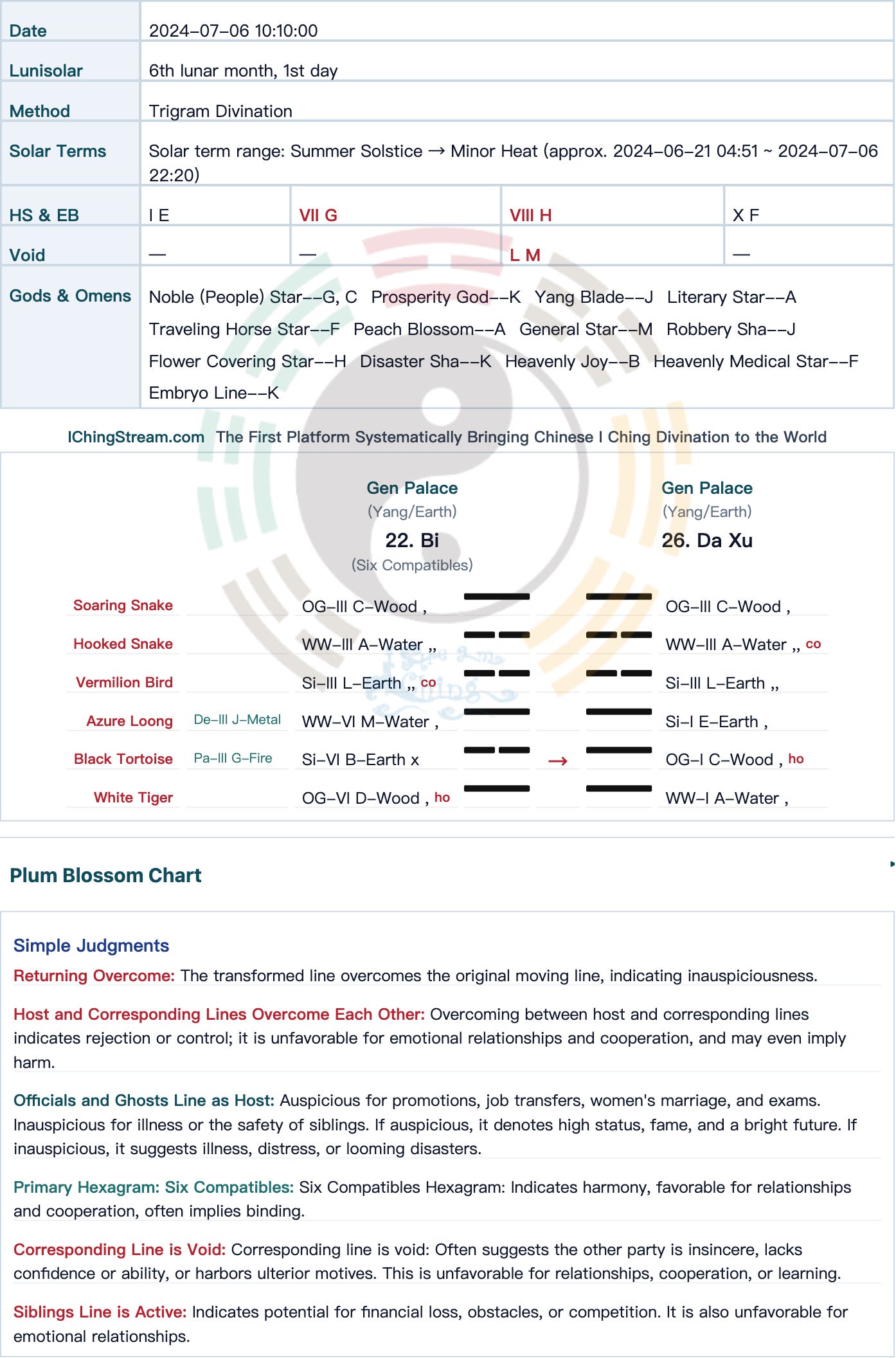
First Reading: Applying to University A

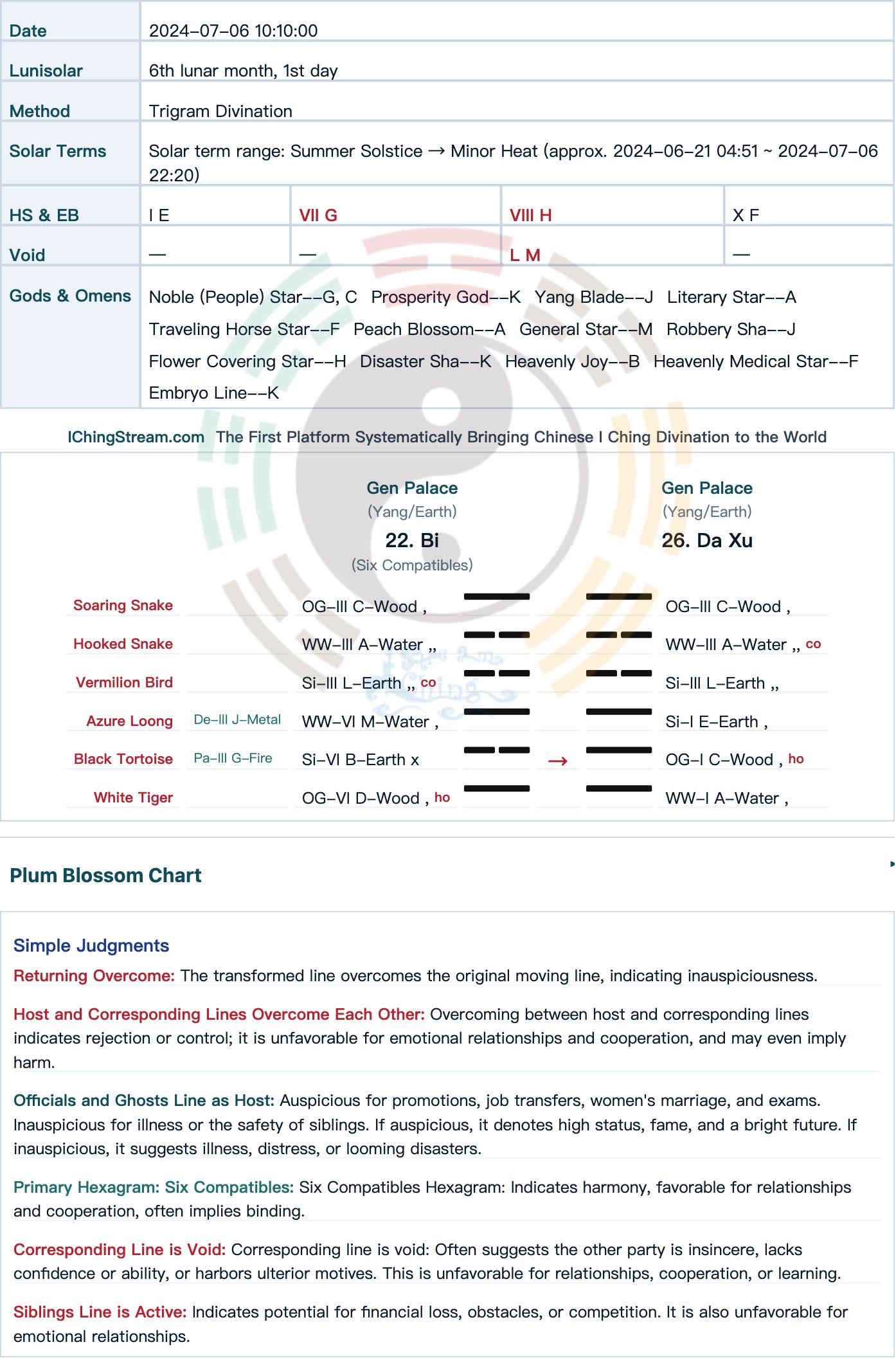
Time of divination: October 19, 2025.

Stem and branch time: II F year, II K month, VIII K day (void: A and B).

Hexagram obtained: Feng to Dun.

Judgment: In readings about examinations, academic study, and admission, the parents line is usually taken as the significator. This is because the parents line represents examinations, documents, materials, admission papers, and academic credentials. Since graduate school admission is also related to future career development, the officials and ghosts line should also be considered. The officials and ghosts line can represent position, title, qualification, and the development direction after admission. In addition, it is also the source god of the parents line.

On the surface, the parents J metal was prosperous and supportive. It aligned with the monthly branch and was also the same earthly branch as the daily branch. This showed that the querent’s examination foundation, documents, and academic qualifications were not weak. In other words, the problem was not that the querent herself had no ability. Nor was it that she had no chance in graduate school admission as a whole.

However, the key problem was that the corresponding line, representing University A as the target school, was void in the cycle. In this reading, the question was not merely whether the querent had examination ability. Instead, it was about whether University A was the right target. Since the corresponding line represented the target side and was void, it showed that this specific school was not solid. It was not connected and was difficult to obtain. Therefore, although the parents line was strong, the target of University A itself was empty.

The sixth line was also active, and the active line was near the host line. At the same time, the officials and ghosts line and the parents line were both active, and the officials and ghosts line generated the parents line. These signs showed that the key forces related to examination, school, and future career development were moving closer to the querent’s current living and working environment. They were not moving toward her hometown.

This made University A less convincing as the priority choice. Meanwhile, the later readings would be needed to compare the other options more clearly.

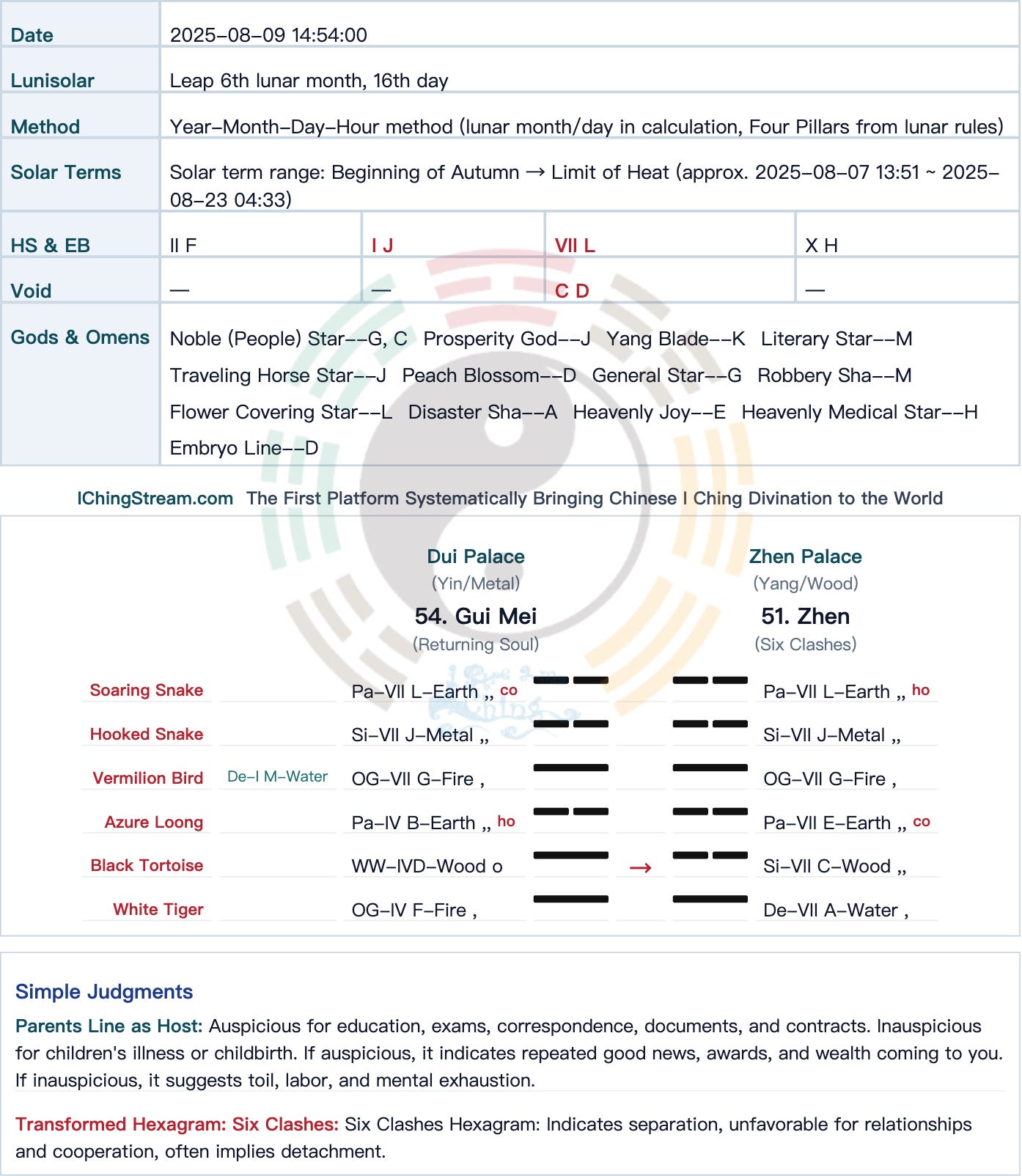
Second Reading: Applying to University B

Time of divination: October 27, 2025.

Stem and branch time: II F year, III L month, VI F day (void: L and M).

Hexagram obtained: Gui Mei to Kui.

Judgment: This hexagram again showed the image of “a prosperous significator and a strong host line,” and it was even clearer than the first reading. For an examination reading, the parents line was still taken as the significator. In this hexagram, the host parents B earth was prosperous and supportive. It received support from the monthly branch and generation from the daily branch, so the significator was very strong.


😄Thank you all for your support, and thank you for your patience. We know many of you have been waiting for this.

⚡️Quick reminder: the current I Ching Stream package is still $699.99 before applicable taxes before Yi Mao is added.

Next week, the package price will increase to $849.99. If you are interested, this is the final window to pre-order at the lower price.

Early buyers lock in the lower price and receive more benefits as the package continues to expand.

The package currently includes 7 major classical works and collections. After Encompassing I Ching Divination (Yi Mao, 《易冒》) is added, it will include 8 major classical works and collections. At that point, the package price will increase to $849.99 before applicable taxes.

The estimated individual value of these 8 titles is around $1,309 before applicable taxes. By locking in now at $699.99 before applicable taxes, readers secure access to the current package and Yi Mao once added. In addition, they receive future books and selected materials added to this specific package without paying the later increased package price.

In short: early buyers can lock in long-term access to the major Six Lines divination classical texts at today’s lower package price.

Package buyers also receive free lifetime access to our private Discord study group, expected to begin formal operation in the second half of this year.

If you purchase the package together with our I Ching Divination Foundations pre-order course, you may also receive an additional study bonus. The course is currently available at the pre-order price, and the price will also increase after its official release.

👉 Lock in the current $699 package price before Yi Mao is added:

https://www.ichingstream.com/bundle/

👉 Course pre-order: I Ching Divination Foundations Course

👉 Your First Book:“I Ching Divination: A Practical Study Roadmap: A Simplified Guide to the Na Jia Method (Wen Wang Gua), Based on I Ching Divination: Complete and Restored (Zengshan Buyi 增删卜易)”


A practice-first roadmap for setting up charts, learning the core workflow, and building timing-aware judgment with a simplified, beginner-friendly structure.

→ Amazon US

Already bought individual books? Contact contact@ichingstream.com. We’ll calculate the difference so you only pay the balance.

Case Study-2026-034 Missing Person Reading: A Rescue Team’s Search for a 93-Year-Old Woman

Disclaimer: This article is intended solely for academic discussion and methodological analysis of Yi principles and divination interpretation. We encourage rational judgment and respect for modern science. In any real emergency, missing-person case, medical crisis, rescue situation, or life-threatening event, always contact professional emergency services, rescue teams, medical personnel, law enforcement, or other qualified authorities immediately.

This case study is provided for learning and reference only.

Learning I Ching divination requires studying a large number of cases. Although all things in the world change according to underlying patterns, their outward forms are infinitely varied. Only through repeated study and deduction from real cases can we gradually calibrate our judgment.

In this sense, the process is similar to the training of modern large AI models. Through theory combined with extensive case analysis, we continuously train our own model-like understanding of how things develop and change. Studying I Ching divination also helps us think about problems from more angles.

The I Ching describes the patterns of change in all things.

In Chinese tradition, Yi learning includes the Three Yi: Lian Shan, Gui Cang, and Zhou Yi. The Zhou Yi is the best-preserved and most continuously used system today.

Within our current textual and cognitive range, Yi learning gives us a way to observe, model, and interpret change.

Today’s case is a solemn one. It concerns a rescue team’s search for a missing elderly woman and the question of her life-or-death condition.

Time of divination: August 24, 2013.

Stem and branch time: X F year, VII J month, IX L day (void: A and B).

Question: A rescue team asked about the current condition of the missing person they were searching for, a 93-year-old woman. Hexagram obtained: Qian to Jian.

Judgment: In a divination about a specific missing person, the corresponding line can be taken as the significator. In this hexagram, the corresponding line was G fire, representing the missing elderly woman. G fire was extremely weak in both the J month and the IX L day. More importantly, it directly entered the tomb of the daily branch L earth.

The obstacle god was active and directly overcame the already powerless significator. In this hexagram, M water was the only active line, and it directly overcame the significator G fire. The transformed L earth could not fully restrain it.

After learning that the missing person was a 93-year-old woman, the parents line was also examined for further confirmation. In this case, the parents line B earth could represent an elder. Although B earth received some support from the daily branch L earth, the relationship between B and L was punishment. More critically, B earth was void in the cycle, because A and B were void. In this context, the void image suggested that the person was no longer present.

The parents line also encountered Growth in the Twelve Stages of Life, which became a further ominous image in this specific context. In ordinary contexts, Growth may be positive, but in a reading about the survival of a very old missing person, it may suggest that this life has ended and another cycle is beginning.

The Six Gods also gave concrete images related to death and burial. The significator G fire aligned with Azure Loong. In auspicious cases, Azure Loong often represents celebration, vitality, or fortunate signs. But in this extremely ominous life-and-death structure, Azure Loong was taken more concretely as “paper money” burned for the deceased.[1]

The parents B earth aligned with Hooked Snake. Hooked Snake belongs to the earth image and can indicate accumulation, mounds, and earth formations.

Conclusion: The judgment was extremely unfavorable.The parents line was void, encountered Growth in a life-and-death context involving an elderly person, and the Six Gods produced concrete images of paper money and a grave mound. Taken together, these signs suggested that the missing elderly woman had most likely already passed away.

Feedback: Sadly, the actual result confirmed the grave signs shown in the hexagram. The rescue team eventually found the missing 93-year-old woman, but she had already passed away.

NOTE:

[1] Chinese Culture Note: Qingming, Burning Paper, and Crossroads

In Chinese folk culture, after a family member or loved one passes away, descendants often express grief and remembrance through rituals such as making offerings, burning paper money, and offering food. During the annual Qingming Festival, many families also visit graves, sweep tombs, worship ancestors, and burn paper offerings to remember deceased relatives and ancestors.

What is commonly called “paper money” is understood in folk belief as money or material support sent to the deceased or ancestors for use in the world of the dead. It may be burned at gravesites, cemeteries, or ancestral tombs, but it may also be burned at crossroads, roadsides, or other specific places. This is why some foreign visitors in China, especially around April, may wonder why people are burning paper on the street.

If someone is seen burning paper at a crossroads, it is not always related to Qingming ancestor worship. Sometimes it may be because someone in the family has recently passed away, and relatives are burning paper for the deceased at a specific place. It may also happen when the family cannot go to the gravesite, or when local custom requires offerings to be sent at a roadside or crossroads. In Chinese folk belief, crossroads are places where paths meet, and they are often viewed as places where the living and the dead, or different kinds of spirits, may pass through. Burning paper there symbolizes sending offerings and paper money to the place where the deceased can receive them.

There is also a Chinese folk belief called the “first seven days (头七),” referring to the seventh day after a person’s death. The details vary by region, but a common idea is that within a certain period after death, the spirit of the deceased may still be attached to family members or may return to familiar places. During this time, family members may hold rituals, burn paper, and make offerings to express farewell and comfort.

Many Chinese folk stories, supernatural tales, dramas, novels, and literary works draw from this system.

Pure Brightness (Qingming, 清明) itself is one of the Twenty-Four Solar Terms in China. It usually falls between April 4 and April 6 in the Gregorian calendar. However, its date in the Chinese lunar calendar changes from year to year.

The traditional Chinese calendar is a lunisolar system. It considers both the moon’s phases and the solar-term system formed by the sun’s movement.

For example, one must determine which stem and branch correspond to the year, month, day, and hour. The stem-branch system is not merely a set of ordinary date labels. It is closely related to ancient astronomical observation, seasonal timing, and calendrical calculation.

Therefore, in traditional Chinese divination, time is not a neutral number. It carries information about yin-yang, the Five Elements, solar terms, and the state of qi. The stem-branch system is also a foundational part of learning I Ching divination and the Six Lines Na Jia method. If you are interested in learning more, you can read our Basics column, especially this article and the surrounding lessons, to build a basic understanding of the Heavenly Stems, Earthly Branches, solar terms, and divination timing:

I Ching Divination-Basics

I Ching Divination Basics Part 4.4: The Sexagenary Cycle (Sixty Jia Zi) in Na Jia Timing

Happy Chinese New Year! 🎉…

Read more

5 months ago · I Ching Stream

If there are certain themes you would like to see in future case studies, welcome to leave a comment and share what kinds of divination cases interest you most.
Only a Few Days Until Yi Mao’s Official Release: Why Cheng Liangyu Was Not an Ordinary Fortune-Teller

Disclaimer:


All personal information in this case study has been anonymized or omitted. This case study is provided for learning and reference only. It is not intended as medical, veterinary, legal, financial, investment, or other professional advice.

Before that happens, the current I Ching Stream package remains available at $699.99 before applicable taxes. Once Yi Mao is added, the package will expand from 7 to 8 major classical works and collections, and the package price will increase to $849.99 before applicable taxes.

For readers who have been waiting, these are the final few days to lock in the current package price before the increase.

In the previous two posts, we shared Cheng Liangyu’s own Author’s Preface and Wang Zehong’s deeply moving preface.

Cheng Liangyu’s own preface showed us the life of the blind master behind Yi Mao: his childhood blindness, his turn from medicine to I Ching divination, his study under Zhang Xingyuan, his encounter with the Kupao Elder, and his lifelong effort to preserve the deeper reasoning of the tradition.

Wang Zehong’s preface then showed how the book became a final wish. It recorded Cheng Liangyu’s illness, Hu Lütang’s role in arranging the manuscript, the death of both men before the book fully entered the world, and Cheng Liangyu’s son coming in mourning dress to fulfill his father’s final instruction.

Together, those first two prefaces show us how Yi Mao was written and entrusted.

Today, I would like to share two more prefaces: Lu Jin’s Preface to Yi Mao and Gu Baowen’s Preface to Yi Mao.

These two prefaces answer another important question:

Why did Cheng Liangyu’s contemporaries regard him as more than an ordinary fortune-teller?

Some readers approach the I Ching mainly through philosophy, symbolism, ethics, or the Judgment and Line statements. Others may see practical divination as something secondary, popular, or merely superstitious.

But the prefaces to Yi Mao show a different classical Chinese understanding.

For Lu Jin and Gu Baowen, Cheng Liangyu’s mastery of divination was not outside Yi learning. It was one of the ways Yi learning became visible, testable, and useful in the world.

This is why Yi Mao is more than a manual of techniques.

It is a bridge between principle, number, image, method, and living practice.

Below are the full prefaces by Lu Jin and Gu Baowen from the upcoming I Ching Stream English edition.


Lu Jin’s Preface to Yi Mao

When I[1] was still a boy, I heard that in Xin’an there was a Master Cheng Yuanru who was skilled in divination. He lived in seclusion to the west of our Hangzhou city, yet carriages and horses crowded before his door as if at a marketplace. Even when the sun had already declined toward evening, he still could not lower the curtain and rest. My friend Hu Lütang repeatedly praised this man, so I once followed along and secretly observed him. His appearance was tall and imposing, and his speech flowed like a river. I knew in my heart that he was not of the ordinary class of fortune-tellers and diviners.

Later, Yuanru moved outside the city wall and lived near me as a neighbor, so our friendship became increasingly close. From time to time, we visited one another, and I heard his broader discussions. Even aged scholars and seasoned Confucians could not match him. I privately thought: Jing (Jing Fang, 京房),[2] Jiao (Jiao Yanshou, 焦延寿), Guan (Guan Lu, 管辂), and Guo (Guo Pu, 郭璞) were all deeply skilled in the numbers of the Yi and became renowned through their writings. Yuanru, though blind, possessed such extensive learning. If he had not long possessed a spiritual understanding, how could he have reached this level?

People said, “Yuanru is skilled in numbers. He keeps them secret and does not reveal them, merely concealing his words within ordinary conversation.”

Yuanru smiled and replied, “The sages exhausted principle and number, using them for principle. Later worthies exhausted number and principle, making principle manifest through number. How could this be appropriate?

“People know that what principle shows to others is manifest, while what number tells to others is subtle. Fortunately, I encountered Master Xingyuan and the Kupao Elder. I deeply studied the books and numbers of the sages and worthies, and from them searched for principle.

I knew that Yuanru was probably a man who had attained the Way. Even Jizhu[3] and Junping might not have surpassed him.

Yuanru said, “To go is not difficult. But the Way of divination has long followed inherited dregs and has not yet exhausted its profundities. I have received the transmission of my teachers and wish to establish words to ask the world. I have held this intention for nearly twenty years, yet in the end I have not completed it. What am I to do?”

The clerks said, “We will ask on your behalf. There will be enough time for you to complete your matter.”

When he awoke, he immediately exerted himself to write the book. He entrusted it to Lütang for punctuation and arrangement.

Alas. To establish words and transmit them to the world is an achievement that benefits humanity. Yuanru held this aspiration for nearly twenty years, yet its completion was so difficult.

This cannot be falsely denied. Those who read Yi Mao will naturally understand this in their own hearts. It is not merely because my friendship with him was deep that I privately praised him in this way.

Respectfully Written in the Middle Autumn Month, the Jiachen (I E) Year of the Kangxi Reign (1664 CE)

Lu Jin, courtesy name Jinsi, of Xiling


Notes to Lu Jin’s Preface

[1] Lu Jin (陆进), courtesy name Jinsi (荩思, also written 尽思 in some editions), was a Qing dynasty scholar and poet from Renhe, with some sources identifying him as from Yuhang. He was a tribute student and once served as an instructor in Wenzhou.

[2] Jing Fang (京房, 77 to 37 BCE), courtesy name Junming (君明), was a Western Han scholar of the I Ching. After the ancient Great Expansion Method of yarrow-stalk divination gradually declined in practical use, this Na Jia-based line system became one of the mainstream methods of I Ching divination in China. Later I Ching divination writings frequently cite “Jing” as a representative master of technical I Ching interpretation.

[3] Jizhu refers to Sima Jizhu (司马季主), a renowned Western Han diviner recorded in Records of the Grand Historian.


Gu Baowen’s Preface to Yi Mao

I[1] once read historical accounts stating that Guan Gongming was skilled in the Yi, yet some dismissed his Yi learning as nothing more than evasive replies to reckless rhetoric. Only after reading Master Cheng’s book did I truly come to believe otherwise.

Master Cheng once sat behind lowered curtains in the Hulin marketplace, discerning fortune and misfortune and discussing regret and shame, all of which were nothing other than the Yi. Yet the book Yi Mao does not fully discourse on the Yi, and yet nothing in it lies outside the Yi. Principle arises from the Yi, and outside the Yi there is no principle. That it does not fully discourse on the Yi is because the Yi manifests through numbers; the application of numbers is not itself the Yi.

The Yi gives rise to generation without fixed form, extending analogies to exhaust the numinous and reach transformation. The sages never intended people to wither among hexagram and line statements and call that the Yi.

Thus the Appended Commentary (Xi Ci, 《系辞》) say that Mao (冒) means to encompass and to cover. The Yi governs their overarching structure.

The sexagenary cycle, the Six Gods, transformations, mutual change, contradictory echo and repetitive echo, the stars, the host and corresponding lines, and the essential teachings contained in the ninety-one chapters are not, strictly speaking, direct discourses on the Yi itself; yet none of them lies outside the affairs of the Yi. Thus, Master Cheng’s book does not explicitly speak of the Yi, yet it is supremely precise in speaking of the Yi.

Those today fail to perceive this. Upon obtaining the books of Jiao Shi[2] and others, they hide them away and believe the Way resides entirely therein. How could they know the depth contained here? Master Cheng stands among the modern counterparts of Guan and Guo.[3] Those who divined invariably found response. He practiced thus for over twenty years. At forty, illness confined him behind closed doors. Inner movements arose, signs appeared repeatedly, and he resolved to write.

Exclusive secrets seem disfavored by creation. Looking upon this single volume of Yi Mao, one may say that Master Cheng has not truly died.

Written in Autumn, on the Day After the Full Moon of the Seventh Lunar Month, the Jiachen (I E) Year of the Kangxi Reign (1664 CE)

Gu Baowen of Qiexiang, Qiantang


Notes to Gu Baowen’s Preface

[1] Gu Baowen (顾豹文, 1618 to 1693 CE), courtesy name Jiwei (季蔚) and literary name Qie’an (且庵), was a Qing dynasty official and scholar from Qiantang, present-day Hangzhou. He passed the imperial examination in 1655 CE and later served in several official posts, including Censor of the Henan Circuit. In Yi Mao, he wrote one of the prefaces, explaining the meaning of the title and praising Cheng Liangyu’s work as an important transmission of Yi learning.

[2] Jiao Shi refers to the tradition associated with Jiao Yanshou (焦延寿), a Western Han dynasty Yi scholar to whom Jiao’s I Ching Forest (Jiaoshi Yi Lin, 《焦氏易林》) is traditionally attributed. This work is one of the most famous divinatory texts in the history of Yi learning. It arranges judgments according to the transformations among the sixty-four hexagrams, producing a large body of poetic and symbolic divination statements.

[3] Guan and Guo refers to Guan Lu (管辂, 209 to 256 CE, courtesy name Gongming, 公明) and Guo Pu (郭璞, 276 to 324 CE, courtesy name Jingchun, 景纯). Guan Lu was a famous diviner and Yi scholar of the Three Kingdoms period, renowned for his skill in interpreting omens, dreams, and divination signs. Guo Pu was a scholar, writer, commentator, and diviner of the Eastern Jin period, later widely associated with geomancy, omen interpretation, and classical divinatory learning. In traditional Chinese discussions of divination, Guan and Guo are often invoked as exemplary masters of Yi-based prediction.


Reading Lu Jin and Gu Baowen’s prefaces, we can understand why Yi Mao became an enduring classic.

It was not preserved merely because it contained many rules.

Lu Jin saw that Cheng Liangyu was not of the ordinary class of fortune-tellers and diviners. He understood that Cheng’s mastery came from the unity of principle and number. To Cheng Liangyu, number was not opposed to principle, and technique was not separate from meaning.

Gu Baowen went even further. He explained that although Yi Mao does not fully discourse on the Yi in the usual philosophical manner, nothing in it lies outside the Yi. The sexagenary cycle, the Six Gods, transformations, mutual change, contradictory echo, repetitive echo, stars, host and corresponding lines, and the ninety-one chapters of methods are not external decorations. They are ways in which the Yi becomes operational in the world.

This is one of the core reasons I Ching Stream is publishing Encompassing I Ching Divination (Yi Mao, 《易冒》) in English.

For too long, English readers have often encountered the I Ching mainly as philosophy, symbolism, or personal reflection. These dimensions are valuable, but they do not exhaust the living divinatory tradition of the Yi.

Yi Mao helps restore that missing dimension.

It shows that practical divination is not necessarily a lower form of Yi learning.

In the first post, Cheng Liangyu’s own preface showed us the life of a blind master.

I Ching Stream is honored to help carry this transmission forward.

May this flame continue to be passed from hand to hand.

I Ching Divination Basics III. Part 3.2.2: Installing the Hexagram Name through the Eight Palaces

Disclaimer:


All personal information in this case study has been anonymized or omitted. This case study is provided for learning and reference only. It is not intended as medical, veterinary, legal, financial, investment, or other professional advice.

III. Arranging the Six Lines Chart

Part 3.2. Installing the Hexagram Components

Part 3.2.2. Installing the Hexagram Name through the Eight Palaces

After installing the Stems and Branches, the next step is to identify the hexagram name and its palace.

In Six Lines divination, a hexagram is not treated as an isolated symbol. It belongs to one of the Eight Palaces. Each palace is governed by one of the Eight Pure Hexagrams and contains eight hexagrams in total.

These eight positions are arranged in a fixed order:

Eight Pure Hexagram → 1st Generation Hexagram → 2nd Generation Hexagram → 3rd Generation Hexagram → 4th Generation Hexagram → 5th Generation Hexagram → Wandering Soul Hexagram → Returning Soul Hexagram

This structure is traditionally associated with Jing Fang’s Eight Palaces system.

The Eight Pure Hexagrams are the root hexagrams of the Eight Palaces.

In practice, the Eight Palaces are best learned through a chart. The chart below shows each palace from left to right: the Eight Pure Hexagram, the 1st Generation Hexagram, the 2nd Generation Hexagram, the 3rd Generation Hexagram, the 4th Generation Hexagram, the 5th Generation Hexagram, the Wandering Soul Hexagram, and the Returning Soul Hexagram.

Each cell gives the actual six-line form of the hexagram, followed by its King Wen number, pinyin name, and English meaning. This allows the reader to see not only the name of the hexagram, but also its actual structure and its position within the Eight Palaces system.

Figure: Jing Fang’s Eight Palaces Hexagram Table

The Eight Palaces are as follows:

Qian Palace belongs to Metal.

Kan Palace belongs to Water.

Gen Palace belongs to Earth.

Zhen Palace belongs to Wood.

Xun Palace belongs to Wood.

Li Palace belongs to Fire.

Kun Palace belongs to Earth.

Dui Palace belongs to Metal.

The first hexagram in each palace is the Eight Pure Hexagram, also called the home-palace hexagram. For example, Qian is the home-palace hexagram of the Qian Palace, Kan is the home-palace hexagram of the Kan Palace, and Dui is the home-palace hexagram of the Dui Palace.

The next five hexagrams are the 1st Generation, 2nd Generation, 3rd Generation, 4th Generation, and 5th Generation Hexagrams. The seventh position is the Wandering Soul Hexagram, and the eighth position is the Returning Soul Hexagram.

The complete Eight Palaces sequence is as follows.

Qian Palace: Metal

The Qian Palace belongs to Metal.

Its eight hexagrams are:

  1. 1. Qian (The Creative) — Heaven over Heaven — the Eight Pure Hexagram / home-palace hexagram
  2. 44. Gou (Coming to Meet) — Heaven over Wind — the 1st Generation Hexagram
  3. 33. Dun (Retreat) — Heaven over Mountain — the 2nd Generation Hexagram
  4. 12. Pi (Standstill / Stagnation) — Heaven over Earth — the 3rd Generation Hexagram
  5. 20. Guan (Contemplation / View) — Wind over Earth — the 4th Generation Hexagram
  6. 23. Bo (Splitting Apart) — Mountain over Earth — the 5th Generation Hexagram
  7. 35. Jin (Progress) — Fire over Earth — the Wandering Soul Hexagram
  8. 14. Da You (Possession in Great Measure) — Fire over Heaven — the Returning Soul Hexagram

Kan Palace: Water

The Kan Palace belongs to Water.

Its eight hexagrams are:

  1. 29. Kan (The Abysmal / Water) — Water over Water — the Eight Pure Hexagram / home-palace hexagram
  2. 60. Jie (Limitation) — Water over Lake — the 1st Generation Hexagram
  3. 3. Zhun (Difficulty at the Beginning) — Water over Thunder — the 2nd Generation Hexagram
  4. 63. Ji Ji (After Completion) — Water over Fire — the 3rd Generation Hexagram
  5. 49. Ge (Revolution / Molting) — Lake over Fire — the 4th Generation Hexagram
  6. 55. Feng (Abundance / Fullness) — Thunder over Fire — the 5th Generation Hexagram
  7. 36. Ming Yi (Darkening of the Light) — Earth over Fire — the Wandering Soul Hexagram
  8. 7. Shi (The Army) — Earth over Water — the Returning Soul Hexagram

Gen Palace: Earth

The Gen Palace belongs to Earth.

Its eight hexagrams are:

  1. 52. Gen (Keeping Still, Mountain) — Mountain over Mountain — the Eight Pure Hexagram / home-palace hexagram
  2. 22. Bi (Grace) — Mountain over Fire — the 1st Generation Hexagram
  3. 26. Da Xu (The Taming Power of the Great) — Mountain over Heaven — the 2nd Generation Hexagram
  4. 41. Sun (Decrease) — Mountain over Lake — the 3rd Generation Hexagram
  5. 38. Kui (Opposition) — Fire over Lake — the 4th Generation Hexagram
  6. 10. Lv (Treading / Conduct) — Heaven over Lake — the 5th Generation Hexagram
  7. 61. Zhong Fu (Inner Truth) — Wind over Lake — the Wandering Soul Hexagram
  8. 53. Jian (Development / Gradual Progress) — Wind over Mountain — the Returning Soul Hexagram

Zhen Palace: Wood

The Zhen Palace belongs to Wood.

Its eight hexagrams are:

  1. 51. Zhen (The Arousing / Shock, Thunder) — Thunder over Thunder — the Eight Pure Hexagram / home-palace hexagram
  2. 16. Yu (Enthusiasm) — Thunder over Earth — the 1st Generation Hexagram
  3. 40. Jie (Deliverance) — Thunder over Water — the 2nd Generation Hexagram
  4. 32. Heng (Duration) — Thunder over Wind — the 3rd Generation Hexagram
  5. 46. Sheng (Pushing Upward) — Earth over Wind — the 4th Generation Hexagram
  6. 48. Jing (The Well) — Water over Wind — the 5th Generation Hexagram
  7. 28. Da Guo (Preponderance of the Great) — Lake over Wind — the Wandering Soul Hexagram
  8. 17. Sui (Following) — Lake over Thunder — the Returning Soul Hexagram

Xun Palace: Wood

The Xun Palace belongs to Wood.

Its eight hexagrams are:

  1. 57. Xun (The Gentle / The Penetrating, Wind) — Wind over Wind — the Eight Pure Hexagram / home-palace hexagram
  2. 9. Xiao Xu (The Taming Power of the Small) — Wind over Heaven — the 1st Generation Hexagram
  3. 37. Jia Ren (The Family / The Clan) — Wind over Fire — the 2nd Generation Hexagram
  4. 42. Yi (Increase) — Wind over Thunder — the 3rd Generation Hexagram
  5. 25. Wu Wang (Innocence / The Unexpected) — Heaven over Thunder — the 4th Generation Hexagram
  6. 21. Shi He (Biting Through) — Fire over Thunder — the 5th Generation Hexagram
  7. 27. Yi (The Corners of the Mouth / Providing Nourishment) — Mountain over Thunder — the Wandering Soul Hexagram
  8. 18. Gu (Work on What Has Been Spoiled / Decay) — Mountain over Wind — the Returning Soul Hexagram

Li Palace: Fire

The Li Palace belongs to Fire.

Its eight hexagrams are:

  1. 30. Li (The Clinging, Fire) — Fire over Fire — the Eight Pure Hexagram / home-palace hexagram
  2. 56. Lv (The Wanderer) — Fire over Mountain — the 1st Generation Hexagram
  3. 50. Ding (The Caldron) — Fire over Wind — the 2nd Generation Hexagram
  4. 64. Wei Ji (Before Completion) — Fire over Water — the 3rd Generation Hexagram
  5. 4. Meng (Youthful Folly) — Mountain over Water — the 4th Generation Hexagram
  6. 59. Huan (Dispersion / Dissolution) — Wind over Water — the 5th Generation Hexagram
  7. 6. Song (Conflict) — Heaven over Water — the Wandering Soul Hexagram
  8. 13. Tong Ren (Fellowship with Men) — Heaven over Fire — the Returning Soul Hexagram

Kun Palace: Earth

The Kun Palace belongs to Earth.

Its eight hexagrams are:

  1. 2. Kun (The Receptive) — Earth over Earth — the Eight Pure Hexagram / home-palace hexagram
  2. 24. Fu (Return / The Turning Point) — Earth over Thunder — the 1st Generation Hexagram
  3. 19. Lin (Approach) — Earth over Lake — the 2nd Generation Hexagram
  4. 11. Tai (Peace) — Earth over Heaven — the 3rd Generation Hexagram
  5. 34. Da Zhuang (The Power of the Great) — Thunder over Heaven — the 4th Generation Hexagram
  6. 43. Guai (Break) — Lake over Heaven — the 5th Generation Hexagram
  7. 5. Xu (Waiting / Nourishment) — Water over Heaven — the Wandering Soul Hexagram
  8. 8. Bi (Holding Together / Union) — Water over Earth — the Returning Soul Hexagram

Dui Palace: Metal

The Dui Palace belongs to Metal.

Its eight hexagrams are:

  1. 58. Dui (The Joyous, Lake) — Lake over Lake — the Eight Pure Hexagram / home-palace hexagram
  2. 47. Kun (Oppression / Exhaustion) — Lake over Water — the 1st Generation Hexagram
  3. 45. Cui (Gathering Together / Massing) — Lake over Earth — the 2nd Generation Hexagram
  4. 31. Xian (Influence / Wooing) — Lake over Mountain — the 3rd Generation Hexagram
  5. 39. Jian (Obstruction) — Water over Mountain — the 4th Generation Hexagram
  6. 15. Qian (Modesty) — Earth over Mountain — the 5th Generation Hexagram
  7. 62. Xiao Guo (Preponderance of the Small) — Thunder over Mountain — the Wandering Soul Hexagram
  8. 54. Gui Mei (The Marrying Maiden) — Thunder over Lake — the Returning Soul Hexagram

Installing the hexagram name is not merely a naming step. It tells us which palace the hexagram belongs to, which Five Element governs that palace, and where the hexagram stands within the Eight Palaces sequence.

Without identifying the correct palace, one cannot correctly determine which line is parents, siblings, descendants, wife and wealth, or officials and ghosts.

The hexagram name tells us what the hexagram is. The palace tells us where it belongs. The palace element tells us how the Six Relationships are assigned.

Together, they form the structural foundation of the Six Lines chart.

Case Study-2026-033 Career Promotion: Why the Promotion Failed

Disclaimer:


All personal information in this case study has been anonymized or omitted. This case study is provided for learning and reference only. It is not intended as medical, veterinary, legal, financial, investment, or other professional advice.

Time of divination: December 22, 2024.

Stem and branch time: I E year, A month, VII J day (void: A and B).

A friend came to ask about a possible promotion. The hexagram obtained was Jian to Ge.

Judgment: In a promotion reading, the officials and ghosts line is taken as the significator. In this hexagram, the officials and ghosts line was G fire, representing the position, title, or promotion opportunity. However, G fire was clashed and overcome by the A month, forming monthly break. At the same time, fire was in a dead place in the A month and received no meaningful support from the daily branch. In the Twelve Stages of Life, the officials and ghosts G fire was also in Sickness. The significator representing the promotion was therefore damaged, weak, and unable to carry the matter. The significator representing the promotion was therefore damaged, weak, and unable to carry the matter. This already showed that the position would be difficult to obtain.


😄Thank you all for your support, and thank you for your patience. We know many of you have been waiting for this.

The package currently includes 7 major classical works and collections.

The estimated individual value of these 8 titles is around $1,309 before applicable taxes. By locking in now at $699 before applicable taxes, readers secure access to the current package, Yi Mao once added, and future books and selected materials added to this specific package without paying the later increased package price.

In short: early buyers can lock in long-term access to the major Six Lines divination classical texts at today’s lower package price.

Package buyers also receive free lifetime access to our private Discord study group, expected to begin formal operation in the second half of this year.

If you purchase the package together with our I Ching Divination Foundations pre-order course, you may also receive an additional study bonus. The course is currently available at the pre-order price, and the price will also increase after its official release.


https://www.ichingstream.com/bundle/

👉 Course pre-order: I Ching Divination Foundations Course

👉 Your First Book:“I Ching Divination: A Practical Study Roadmap: A Simplified Guide to the Na Jia Method (Wen Wang Gua), Based on I Ching Divination: Complete and Restored (Zengshan Buyi 增删卜易)”


A practice-first roadmap for setting up charts, learning the core workflow, and building timing-aware judgment with a simplified, beginner-friendly structure.


→ Amazon US

Already bought individual books? Contact contact@ichingstream.com. We’ll calculate the difference so you only pay the balance.

Case Study-2026-032 Project Forecast: A Trap Dressed as Opportunity

Disclaimer:


All personal information in this case study has been anonymized or omitted. This case study is provided for learning and reference only. It is not intended as medical, veterinary, legal, financial, investment, or other professional advice.

Time of divination: November 13, 2024.

Stem and branch time: I E year, II M month, VIII F day (void: J and K).

The querent was interested in a project and was considering cooperating with others. He made a divination to ask about the project’s prospects and whether it would bring wealth later. The hexagram obtained was Shi.

Judgment: To judge the prospects of a project, the parents line is taken as the significator. In this hexagram, the sixth-line corresponding line, parents K metal, represented the project being asked about. K metal was in rest and constraint in the M month and was also void in the cycle, because J and K were void. The project significator was neither prosperous nor supportive. Moreover, it was also void. This objectively showed that the project lacked substance and that its future prospects were poor.

The corresponding line also revealed the attitude of the project side or cooperation side. The sixth-line corresponding line represented the other party, the project side, or the proposed cooperation partner. This line was parents K metal and aligned with Soaring Snake. Soaring Snake governs falsehood, illusion, entanglement, and unreal things. Therefore, this indicated that the other party was not sincere and that the project carried a deceptive quality.

The source god of the parents line further exposed the other party’s hidden intention. The second-line officials and ghosts E earth acted as the source god that generated the parents line K metal. This E earth aligned with Black Tortoise and also formed compatibility with the parents line, because E and K are compatible. Black Tortoise governs obscurity, secrecy, deception, and hidden schemes. Additionally, the party was setting up a deceptive trap to lure the querent in.


😄Thank you all for your support, and thank you for your patience. We know many of you have been waiting for this.

⚡️Quick reminder: the current I Ching Stream package is still $699 before applicable taxes before Yi Mao is added.

The package currently includes 7 major classical works and collections. After Encompassing I Ching Divination (Yi Mao, 《易冒》) is added, it will include 8 major classical works and collections. The package price will increase to $849 before applicable taxes.

The estimated individual value of these 8 titles is around $1,309 before applicable taxes. By locking in now at $699 before applicable taxes, readers secure access to the current package and Yi Mao once added. In addition, they will receive future books and selected materials added to this specific package without paying the later increased package price.

In short: early buyers can lock in long-term access to the major Six Lines divination classical texts at today’s lower package price.

Package buyers also receive free lifetime access to our private Discord study group, expected to begin formal operation in the second half of this year.

If you purchase the package together with our I Ching Divination Foundations pre-order course, you may also receive an additional study bonus. The course is currently available at the pre-order price. However, the price will also increase after its official release.

👉 Lock in the current $699 package price before Yi Mao is added:


https://www.ichingstream.com/bundle/

👉 Course pre-order: I Ching Divination Foundations Course

👉 Your First Book:“I Ching Divination: A Practical Study Roadmap: A Simplified Guide to the Na Jia Method (Wen Wang Gua), Based on I Ching Divination: Complete and Restored (Zengshan Buyi 增删卜易)”

A practice-first roadmap for setting up charts, learning the core workflow, and building timing-aware judgment with a simplified, beginner-friendly structure.

→ Amazon US

Already bought individual books? Contact contact@ichingstream.com. We’ll calculate the difference so you only pay the balance.

Case Study-2026-031 Rental Feng Shui: A New Room With Hidden Problems

Disclaimer:


All personal information in this case study has been anonymized or omitted. This case study is provided for learning and reference only. It is not intended as medical, veterinary, legal, financial, investment, or other professional advice.

Time of divination: May 31, 2024.

Stem and branch time: I E year, VI F month, II H day (void: E and F).

A female querent had just paid and signed a contract for a short-term rental. On the first day of moving in, she made a divination to ask whether the Feng Shui and living environment of this rental would benefit or harm her. The hexagram obtained was Pi to Jin.

Judgment: The hexagram first showed that the house was newly renovated, but the living condition was not ideal. The first-line parents H earth entered the hexagram through the daily branch and aligned with Azure Loong. Azure Loong governs cleanliness, freshness, neatness, and renovation.

The lighting of the room was extremely poor. The second line represents the inside of the residence. In this hexagram, the second-line officials and ghosts F fire was void in the cycle, because E and F were void. The fourth-line officials and ghosts G fire was also held by compatible entanglement with the daily branch H earth, since G and H are compatible. Fire governs light. This reflected a room with very poor natural lighting and obvious obstruction.

The hexagram also showed poor ventilation and an unpleasant smell inside the room. The third-line host line represented the querent’s living place. It was the wife and wealth D wood, and wood governs wind and airflow. This line aligned with Hooked Snake and entered the tomb. Hooked Snake governs stagnation, heaviness, and accumulation. This directly showed that the room had very poor ventilation, a stuffy interior, and an unpleasant smell.

The external environment showed a road clash against the residence. The fifth line can represent roads. In this hexagram, the fifth-line siblings J metal aligned with White Tiger and was the only active line. White Tiger governs roads, harshness, danger, and harmful force. At the same time, on the H day, F fire was the Traveling Horse Star.[1] Therefore, the image of an active White Tiger road combining with the Traveling Horse residence line formed a clear Feng Shui image of road clash against the house, meaning that a main road directly rushed toward the residence.

The noise was also severe. The fifth-line White Tiger road was active, showing moving vehicles and harsh external disturbance.

The hexagram then showed the harmful effect on the querent herself. The host line was the wife and wealth D wood. In the H daily branch, it was in a state of rest and constraint and also entered the tomb. Entering the tomb is like entering confinement. Living in this place would lead to financial consumption, worries about money, and emotional pressure.

There was also a direct image of harm to the body. The fifth-line siblings J metal aligned with White Tiger and was the only active line. It directly overcame the third-line host line D wood. White Tiger carries a harmful and forceful nature, and metal overcoming wood is a direct image of injury, pressure, and harm. This was like escaping one danger only to enter another. It was highly unfavorable for the querent’s health.

The empty and entangled fire lines further showed possible physical hidden problems. This suggested that the Feng Shui environment could trigger or aggravate hidden issues related to the stomach and intestines, the heart, and gynecological conditions.

Conclusion: The rental was newly renovated, but its Feng Shui and living environment were unfavorable. The hexagram showed poor light, poor ventilation, unpleasant smell, heavy road disturbance, severe noise, and weak sound insulation. The road clash image was especially clear: the fifth-line White Tiger road was active and combined with the second-line Traveling Horse residence line, showing a road directly rushing toward the house.

For the querent personally, the host line entered the tomb and was overcome by the active White Tiger siblings line. This showed financial loss, emotional pressure, physical discomfort, and potential harm to health.The only practical option left was to consider Feng Shui adjustments and environmental remedies.

Feedback: The actual result matched the judgment. The querent confirmed that the room had indeed just been renovated and that she was the first tenant to move in. The lighting inside was poor.When the door was opened, there was indeed an unpleasant smell, and the ventilation was poor. Because the contract had already been signed and the rent had been paid, the querent could not withdraw from the rental and could only consider using Feng Shui arrangements to adjust and reduce the negative effects.

Note: [1] The Traveling Horse Star is associated with movement, distance, and the qualities of softness and hardness.

If there are certain themes you would like to see in future case studies, welcome to leave a comment and share what kinds of divination cases interest you most.
Case Study-2026-030 Investment Scam: Could the Money Be Recovered?

Disclaimer:


All personal information in this case study has been anonymized or omitted. This case study is provided for learning and reference only. It is not intended as medical, veterinary, legal, financial, investment, or other professional advice.

Time of divination: October 21, 2025, at 8:09 PM.

Stem and branch time: II F year, III L month, X M day (void: A and B), IX L hour.

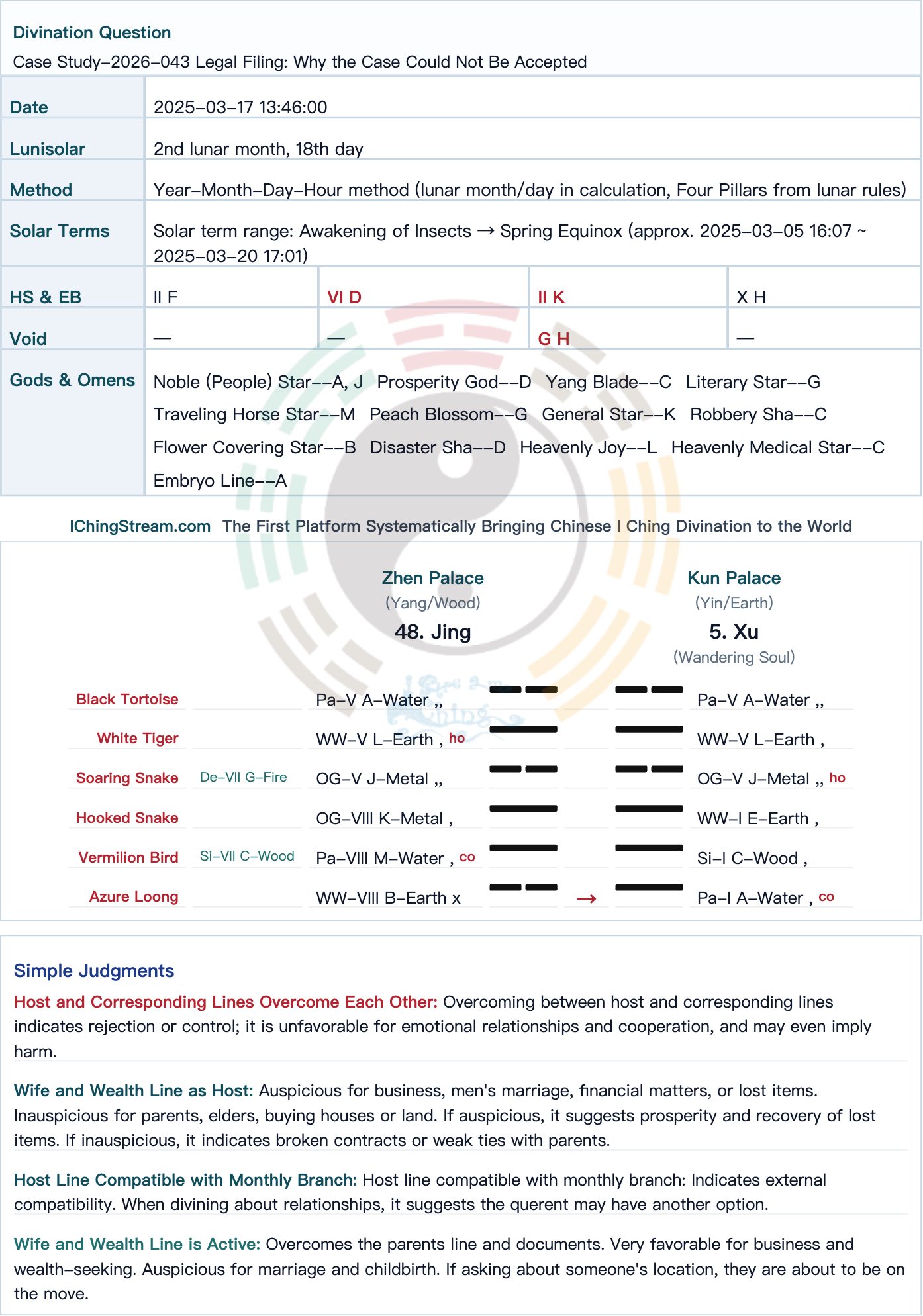
The querent’s wife had joined an online investment platform. When she tried to withdraw the money, the platform claimed that she had made an “operation error” and demanded that she add a large additional investment within a limited time. Only then would withdrawal be allowed. The husband had opposed the investment from the beginning. The hexagram obtained was Kan.

Judgment: The overall hexagram image first showed deep danger and entrapment. The hexagram obtained was Kan, repeated water.In addition, this hexagram is a Six Clashes hexagram. When asking about seeking money or recovering lost funds, encountering Six Clashes often indicates scattering, disruption, and failure to gather the matter back. It was similar to a pig-butchering scam.

In general, when seeking wealth, receiving Kan or a hexagram from the Kan Palace is unfavorable for wealth. However, the final judgment still depends on whether the wife and wealth line, as the significator for money, is prosperous and supportive. By contrast, when seeking wealth, receiving hexagrams from the Xun or Zhen Palace can often give a more favorable overall image for wealth.

To judge whether the money could be recovered, the wife and wealth line was taken as the significator. The host line, representing the querent’s side, was the sixth-line siblings A water. It aligned with White Tiger and was also void in the cycle, because A and B were void. The siblings line is the god of robbing wealth. When siblings hold the host line in a wealth recovery question, it already suggests loss of money. Its alignment with White Tiger further showed worry, damage, distress, and a painful financial matter.

The corresponding line, representing the money and the opposite side of the matter, was the third-line wife and wealth G fire. In this context, it matched an online platform using messages and excuses to demand more money.

The host line siblings A water and the corresponding line wife and wealth G fire formed an A and G clash. The host and corresponding lines were not only in a water and fire overcoming relationship, but also directly clashed with each other. This showed that the money and the querent’s side were in a state of opposition, rejection, and separation. Consequently, the money was not moving toward the querent.

The condition of the significator was also extremely weak.The wealth line was declining, drained, and overcome, with no vitality.

The platform’s demand for additional investment also matched the hexagram image. The wife and wealth line was weak and overcome, while the host line was siblings A water, the god of robbing wealth. Thus, the so-called additional payment was not a solution, but another layer of the trap.

Conclusion: The money could not be recovered. The overall image of Kan showed danger and entrapment, while Six Clashes indicated scattering and failure to gather the matter back. The host line was siblings A water, the god of robbing wealth, aligned with White Tiger and void in the cycle, showing loss, distress, and lack of effective control. Therefore, the money already invested was extremely unlikely to return.

Feedback: The actual result matched the judgment.In the early stage, the wife had invested a total of 70,000 RMB. Because the wife strongly refused to report the matter to the police, the querent ultimately chose not to report it. He made this decision partly to preserve her dignity and partly to let her learn a serious lesson. In the end, the money was not recovered.

I Ching Divination Basics III. Part 3.2.1: Installing the Stems and Branches onto the Six Lines

Disclaimer:

All personal information in this case study has been anonymized or omitted. This case study is provided for learning and reference only. It is not intended as medical, veterinary, legal, financial, investment, or other professional advice.

III. Arranging the Six Lines Chart

After a hexagram is cast, the next step is to install the necessary components onto the Six Lines chart. One of the most important steps is installing the Heavenly Stems and Earthly Branches onto each line.

In Six Lines divination, each trigram has a fixed pattern of Stems and Branches. The assignment changes depending on whether the trigram appears as the inner trigram or the outer trigram. Specifically, the inner trigram refers to the lower three lines of the hexagram. In contrast, the outer trigram refers to the upper three lines.

The rules are as follows.

When Qian is the inner trigram, the first line begins with I A, the second line is I C, and the third line is I E.

When Kun is the inner trigram, the first line begins with II H, the second line is II F, and the third line is II D.

When Kan is the inner trigram, the first line begins with V C, the second line is V E, and the third line is V G.

These assignments are not optional decorations. Instead, they form the technical foundation for later steps in the Six Lines chart.

Therefore, before judging a hexagram, one must first identify the inner and outer trigrams correctly. After that, install the corresponding Stems and Branches line by line.

For the complete practical reference charts used in hexagram interpretation, including key tables for Six Lines divination, please visit https://www.ichingstream.com/reference-charts/.

You may also bookmark this page and the Chinese Perpetual Calendar at https://www.ichingstream.com/perpetual-calendar/ for convenient reference during future practice.

The Birth of Yi Mao: An Enduring Classic of I Ching Divination

In the previous post, we shared Cheng Liangyu’s own Author’s Preface to Encompassing I Ching Divination (Yi Mao, 《易冒》).

That preface allowed us to hear Cheng Liangyu speak in his own voice. He told us how he lost his sight at the age of five, turned from medicine to I Ching divination, studied under Zhang Xingyuan, received further instruction from the Kupao Elder, compared earlier works, verified methods through practice, and finally began writing because he feared that the deeper reasoning of I Ching divination might not be transmitted clearly to later generations.

Today, I would like to share another preface, one that moves the story into a deeper and more painful place.

This is Wang Zehong’s Preface to Yi Mao.

Before entering the preface itself, it is worth noting who wrote these prefaces. They were not casual admirers, ordinary clients, or anonymous readers. Wang Zehong was a Qing dynasty official and scholar who passed the imperial examination in 1655 and later served as Minister of Rites. Gu Baowen was also a Qing official and scholar, a successful imperial examination candidate who later served as Censor of the Henan Circuit. Lu Jin was a scholar and poet associated with the Xiling literary circle.

For readers unfamiliar with classical Chinese society, this background matters. The imperial examination system was one of the main paths through which educated men entered official service and the scholarly elite. A preface written by such figures was not merely a polite introduction. It could function as recognition, endorsement, testimony, and transmission. The fact that men of this background wrote for Yi Mao shows that Cheng Liangyu’s work was not treated as ordinary fortune-telling, but as a serious contribution to Yi learning and practical divination.

This also reflects an important cultural background in classical China.  Loyalty, righteousness, friendship, and moral obligation were not abstract ideals. When a friend entrusted a work before death, fulfilling that wish became a matter of honor.

To write a preface in such a context was not merely to praise a book. It was to bear witness, to keep faith, and to help carry a life’s work into the world.

Wang Zehong’s preface should be read within this moral world. Cheng Liangyu entrusted the book to his friends. Hu Lütang helped revise and arrange it. After Cheng Liangyu’s death, his son came in mourning dress to fulfill his father’s final command. Wang Zehong accepted the task because he understood that this was no ordinary request. It was an act of trust, and therefore it required an answer worthy of that trust.

If Cheng Liangyu’s own preface shows the life behind the book, Wang Zehong’s preface shows how the book became a final wish.

We also see the grief of his son, who came in mourning dress after his father’s death, holding a copy of Yi Mao, and asking Wang Zehong to fulfill his father’s final instruction.

This is one of the most moving moments in the entire set of prefaces.

Below is the full Wang Zehong’s Preface to Yi Mao from the upcoming I Ching Stream English edition.


Wang Zehong’s Preface to Yi Mao

When I[1] was in Chang’an, I had already heard of Master Cheng Yuanru’s virtue. Only ten years later did I finally have the chance to visit him at his home. Yuanru declined, citing illness. Through Hu Lütang’s introduction, I visited twice more, and only then did Yuanru come out to receive me. Listening to his discourse, I realized he belonged to the same company as the likes of Junping[2] of old. From that time on, I visited his home often. Although Yuanru lay ill in bed, he would always force himself to rise, sit with me, and talk at length without fatigue.

One day he said to me: “At five, I lost my sight from smallpox and could not pursue the examination path. I studied medicine but failed, and only then began studying the Yi. At first I studied under Master Xingyuan. Later in life I encountered the Kupao Elder. We tested and verified matters with each other and gained insight. I had someone write down notes, and over the years it became a book. I only worry that the wording is too verbose and that the meaning may at times repeat. So I have entrusted Lütang to consult with you for revision. When the book is finished, please write a preface for me.” I agreed.

Not long after, Lütang died. Yuanru’s grief deepened. He wept in mourning, and his illness worsened day by day. I went to inquire after him. He could not come out, yet I still marveled at his insistence on rising.

Before long, Yuanru also passed from this world. Alas, how painful. Barely ten days later, someone came in mourning dress, his face dark with grief, holding a copy of Yi Mao. He knelt for a long time, tears streaming, and said: “When my father was near death, he held my hand and solemnly instructed me. I have therefore faithfully followed his final command and come to seek you. I beg you, sir, do not refuse.” How could I bear to decline?

I privately lament that Yi learning today does not perish because people do not study the Yi, but perishes because so many who study it ruin it. Yet those who do not truly study the Yi steal heterodox techniques and call them the Yi. Of all forms of cutting it off, what could be worse? When Chengzi (程颐) transmitted the Yi, he based it on Wang Bi (王弼). Wang Bi derived it from Fei Zhi (费直). Zhu Xi’s (朱熹) Original Meaning was based on Lü Bogong (吕伯恭). The ancient Yi traced back to Tian He (田何). None ever used what is not the Yi to explain the Yi.[3]

Each time he divined a hexagram, he examined the line images, constancy and regret, yin and yang, movement and stillness, and a person’s lifelong good and ill fortune, along with remorse and humiliation, became as clear as fire seen in full view. Because of this, his reputation spread widely. Some even traveled a thousand li[4] to seek a single sentence and then left. Yet Yuanru never dared to think highly of himself. Day after day, he only contemplated images and practiced divination to verify matters through lived experience.

Alas. Among our contemporaries, some achieve prominent position and public renown, and arrogantly style themselves men of letters. Yet when others ask them about the central meaning of the classics they claim to have studied, they cannot even silently recall the chapters and lines, much less grasp their subtle essentials. How could they compare to Yuanru? Moreover, today’s affliction is that scholar officials regard mastering the classics and studying antiquity as pedantic, and instead chase ornate rhetoric and empty acclaim, taking pride in display. None have truly attained meaning, speaking of what lies beyond images and numbers.

As the book neared completion, Lütang and Yuanru died one after the other. Some say that profound meanings and secret principles cannot remain hidden as Heaven and Earth’s private store, or that the disclosure of the mechanism went too far. I say that studying the Yi reduces error. When reflection reaches its utmost, it connects with spirits and the divine.

I have never heard that the Way of Heaven forbids people to awaken deeply within principle and meaning. To hear the Way in the morning and die in the evening is sufficient. If not, then consider Yuanru’s end. His words did not turn to private matters. He held fast to this book alone. Was that love of fame? Rather, he feared later generations might not receive its transmission. So he did not worry for himself, but worried for others. In that case, the earnest intention with which Yuanru repeatedly entrusted this to me is, at last, consoled.

Written in the Middle Autumn Month, the Third Year of the Kangxi Reign (1664 CE)

Wang Zehong of the Anshi clan, Chujiang


Notes

[1] Wang Zehong (王泽弘), courtesy name Juanlai (涓来) and literary name Haolu (昊庐), was a Qing dynasty official and scholar from Huanggang, Huguang. He passed the imperial examination in 1655 CE and later served as Minister of Rites. In Yi Mao, he appears as the author of one of the prefaces. According to his preface, he came to know Cheng Liangyu through Hu Lütang and later wrote the preface at the request of Cheng Liangyu and his family.

[2] Junping refers to Yan Junping (严君平), a Han dynasty I Ching scholar who once practiced divination in the marketplace and was highly respected by later generations. Gongming refers to Guan Gongming, namely Guan Lu (管辂), a famous I Ching scholar and diviner of the Three Kingdoms period, known for his extraordinary skill in divination.

[3] Chengzi (程子) refers here to Cheng Yi (程颐, 1033 to 1107 CE), one of the major founders of Song dynasty Neo-Confucianism and the author of an influential commentary on the I Ching. Wang Bi (王弼, 226 to 249 CE) was a Cao Wei philosopher whose commentary on the Zhouyi became one of the most important interpretive works in the history of Yi learning. Fei Zhi (费直) was a Han dynasty Yi scholar associated with the Fei school of I Ching transmission, which later became an important textual lineage.

Zhu Xi (朱熹, 1130 to 1200 CE) was the central figure of Song Neo-Confucianism and the author of Zhouyi Benyi, or Original Meaning of the ZhouyiLü Bogong (吕伯恭), also known as Lü Zuqian (吕祖谦, 1137 to 1181 CE), was a Southern Song scholar closely associated with Zhu Xi and the scholarly transmission of the classics. Tian He (田何) was an early Han scholar traditionally regarded as a key transmitter of ancient I Ching learning into the Han dynasty.

In this passage, Wang Zehong invokes these figures to emphasize that legitimate Yi learning always developed through recognized textual and scholarly lineages, rather than by using teachings outside the Yi to explain the Yi.

[4] Traditional Chinese distance units varied by period and context, so modern equivalents should be understood as approximate references rather than exact conversions. In the modern standardized system, one li (里) is generally taken as 500 meters, or about 0.31 miles. One zhang (丈) equals ten chi (尺), about 3.33 meters. One chi is about 33.3 centimeters, and one cun (寸) is one tenth of a chi, about 3.33 centimeters. In many premodern texts, these units may not correspond exactly to modern measurements, but they provide a useful sense of scale for the reader.


Reading Wang Zehong’s preface, one can see how Yi Mao entered the world not merely as a manuscript, but as a trust.

Hu Lütang helped revise and arrange the work. Cheng Liangyu held fast to the book at the end of his life. His son came in mourning dress to fulfill his father’s final command. Wang Zehong accepted the task because he understood that this was not an ordinary request, but a responsibility.

This is how an enduring classic is born.

Not only through rules, methods, and technical insight, but through people who believe that a body of knowledge must not disappear.

Wang Zehong’s preface also reveals a deeply Chinese ideal of transmission. A book could be more than a text. It could be a trust between friends, a son’s duty to his father, a scholar’s moral obligation, and a gentleman’s promise to help carry worthy learning into the future.

As I Ching Stream prepares to bring Encompassing I Ching Divination (Yi Mao, 《易冒》) to English readers, we feel deeply honored to continue this line of transmission.

More than three centuries ago, Cheng Liangyu wished that this work be given to the world.

Today, across languages and cultures, we are honored to help carry that wish forward.

May this flame continue to be passed from hand to hand.

A Brief Note for Readers

Encompassing I Ching Divination (Yi Mao, 《易冒》) is scheduled to be added to the I Ching Stream package in early June. Before it is added, the current package remains available at $699 before applicable taxes.

Once Yi Mao is added, the package will expand from 7 to 8 major classical works and collections, and the package price will increase to $849 before applicable taxes. Future additions to this specific package are also planned, including Supplement to the I Ching Forest (Yi Lin Bu Yi, 《易林补遗》), the important classical work traditionally associated with Zhang Xingyuan, Cheng Liangyu’s teacher.

👉 Lock in the current package price before Yi Mao is added:

https://www.ichingstream.com/bundle/