For readers who want to study Six Lines divination more seriously through classical sources, the I Ching Stream Classical Text Package brings together major classical works and collections for Na Jia, Wen Wang Gua, and traditional Chinese I Ching divination.
It helps readers compare methods, study classical cases, understand chart structure, and gradually build a complete view of the Six Lines tradition.
For readers who are just beginning and want a simple first step, we recommend:
👉 Your First Book:“I Ching Divination: A Practical Study Roadmap: A Simplified Guide to the Na Jia Method (Wen Wang Gua), Based on I Ching Divination: Complete and Restored (Zengshan Buyi 增删卜易)”
A practice-first roadmap for setting up charts, learning the core workflow, and building timing-aware judgment with a simplified, beginner-friendly structure.
We encourage rational judgment and respect for modern science. In any real emergency, missing-person case, medical crisis, rescue situation, or life-threatening event, always contact professional emergency services, rescue teams, medical personnel, law enforcement, or other qualified authorities immediately.
Disclaimer: This article is intended solely for academic discussion and methodological analysis of Yi principles and divination interpretation. This case study is provided for educational purposes. We encourage rational judgment and respect for modern science. In any real emergency, missing-person case, medical crisis, rescue situation, or life-threatening event, always contact professional emergency services, rescue teams, medical personnel, law enforcement, or other qualified authorities immediately.
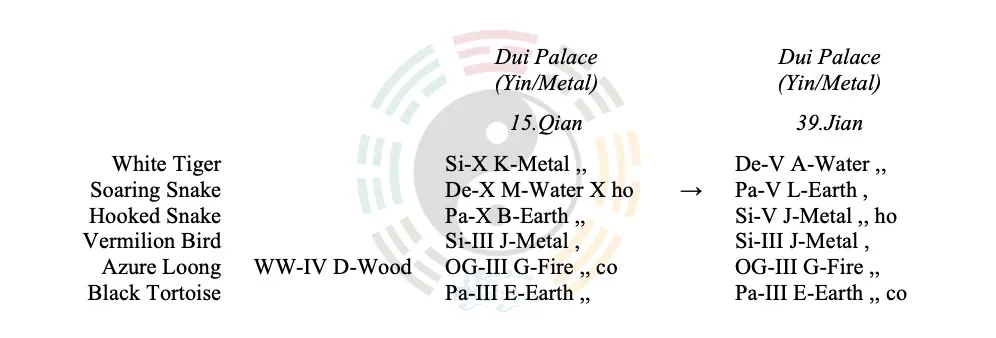
Yesterday, June 19, was the Dragon Boat Festival in China. Watching the exciting dragon boat races held across different regions reminded me of an old dragon boat divination case that had been discussed online many years ago.
This case is especially interesting because it is not about personal relationships, career, wealth, illness, lawsuits, house purchases, or investment. It is a very typical case of direct competition: Village A and Village B were going to compete in a dragon boat race. Would Village A win?
Many people assume that Six Lines divination is mainly used for personal matters, such as relationships, work, health, legal disputes, property, and money. In fact, as long as the question contains clear opposing sides, a win-or-lose structure, or a competitive relationship, Six Lines divination can also be used to judge matches, competitions, selections, examinations, bidding, and even certain election-like or camp-against-camp situations.
The key in this type of reading is not simply “which side looks stronger.” The core lies in the relationship between the host line and the corresponding line. Generally speaking, the host line represents one’s own side, while the corresponding line represents the opposing side. One must then compare the prosperity and weakness of both sides, their movement and transformation, void, break, tomb and extinction, the force of the Six Spirits, and whether the day of the event generates or overcomes either side.
Very often, neither side is in a perfect state. The real question is which side is more severely damaged, and which side is less able to perform at the critical moment.
The World Cup is also taking place recently, and I will later share more Six Lines cases related to the World Cup, sports matches, and win-or-lose judgments. Sports competition cases are excellent for training the ability to compare the host and corresponding lines, read the shifting strength between two sides, judge the influence of the event day, and weigh the relative severity of movement and transformation. They may look lively and entertaining, but they test very fundamental skills.
The following case was cast on the day before the race.
Time of divination: June 17, 2023.
Stem and branch time: X D year, V G month, III G day (void: C and D).
The question was: Tomorrow, Village A will compete against Village B in a dragon boat race. Will Village A win?
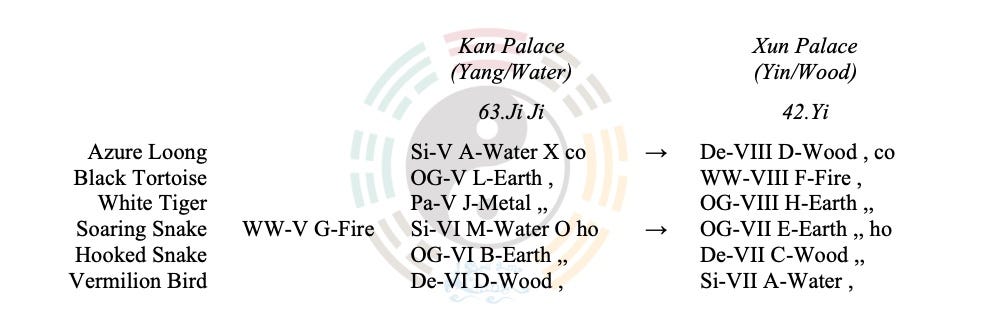
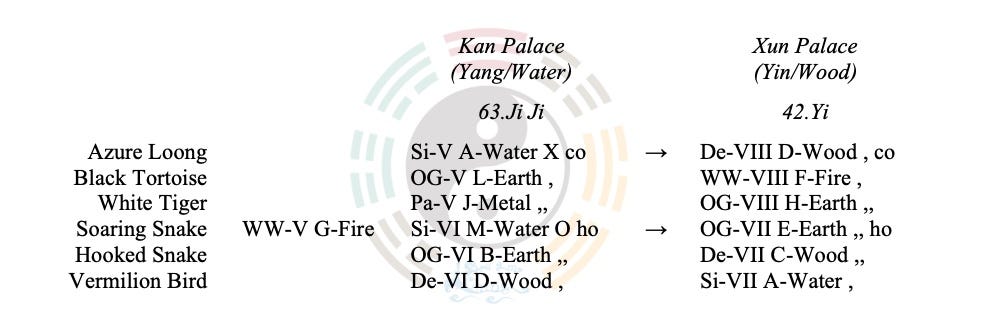
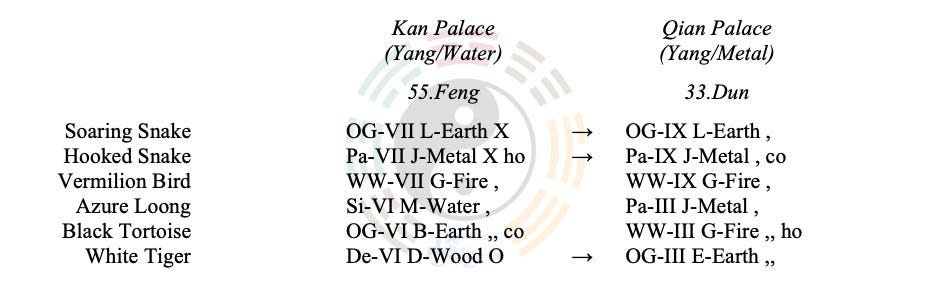
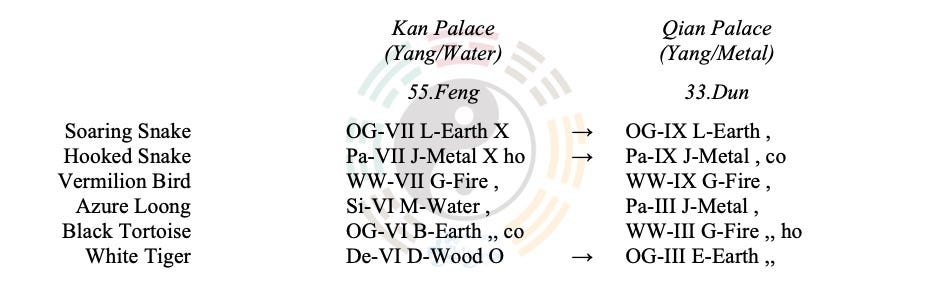
Hexagram obtained: Ji Ji to Yi.
Judgment: After a group discussion among several online participants, the core consensus was that Village A would lose.
1. Host and corresponding line positioning, and the force of the Six Gods
In a competition reading, the host line represents one’s own side, which in this case was Village A. The corresponding line represents the opponent, which was Village B.
In this hexagram, the host line was siblings M water and aligned with Soaring Snake. Soaring Snake can indicate panic, entanglement, abnormality, confusion, and unstable reactions. In a race, this can suggest unstable performance, loss of rhythm, disorder, or a failure to maintain composure.
The corresponding line was siblings A water and aligned with Azure Loong (aka:dragon). Azure Loong indicates joy, smoothness, elevated position, favorable momentum, and victory. In a race, this can be taken as a sign of better morale, smoother performance, and a stronger winning image.
Looking only at the Six Spirits, the opposing side, Village B, already had the upper hand.
2. The core negative image for Village A: returning overcome and movement into the tomb
This was the most decisive sign for judging that Village A would lose.
The host line, siblings M water, was active and transformed into officials and ghosts E earth. In the Five Elements, earth overcomes water. Therefore, the host line transformed into an element that overcame itself, forming returning overcome. In other words, once Village A’s own side became active, it produced a force that turned back to damage itself.
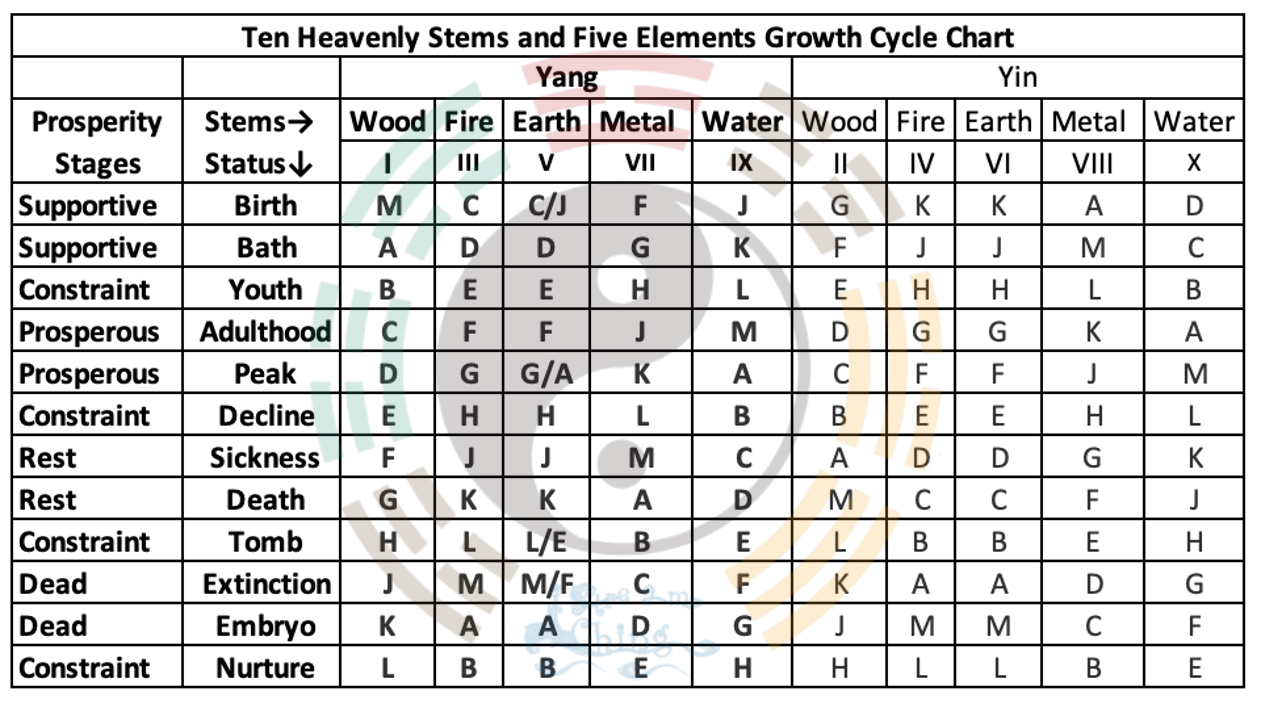
At the same time, E earth is the tomb of water. Therefore, the host line also had the image of moving and entering the tomb. In a race, this structure shows that one’s own side is not only being suppressed, but also likely to have its rhythm locked, trapped, or buried, making it difficult to perform.
This was not merely weak condition. It was self-damage through movement. For a win-or-lose judgment, the host line transforming with returning overcome and moving into the tomb is a very heavy losing image.
3. The event-day timing was also unfavorable to Village A
This hexagram was cast one day before the race, and the question specifically asked about “tomorrow’s” competition. The day of divination was a G day, so the next day was an H day.
The host line was M water, and H earth overcomes M water. Therefore, the H Earth day was an obstacle god that specifically overcame the water host line. This meant that on the actual day of the race, the external timing and objective environment were even more unfavorable to Village A.
Thus, the host line was not only structurally damaged within the hexagram. The day of the race itself further strengthened the pressure against Village A.
4. Both sides were weak, but Village A was more severely damaged
The interesting point in this hexagram is that the opponent’s corresponding line was also in poor condition.
The corresponding line A water was in monthly break and daily break under the G month and G day. It was already damaged. In addition, it was active and transformed into D wood, and D wood was void in the cycle. This showed that the opponent was also not strong or flawless. Village B may also have had weakness, mistakes, or unstable performance.
However, in a win-or-lose reading, one cannot judge only by whether one side has problems. One must compare the severity of damage on both sides.
Although the corresponding line suffered monthly break, daily break, and transformed into void, the host line suffered returning overcome and moved into the tomb. By comparison, the damage to the host line was more direct and more fatal. Both sides may have performed poorly, but Village A’s own damage was heavier, so it was still difficult for Village A to win.
Conclusion: Village A would lose.
The key to this hexagram was not a simple statement that “the corresponding line was good and the host line was bad.” Rather, the key was the comparison of damage between the two sides. The corresponding line was indeed seriously damaged by break and void, but the host line was active with returning overcome, entered the tomb, and was further overcome by the H day on the day of the race. Village A was more severely damaged, so it was unlikely to win this race.
Feedback: The final result confirmed the judgment. Village A lost the dragon boat race.
The value of this case is that it shows an important principle in Six Lines competition readings: victory is not determined by which side is completely undamaged, but by which side can better withstand the timing, which side is less damaged, and which side can still perform at the critical moment.
In sports matches, bidding competitions, exam rankings, selection processes, elimination rounds, and even certain election-like or camp-against-camp situations, this method of host-corresponding comparison and relative damage assessment is extremely important.
Note: Dragon Boat Festival, Qu Yuan, and Traditional Customs
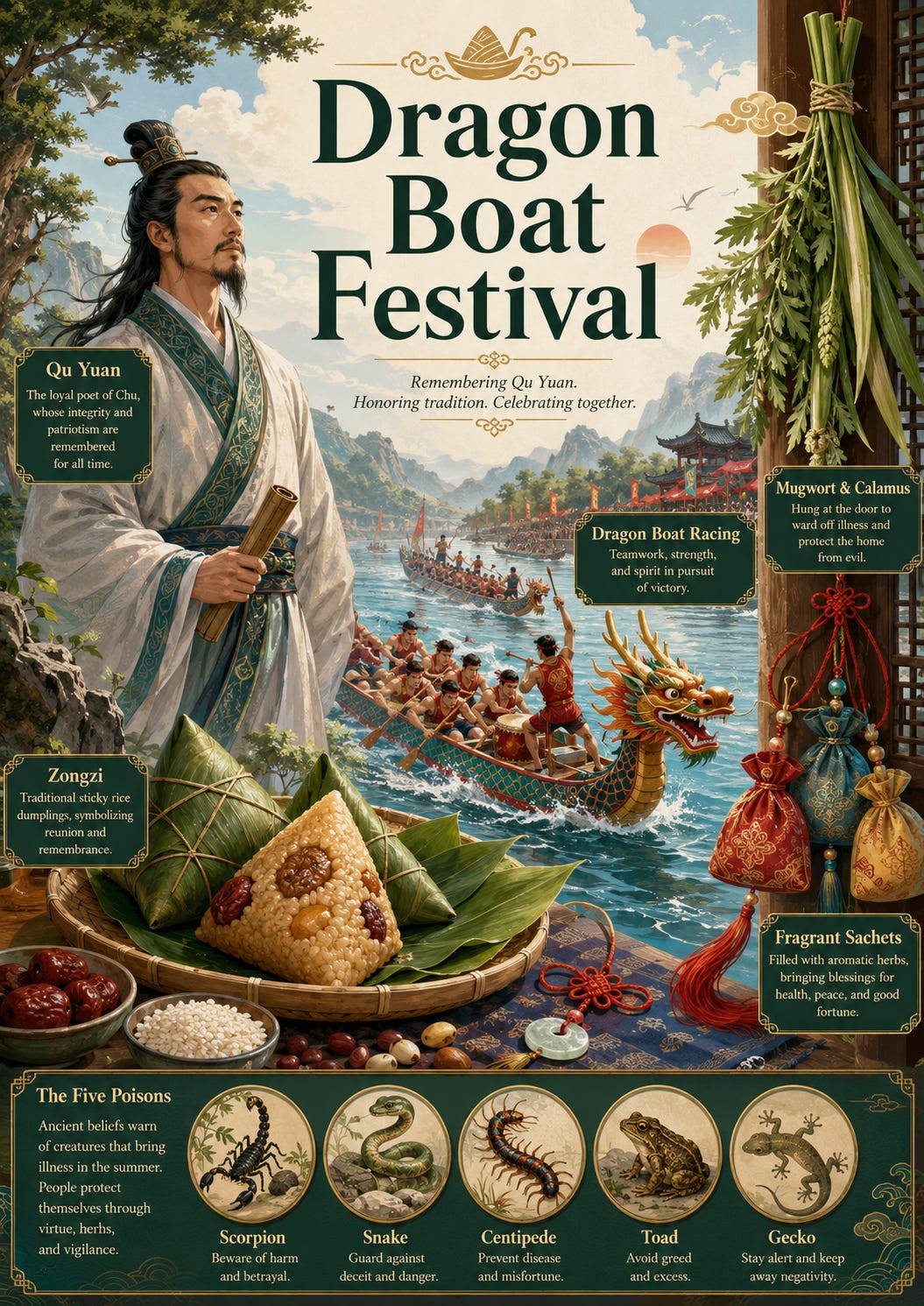
The Dragon Boat Festival is one of the major traditional festivals in China. It is not a festival with only one single origin. Rather, it is a composite festival formed through several thousand years of cultural development. It includes midsummer customs for avoiding illness and harmful influences, protection against the Five Poisons, beliefs connected with dragon and water spirits, water rituals, southern dragon boat traditions, and later commemorations of historical figures.
However, in later Chinese culture, Qu Yuan became the most representative symbolic figure of the Dragon Boat Festival. Today, when many people mention the Dragon Boat Festival, the first things that come to mind are Qu Yuan, dragon boat racing, and zongzi.
Qu Yuan, approximately 340–278 BCE, was a poet and political figure of the State of Chu during the Warring States period. He was loyal to Chu but was repeatedly pushed out of politics, and his political ideals could not be realized. In 278 BCE, Qin forces captured Ying, the capital of Chu, and the State of Chu suffered a major blow. According to tradition, Qu Yuan, devastated by the danger facing his country and the collapse of his ideals, drowned himself in the Miluo River on the fifth day of the fifth lunar month.
According to legend, when the local people heard that Qu Yuan had thrown himself into the river, they rowed out in boats to search for him, hoping to rescue him. This later became one of the most familiar explanations for the origin of dragon boat racing. People also threw rice dumplings into the river, hoping that fish and shrimp would not eat Qu Yuan’s body. This became one of the folk explanations for the custom of eating zongzi.
Qu Yuan came to be remembered not only as a major poet, but also as a cultural symbol of loyalty, moral integrity, and principled responsibility. In later Chinese historical memory, he became one of the most representative figures associated with this ideal personality.
Of course, Dragon Boat Festival customs go far beyond the story of Qu Yuan. In traditional Chinese thought, the fifth lunar month was associated with increasing heat, dampness, insects, and harmful seasonal influences. Therefore, the Dragon Boat Festival also includes customs such as avoiding the Five Poisons, hanging mugwort and calamus, wearing fragrant sachets, drinking realgar wine, and bathing with herbal water. These customs were used to pray for safety and to ward off illness and harmful influences.
The Five Poisons usually refer to poisonous or harmful creatures such as the snake, scorpion, centipede, toad, and gecko. Around the Dragon Boat Festival, the weather becomes warmer, and insects and reptiles become more active. Ancient people therefore developed many seasonal customs for protection and purification. Behind these customs are both folk beliefs and practical observations about season, illness, and environmental change.
Eating zongzi is one of the best-known Dragon Boat Festival customs. There are major regional differences between northern and southern China. Northern zongzi are often sweet, such as red date zongzi or red bean paste zongzi. Southern zongzi are often savory, such as pork zongzi, salted egg yolk zongzi, and braised pork zongzi. Different regions also developed their own festival food traditions based on local ingredients and taste.
On the Chinese internet, people often jokingly argue over whether sweet zongzi or savory zongzi are better. I am from northern China, a region where sweet zongzi are more common, so I originally belonged to the sweet-zongzi side. But after I grew up and tasted savory zongzi with salted egg yolk and braised pork, I converted to the savory-zongzi camp.
For readers who are curious, you can try both sweet and savory zongzi and see which side you belong to. You can also try making them yourself. Wrapping zongzi with friends and then eating them together is one of those small but very happy festival experiences.
Dragon boat racing has an especially strong collective and competitive character. It can be explained as a commemorative reenactment of the effort to rescue Qu Yuan, but it may also be traced to older water rituals, dragon totem beliefs, and customs of exorcism and blessing.
If there are competition, sports, or win-or-lose case topics that interest you, welcome to leave a comment and let me know.
Disclaimer: This article is intended solely for academic discussion and methodological analysis of Yi principles and divination interpretation. We encourage rational judgment and respect for modern science. In any real emergency, missing-person case, medical crisis, rescue situation, or life-threatening event, always contact professional emergency services, rescue teams, medical personnel, law enforcement, or other qualified authorities immediately.
Recently, a reader asked an important question: if Chinese practitioners today use the Great Expansion (Dayan or yarrow stalk) method less often, is it simply because the yarrow-stalk casting procedure is too complicated?
The issue is not only the casting method.
A casting method is only the way to obtain a hexagram. What truly determines the quality of a divination is the interpretive system that follows. Many readers easily confuse “how to cast a hexagram” with “how to interpret a hexagram.” The Great Expansion method has not been completely preserved as a full historical system. What has mostly survived is the yarrow-stalk procedure for obtaining a hexagram. In actual interpretation, the textual path based on the hexagram statements and line statements is relatively clear, but the other, more important half of the Great Expansion tradition — its image-number interpretive method — gradually divided, dispersed, and was partly absorbed into later traditions such as Plum Blossom Divination, image-based interpretation, and other branches of Yi divination.
If a divination method preserves only the casting procedure but lacks a complete corresponding interpretive system, it is difficult to call it a fully preserved tradition. The effectiveness of divination does not depend only on “how a hexagram is obtained.” It also depends on whether one can systematically interpret the images, texts, positions, transformations, timing, and real-world matter shown in the hexagram. Without image-based interpretation and structural judgment, the analysis naturally becomes incomplete.
Of course, no matter which method one studies, the key is not to mechanically apply a few isolated rules. The key is to understand the entire structure of the system, grasp its underlying principles, and apply them flexibly according to the actual hexagram and the real situation. True divination ability comes from the integration of system, principle, and practice.
For this reason, if one wants to study a relatively complete, operable, and trainable system of I Ching divination today, Na Jia Six Lines and Plum Blossom Divination remain two of the more systematically preserved branches in Chinese tradition. Na Jia Six Lines, in particular, is supported by many classical works, including I Ching Divination: Complete and Restored (Zengshan Buyi, 《增删卜易》), The Orthodox Method of I Ching Divination (Bushi Zhengzong, 《卜筮正宗》), Encompassing I Ching Divination (Yi Mao, 《易冒》), and Supplement to the I Ching Forest (Yi Lin Bu Yi, 《易林补遗》). It also has a large number of cases that can be repeatedly studied, verified, and reviewed.
For those interested in ancient Great Expansion divination, ancient divination cases, and image-based interpretation, Studies on Ancient I Ching Divination Cases (Zhouyi Gushi Kao, 《周易古筮考》) is also worth studying. Its author, Shang Binghe, made an important contribution to organizing ancient divination cases and restoring image-based interpretive reasoning. We will also publish related academic research on this subject in the future, further discussing the relationship between ancient image-based divination and later Yi divination traditions. However, Shang Binghe’s work is better understood as an important attempt at recovery and reconstruction. It does not mean that the full ancient interpretive system of Great Expansion divination has already been completely restored.
Today’s house-purchase case happens to show how three approaches can work together:
Hexagram text sets the broad situation.
Image-based interpretation reads the details.
Na Jia analyzes funding and timing.
The main hexagram, Da You, sets a generally favorable overall trend. The transformed hexagram, Bi, shows the image of decoration, furnishing, and later beautification of the property. Multiple parents lines in the hexagram show that there were several property options. Meanwhile, the funding gap, the likely purchase years, and the final timing needed to be judged through the Six Relationships, void and break, movement and transformation, and returning generate within Na Jia.
Therefore, the value of this case is not only whether the house purchase would succeed.
Time of divination: October 18, 2025.
Stem and branch time: II F year, III L month, VII J day (void: A and B).
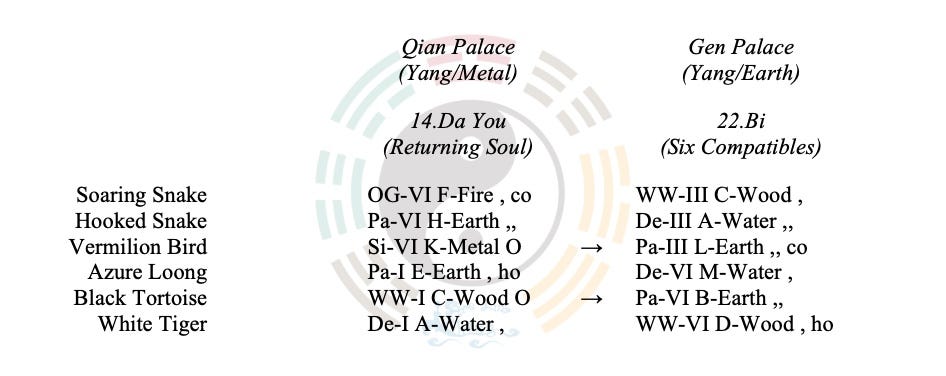
Hexagram obtained: Da You to Bi.
Judgment:The broad image of the hexagram was favorable. The main hexagram was Da You, which carries the image of abundance, possession, and things being broadly available. This showed that the overall trend of the house-purchase matter was not poor.
The property situation was also shown clearly through the parents lines. In Six Lines divination, the parents line represents houses, property, contracts, documents, and real estate paperwork. In this hexagram, the four parents lines E, L, B, and H were all present. This showed that there were multiple property options or house-related possibilities. The third-line parents E earth held the host line, remained still, and aligned with the auspicious spirit Azure Loong. This indicated that the querent had the opportunity to purchase a relatively suitable property in a stable way.
The funding issue was shown by the wife and wealth line. The second-line wife and wealth C wood represented money and available funds. This showed that the current funding for the house purchase had not yet been fully resolved. Therefore, the key timing for the funds becoming available could be seen in the B year or H year.
The purchase timing was shown through movement and returning generate. The fourth-line siblings K metal was active, showing that the querent was already actively planning, comparing options, and pushing the matter forward. K metal moved and transformed into parents L earth, forming returning generate. Since the parents line represents houses, property, and contracts, and the transformed L earth was also the Planning Star[1] of the day, this further showed that the house purchase already had a clear plan and direction. According to the rules of prosperity, movement, and transformation, the theoretical timing for the formal purchase could be seen in the K year or L year.
Conclusion: The house-purchase matter was ultimately likely to succeed.
Feedback: Awaiting further verification.
The key point of this case is not the isolated use of one method. It is the integrated judgment. The hexagram text first sets the general trend of auspiciousness or difficulty. Image-based interpretation then adds details about the property condition and later decoration. Na Jia Six Lines further refines the funding situation, progress of action, and timing. Only when these three are considered together can the reading form a more complete interpretive loop.
Note: [1] The Planning Star is determined by the earthly branch of the day. A common method is as follows: for J, A, and E days, the Planning Star is in L; for F, K, and B days, the Planning Star is in H; for C, G, and L days, the Planning Star is in E; for M, D, and H days, the Planning Star is in B.
The Planning Star governs planning, arrangements, preparation, and strategic intention.
In this hexagram, the day was VII J. The earthly branch was J, and J belongs to the J-A-E structure, so the Planning Star was in L. The fourth-line K metal moved and transformed into parents L earth, exactly producing the Planning Star. Therefore, it could be taken as an image of an existing house-purchase plan and a clear direction of action.
If there are certain themes you would like to see in future case studies, welcome to leave a comment and share what kinds of divination cases interest you most.
Disclaimer: This article is intended solely for academic discussion and methodological analysis of Yi principles and divination interpretation. We encourage rational judgment and respect for modern science. In any real emergency, missing-person case, medical crisis, rescue situation, or life-threatening event, always contact professional emergency services, rescue teams, medical personnel, law enforcement, or other qualified authorities immediately.
Time of divination: March 16, 2026, at 7:00 PM.
Stem and branch time: III G year, VIII D month, VI B day (void: G and H).
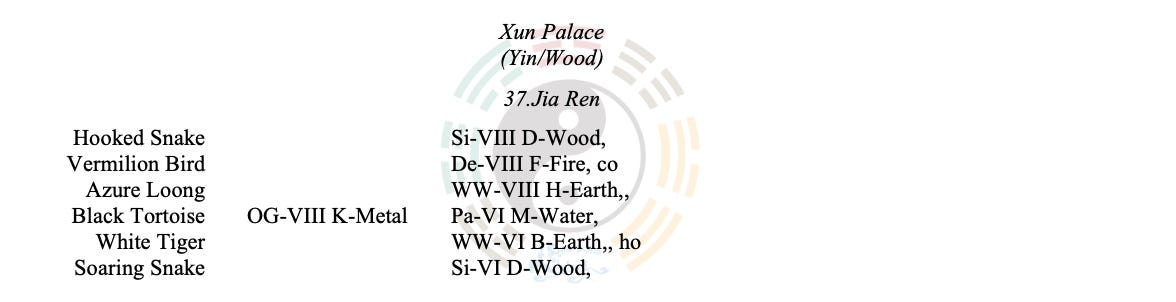
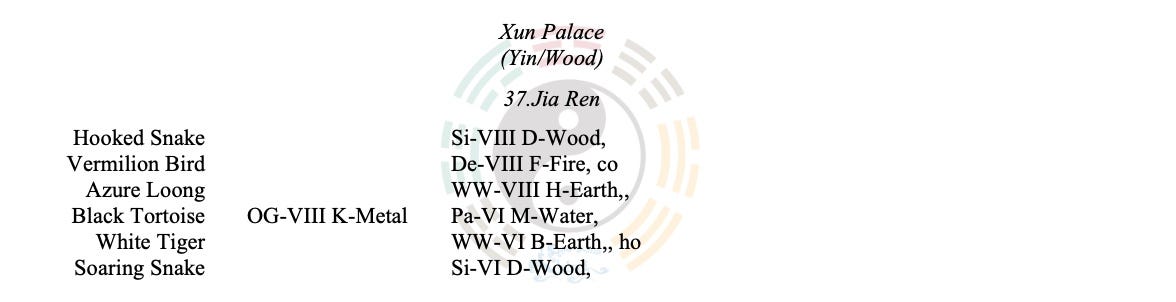
The querent was the boss of a local branch of a private company. The parent company had previously allocated a special employee subsidy fund that was supposed to be distributed to staff, but the querent’s local branch withheld the funds instead of paying them out. Later, this was discovered during an audit by the parent company. Because headquarters was conducting a broad inspection involving many branches, the querent became extremely worried that he would be severely punished. Hexagram obtained: Jia Ren.
Judgment: In this legal and disciplinary dispute, the host line and the inner trigram represented the querent and his own branch. The host line was the second-line wife and wealth B earth. It was strongly overcome by the monthly branch D wood, showing that the branch did have a problem and was under pressure from the audit. However, B earth also coincided with the daily branch B earth and received support from the day. Therefore, although the matter was unfavorable, the host line was not broken or completely damaged. This showed that, within the overall inspection, the querent’s branch had a problem, but the severity was relatively limited.
The other branches could be compared through another line of the same type. The fourth-line wife and wealth H earth, located in the outer trigram, was the same Six Relationship as the host line and could be used to represent other branches involved in the same inspection. This H earth was overcome by the D month and was also clashed by the B day, because B and H clash. This formed the image of being overcome by the month and clashed by the day. Compared with the host line B earth, the fourth-line H earth was in a much more damaged condition. This showed that the problems in other branches were far more serious.
The attitude of the parent company and inspection side was shown by the corresponding line. The fifth-line corresponding line was descendants F fire, representing the inspection side or headquarters. This corresponding line did not overcome the host line. Instead, F fire generated B earth, forming the image of the corresponding line generating the host line. In practical terms, this showed that the parent company did not view the querent’s branch as the worst case. The inspection side still had some room for leniency toward his branch.
Therefore, the judgment was not a severe removal or the harshest disciplinary punishment. The branch had mishandled money, so financial loss or a penalty was difficult to avoid. But the host line was still supported by the day, the corresponding line generated the host line, and the worse damage appeared on the same-type wealth line representing other branches. The likely outcome was financial loss to avoid disaster.
Conclusion: The querent would not be heavily punished. His branch would likely receive a financial penalty, but the hexagram did not show removal from position or the most serious disciplinary outcome. Other branches were in far worse condition and would face much harsher consequences.
Feedback:The actual result matched the judgment. The querent recently reported that the judgment had been verified. Because other branches had acted far more seriously, their leaders were severely dealt with. By comparison, the querent’s own branch appeared less severe, and the final result was only a financial penalty. He was not heavily punished.
If there are certain themes you would like to see in future case studies, welcome to leave a comment and share what kinds of divination cases interest you most.
All personal information in this case study has been anonymized or omitted. This case study is provided for learning and reference only. It is not intended as medical, veterinary, legal, financial, investment, or other professional advice.
III. Arranging the Six Lines Chart
Part 3.2. Installing the Hexagram Components
Part 3.2.3. Installing the Host and Corresponding Lines
After identifying the hexagram name, palace, and generation position, the next step is to install the host line. Next, you install the corresponding line.
In Six Lines divination, the host line is one of the most important positions in the chart. It often represents the querent, the main side of the matter, or the central position.
The corresponding line represents the opposite side, the other party, the object being asked about, or the external side of the matter.
Why is it called the corresponding line? The word “corresponding” means that the line responds to, faces, or matches another line in the opposite trigram. The first, second, and third lines of the lower trigram correspond respectively to the fourth, fifth, and sixth lines. These are the lines of the upper trigram.
In other words:
The first line corresponds to the fourth line.
The second line corresponds to the fifth line.
The third line corresponds to the sixth line.
The first line is the first position of the lower trigram, while the fourth line is the first position of the upper trigram. The second line is the middle position of the lower trigram. Meanwhile, the fifth line is the middle position of the upper trigram. The third line is the upper position of the lower trigram. Similarly, the sixth line is the upper position of the upper trigram.
The intermediary lines stand between the host line and the corresponding line. In practical judgment, they often represent people, matters, conditions, obstructions, procedures, or mediating factors. They may also represent intermediate links standing between the two sides.
For example, in a relationship reading, the intermediary lines may sometimes represent a matchmaker or a third party. In a transaction reading, they may represent an intermediary, a contract, or the movement of funds. They can also represent other intermediate links between the buyer and the seller. In readings about documents, lawsuits, or applications, they may also represent procedures, administrative institutions, or approval processes. In addition, they may represent intermediate obstructions.
Therefore, the host line, corresponding line, and intermediary lines form a basic relational framework within the Six Lines chart.
The host line represents the self-side, the querent, or the main position.
The intermediary lines represent the intermediate factors standing between the host and corresponding positions.
As explained in the previous section, each palace contains eight hexagrams:
Once we know which position the hexagram occupies in its palace, we can determine where the host line is located.
The rule is as follows:
An Eight Pure Hexagram is also called a sixth-generation hexagram. As the name implies, its host line is on the sixth line, that is, the top line.
A 1st Generation (Host) Hexagram has the host line on the first line.
A 2nd Generation (Host) Hexagram has the host line on the second line.
A 3rd Generation (Host) Hexagram has the host line on the third line.
A 4th Generation (Host) Hexagram has the host line on the fourth line.
A 5th Generation (Host) Hexagram has the host line on the fifth line.
A Wandering Soul Hexagram has the host line on the fourth line.
A Returning Soul Hexagram has the host line on the third line.
Therefore, the palace position tells us where to place the host line.
The corresponding line is then determined by line pairing:
If the host line is on the first line, the corresponding line is on the fourth line, and the second and third lines are the intermediary lines.
If the host line is on the second line, the corresponding line is on the fifth line, and the third and fourth lines are the intermediary lines.
If the host line is on the third line, the corresponding line is on the sixth line, and the fourth and fifth lines are the intermediary lines.
If the host line is on the fourth line, the corresponding line is on the first line, and the second and third lines are the intermediary lines.
If the host line is on the fifth line, the corresponding line is on the second line, and the third and fourth lines are the intermediary lines.
If the host line is on the sixth line, the corresponding line is on the third line, and the fourth and fifth lines are the intermediary lines.
Installing the host and corresponding lines is not a minor charting step. It establishes the basic relational structure of the entire chart.
These include installing the Six Relationships, identifying the significator line, and judging generation, overcoming, clash, compatibility, void, break, tomb, movement, and transformation.
With this release, another major classical work of Six Lines Divination, Wen Wang Gua, and the Na Jia Method is now available to English-language readers.
For readers who have followed the previous posts in this series, Yi Mao is not only another old divination book. It is a text with a very special position in the classical Six Lines system.
It is neither a brief manual that only presents formulas, nor a simple collection of divination cases. Rather, it begins from the foundations and explains how the method is established, how its reasoning unfolds, and how it should be applied in actual judgment.
This is exactly where Yi Mao stands out.
In many classical Six Lines texts, the steps of reasoning are often omitted for the sake of brevity.
Yi Mao helps fill that gap.
It clarifies the key links, explains the basis of judgment, and uses examples to help the reader follow the logic.
A Classical Text with Recognized Authority
Yi Mao circulated in multiple engraved editions during the Qing dynasty, including editions from the Qianlong period and the Guangxu period. It was also preserved in the Wenyuan Pavilion copy of The Complete Library of the Four Treasuries (Siku Quanshu, 《四库全书》), the monumental imperial collection compiled under the Qing court to gather, classify, edit, and preserve the major works of Chinese textual tradition.
Its inclusion in this official collection reflects the recognized authority of Yi Mao and its importance as a base text for later research, compilation, and transmission.
For serious students of Six Lines Divination, Wen Wang Gua, and the Na Jia Method, the difficulty is often not only terminology. The deeper challenge is understanding the judgment logic behind the terms.
Yi Mao is valuable because it repeatedly explains that logic.
Cheng Liangyu and the Transmission Behind Yi Mao
The author of Yi Mao was Cheng Liangyu (程良玉), courtesy name Yuanru (元如), from Xin’an.
According to his own preface, Cheng Liangyu lost his sight due to illness in childhood and remained blind for the rest of his life. His family once encouraged him to study medicine, but he soon realized that medicine depends heavily on observation, discernment, and clinical judgment, all of which were extremely difficult for a blind person.
He therefore turned his attention fully to the study of the I Ching.
Cheng Liangyu studied under the well-known diviner Zhang Xingyuan (张星元). Zhang Xingyuan was also traditionally associated with Supplement to the I Ching Forest (Yi Lin Bu Yi, 《易林补遗》), another important classical text of I Ching divination that I Ching Stream also plans to publish.
This matters because Yi Mao did not emerge in isolation.
It belongs to a chain of learning: teachers, earlier texts, hidden transmitters, practical verification, and later correction. Cheng Liangyu also encountered the Kupao Elder (枯匏老人), received further instruction, and expanded his work into a more complete system combining principle, image, number, and divination in judgment and application.
He argued that the sages established methods in order to open the ignorance of later generations. If one receives the teaching and then hides it again, what benefit is there in obtaining it alone?
This reveals the deeper spirit behind Yi Mao.
Why Yi Mao Is Important
The value of Yi Mao lies especially in three areas.
First, it explains the foundations in detail.
Second, Yi Mao gives extensive attention to subtle distinctions. In actual Six Lines Divination, the most common difficulty is often not that the practitioner knows no rules at all, but that the relative weight, truth or falsity, sequence, and conditions of application among those rules are unclear. For example, among void in the cycle, monthly break, transformation into extinction, clash scatter, flying gods, hidden gods, mutual hexagrams, and transformed hexagrams, which conditions are genuine, which are partial, and which should be weighed lightly?
Yi Mao repeatedly addresses these questions.
Third, Yi Mao treats time factors in a concrete way. Cheng Liangyu emphasizes prosperity and decline, seasonal timing, the time of divination, and the time when the matter occurs. This is especially helpful for learners who only know how to apply the monthly command and daily branch mechanically.
In addition, Yi Mao includes a large number of divination topics and more than 110 verified cases. It is not only a theoretical work, but also a text with strong practical value.
Its angle of explanation differs from Golden Strategy (Huangjin Ce, 《黄金策》), I Ching Divination: Complete and Restored (Zengshan Buyi, 《增删卜易》), The Orthodox Method of I Ching Divination (Bushi Zhengzong, 《卜筮正宗》), and other classics. These works supplement one another.
The value of the classics lies in reading them together, comparing their methods, and testing their principles through practice.
Principle, Number, and the Missing Technical Dimension of the I Ching
In Lu Jin’s preface, Cheng Yuanru explains that the sages exhausted principle and number, using number to make principle manifest and using principle to guide number. He also points out that people today do not understand image and number, yet recklessly speak of the principles of the Yi.
This point is especially important for modern readers.
These dimensions are valuable, but they do not exhaust the living divinatory tradition of the I Ching.
This dimension has often remained incomplete or inaccessible in English.
That has created a long-standing gap.
It does not replace philosophical understanding.
In this sense, Yi Mao is not merely another old divination book.
It is a bridge between principle and technique, between the visible and the hidden, and between classical Chinese learning and readers who have long lacked access to this complete system in English.
How to Read Yi Mao within the I Ching Stream Series
From the perspective of a learning path, I recommend reading the major Six Lines texts in a connected order.
First, read I Ching Divination: Complete and Restored (Zengshan Buyi, 《增删卜易》) to establish the basic framework of Six Lines judgment.
Then read Yi Mao to supplement many concepts, reasons for distinction, and layers of detail.
Finally, read The Orthodox Method of I Ching Divination (Bushi Zhengzong, 《卜筮正宗》) to consolidate, deepen, and correct many common problems beginners encounter in actual judgment.
After these main works, readers will find it easier to integrate Fire Pearl Forest (Huo Zhu Lin, 《火珠林》), Undersea Eye (Haidi Yan, 《海底眼》), The Complete Book of Divination (Bushi Quanshu, 《卜筮全书》), Supplement to the I Ching Forest (Yi Lin Bu Yi, 《易林补遗》), and other texts.
Why This Translation Matters Now
One reason is that it is not a quick-start book. Its real value lies in its reasoning process, its detailed distinctions, and its explanations of concepts.
Through Yi Mao, readers can more clearly understand the principles behind many basic concepts, rather than merely memorize surface-level rules.
Today, across languages and cultures, this concern still has meaning.
If the classical technical tradition remains locked within difficult Chinese texts, many sincere students around the world can only approach the I Ching from the outside.
Yi Mao Is Now Live
The full English edition of Encompassing I Ching Divination (Yi Mao, 《易冒》) is now available here:
With this release, the I Ching Stream classical library adds another major layer to the English reconstruction of Six Lines Divination, Wen Wang Gua, and the Na Jia Method.
This is not only the release of one book.
It is another step toward making the classical technical tradition of I Ching divination available as a connected system for English-language readers.
Final Bundle Reminder
Because Yi Mao is now live and will be added to the I Ching Stream Bundle, this is the final opportunity to lock in the current bundle price.
The current Bundle price is still:
$699.99 before applicable taxes
Once Yi Mao is added to the Bundle, it will expand from 7 to 8 major classical works and collections, and the price will increase to:
$849.99 before applicable taxes
If you have been considering the Bundle, this is the last window to purchase at the current lower price.Bundle link:
Disclaimer: This article is intended solely for academic discussion and methodological analysis of Yi principles and divination interpretation. We encourage rational judgment and respect for modern science. In any real
emergency, missing-person case, medical crisis, rescue situation, or life-threatening event, always contact professional emergency services, rescue teams, medical personnel, law enforcement, or other qualified authorities immediately.
As admission season arrives in both China and overseas, many students are facing the same difficult question: which school should they choose? Moreover, which path seems more suitable and more promising? For students applying to graduate programs, the decision is often not only about academic preference. It is also about location, future career direction, and practical life arrangements.
Background: The querent was originally from one place but was currently working in another. She was preparing for the graduate school entrance examination and needed to choose among University A, University B, and University C. She therefore made several divinations to ask about the prospects of each school. Later, after the written exam, she also asked whether she would ultimately be admitted.
The key point of this case is not only whether she could be admitted. More importantly, it shows how, when facing multiple options, one may cast separate hexagrams for different choices and compare the strengths and weaknesses of each path. It also shows that when the result is already approaching and the querent is in a state of strong anxiety, one must determine whether the hexagram is answering the objective result. Otherwise, it may simply be reflecting the querent’s mental state.
First Reading: Applying to University A
Time of divination: October 19, 2025.
Stem and branch time: II F year, II K month, VIII K day (void: A and B).
Hexagram obtained: Feng to Dun.
Judgment:In readings about examinations, academic study, and admission, the parents line is usually taken as the significator. This is because the parents line represents examinations, documents, materials, admission papers, and academic credentials. Since graduate school admission is also related to future career development, the officials and ghosts line should also be considered. The officials and ghosts line can represent position, title, qualification, and the development direction after admission. In addition, it is also the source god of the parents line.
On the surface, the parents J metal was prosperous and supportive. It aligned with the monthly branch and was also the same earthly branch as the daily branch. This showed that the querent’s examination foundation, documents, and academic qualifications were not weak. In other words, the problem was not that the querent herself had no ability. Nor was it that she had no chance in graduate school admission as a whole.
However, the key problem was that the corresponding line, representing University A as the target school, was void in the cycle. In this reading, the question was not merely whether the querent had examination ability. Instead, it was about whether University A was the right target. Since the corresponding line represented the target side and was void, it showed that this specific school was not solid. It was not connected and was difficult to obtain. Therefore, although the parents line was strong, the target of University A itself was empty.
The sixth line was also active, and the active line was near the host line. At the same time, the officials and ghosts line and the parents line were both active, and the officials and ghosts line generated the parents line. These signs showed that the key forces related to examination, school, and future career development were moving closer to the querent’s current living and working environment. They were not moving toward her hometown.
This made University A less convincing as the priority choice. Meanwhile, the later readings would be needed to compare the other options more clearly.
Second Reading: Applying to University B
Time of divination: October 27, 2025.
Stem and branch time: II F year, III L month, VI F day (void: L and M).
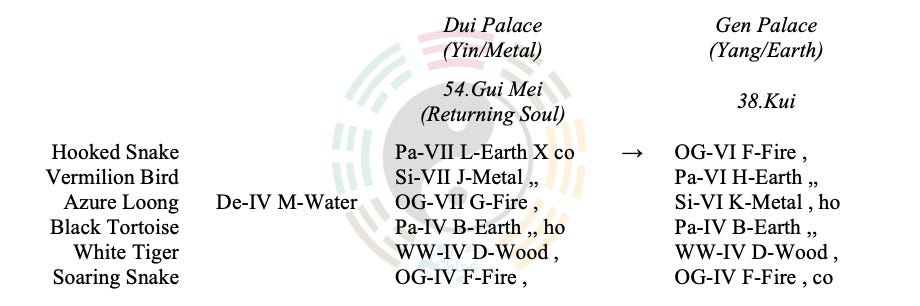
Hexagram obtained: Gui Mei to Kui.
Judgment:This hexagram again showed the image of “a prosperous significator and a strong host line,” and it was even clearer than the first reading. For an examination reading, the parents line was still taken as the significator. In this hexagram, the host parents B earth was prosperous and supportive. It received support from the monthly branch and generation from the daily branch, so the significator was very strong.
😄Thank you all for your support, and thank you for your patience. We know many of you have been waiting for this.
Next week, the package price will increase to $849.99. If you are interested, this is the final window to pre-order at the lower price.
Early buyers lock in the lower price and receive more benefits as the package continues to expand.
The package currently includes 7 major classical works and collections. After Encompassing I Ching Divination (Yi Mao, 《易冒》) is added, it will include 8 major classical works and collections. At that point, the package price will increase to $849.99 before applicable taxes.
The estimated individual value of these 8 titles is around $1,309 before applicable taxes. By locking in now at $699.99 before applicable taxes, readers secure access to the current package and Yi Mao once added. In addition, they receive future books and selected materials added to this specific package without paying the later increased package price.
In short: early buyers can lock in long-term access to the major Six Lines divination classical texts at today’s lower package price.
Package buyers also receive free lifetime access to our private Discord study group, expected to begin formal operation in the second half of this year.
If you purchase the package together with our I Ching Divination Foundations pre-order course, you may also receive an additional study bonus. The course is currently available at the pre-order price, and the price will also increase after its official release.
👉 Lock in the current $699 package price before Yi Mao is added:
👉 Your First Book:“I Ching Divination: A Practical Study Roadmap: A Simplified Guide to the Na Jia Method (Wen Wang Gua), Based on I Ching Divination: Complete and Restored (Zengshan Buyi 增删卜易)”
A practice-first roadmap for setting up charts, learning the core workflow, and building timing-aware judgment with a simplified, beginner-friendly structure.
Disclaimer: This article is intended solely for academic discussion and methodological analysis of Yi principles and divination interpretation. We encourage rational judgment and respect for modern science. In any real emergency, missing-person case, medical crisis, rescue situation, or life-threatening event, always contact professional emergency services, rescue teams, medical personnel, law enforcement, or other qualified authorities immediately.
This case study is provided for learning and reference only.
Learning I Ching divination requires studying a large number of cases. Although all things in the world change according to underlying patterns, their outward forms are infinitely varied. Only through repeated study and deduction from real cases can we gradually calibrate our judgment.
In this sense, the process is similar to the training of modern large AI models. Through theory combined with extensive case analysis, we continuously train our own model-like understanding of how things develop and change. Studying I Ching divination also helps us think about problems from more angles.
The I Ching describes the patterns of change in all things.
In Chinese tradition, Yi learning includes the Three Yi: Lian Shan, Gui Cang, and Zhou Yi. The Zhou Yi is the best-preserved and most continuously used system today.
Within our current textual and cognitive range, Yi learning gives us a way to observe, model, and interpret change.
Today’s case is a solemn one. It concerns a rescue team’s search for a missing elderly woman and the question of her life-or-death condition.
Time of divination: August 24, 2013.
Stem and branch time: X F year, VII J month, IX L day (void: A and B).
Question: A rescue team asked about the current condition of the missing person they were searching for, a 93-year-old woman. Hexagram obtained: Qian to Jian.
Judgment:In a divination about a specific missing person, the corresponding line can be taken as the significator. In this hexagram, the corresponding line was G fire, representing the missing elderly woman. G fire was extremely weak in both the J month and the IX L day. More importantly, it directly entered the tomb of the daily branch L earth.
The obstacle god was active and directly overcame the already powerless significator. In this hexagram, M water was the only active line, and it directly overcame the significator G fire. The transformed L earth could not fully restrain it.
After learning that the missing person was a 93-year-old woman, the parents line was also examined for further confirmation. In this case, the parents line B earth could represent an elder. Although B earth received some support from the daily branch L earth, the relationship between B and L was punishment. More critically, B earth was void in the cycle, because A and B were void. In this context, the void image suggested that the person was no longer present.
The parents line also encountered Growth in the Twelve Stages of Life, which became a further ominous image in this specific context. In ordinary contexts, Growth may be positive, but in a reading about the survival of a very old missing person, it may suggest that this life has ended and another cycle is beginning.
The Six Gods also gave concrete images related to death and burial. The significator G fire aligned with Azure Loong. In auspicious cases, Azure Loong often represents celebration, vitality, or fortunate signs. But in this extremely ominous life-and-death structure, Azure Loong was taken more concretely as “paper money” burned for the deceased.[1]
The parents B earth aligned with Hooked Snake. Hooked Snake belongs to the earth image and can indicate accumulation, mounds, and earth formations.
Conclusion:The judgment was extremely unfavorable.The parents line was void, encountered Growth in a life-and-death context involving an elderly person, and the Six Gods produced concrete images of paper money and a grave mound. Taken together, these signs suggested that the missing elderly woman had most likely already passed away.
Feedback:Sadly, the actual result confirmed the grave signs shown in the hexagram. The rescue team eventually found the missing 93-year-old woman, but she had already passed away.
NOTE:
[1] Chinese Culture Note: Qingming, Burning Paper, and Crossroads
In Chinese folk culture, after a family member or loved one passes away, descendants often express grief and remembrance through rituals such as making offerings, burning paper money, and offering food. During the annual Qingming Festival, many families also visit graves, sweep tombs, worship ancestors, and burn paper offerings to remember deceased relatives and ancestors.
What is commonly called “paper money” is understood in folk belief as money or material support sent to the deceased or ancestors for use in the world of the dead. It may be burned at gravesites, cemeteries, or ancestral tombs, but it may also be burned at crossroads, roadsides, or other specific places. This is why some foreign visitors in China, especially around April, may wonder why people are burning paper on the street.
If someone is seen burning paper at a crossroads, it is not always related to Qingming ancestor worship. Sometimes it may be because someone in the family has recently passed away, and relatives are burning paper for the deceased at a specific place. It may also happen when the family cannot go to the gravesite, or when local custom requires offerings to be sent at a roadside or crossroads. In Chinese folk belief, crossroads are places where paths meet, and they are often viewed as places where the living and the dead, or different kinds of spirits, may pass through. Burning paper there symbolizes sending offerings and paper money to the place where the deceased can receive them.
There is also a Chinese folk belief called the “first seven days (头七),” referring to the seventh day after a person’s death. The details vary by region, but a common idea is that within a certain period after death, the spirit of the deceased may still be attached to family members or may return to familiar places. During this time, family members may hold rituals, burn paper, and make offerings to express farewell and comfort.
Many Chinese folk stories, supernatural tales, dramas, novels, and literary works draw from this system.
Pure Brightness (Qingming, 清明) itself is one of the Twenty-Four Solar Terms in China. It usually falls between April 4 and April 6 in the Gregorian calendar. However, its date in the Chinese lunar calendar changes from year to year.
The traditional Chinese calendar is a lunisolar system. It considers both the moon’s phases and the solar-term system formed by the sun’s movement.
For example, one must determine which stem and branch correspond to the year, month, day, and hour. The stem-branch system is not merely a set of ordinary date labels. It is closely related to ancient astronomical observation, seasonal timing, and calendrical calculation.
Therefore, in traditional Chinese divination, time is not a neutral number. It carries information about yin-yang, the Five Elements, solar terms, and the state of qi. The stem-branch system is also a foundational part of learning I Ching divination and the Six Lines Na Jia method. If you are interested in learning more, you can read our Basics column, especially this article and the surrounding lessons, to build a basic understanding of the Heavenly Stems, Earthly Branches, solar terms, and divination timing:
If there are certain themes you would like to see in future case studies, welcome to leave a comment and share what kinds of divination cases interest you most.
All personal information in this case study has been anonymized or omitted. This case study is provided for learning and reference only. It is not intended as medical, veterinary, legal, financial, investment, or other professional advice.
Together, those first two prefaces show us how Yi Mao was written and entrusted.
Today, I would like to share two more prefaces: Lu Jin’s Preface to Yi Mao and Gu Baowen’s Preface to Yi Mao.
These two prefaces answer another important question:
Why did Cheng Liangyu’s contemporaries regard him as more than an ordinary fortune-teller?
Some readers approach the I Ching mainly through philosophy, symbolism, ethics, or the Judgment and Line statements. Others may see practical divination as something secondary, popular, or merely superstitious.
But the prefaces to Yi Mao show a different classical Chinese understanding.
For Lu Jin and Gu Baowen, Cheng Liangyu’s mastery of divination was not outside Yi learning. It was one of the ways Yi learning became visible, testable, and useful in the world.
This is why Yi Mao is more than a manual of techniques.
It is a bridge between principle, number, image, method, and living practice.
Below are the full prefaces by Lu Jin and Gu Baowen from the upcoming I Ching Stream English edition.
Lu Jin’s Preface to Yi Mao
When I[1] was still a boy, I heard that in Xin’an there was a Master Cheng Yuanru who was skilled in divination. He lived in seclusion to the west of our Hangzhou city, yet carriages and horses crowded before his door as if at a marketplace. Even when the sun had already declined toward evening, he still could not lower the curtain and rest. My friend Hu Lütang repeatedly praised this man, so I once followed along and secretly observed him. His appearance was tall and imposing, and his speech flowed like a river. I knew in my heart that he was not of the ordinary class of fortune-tellers and diviners.
Later, Yuanru moved outside the city wall and lived near me as a neighbor, so our friendship became increasingly close. From time to time, we visited one another, and I heard his broader discussions. Even aged scholars and seasoned Confucians could not match him. I privately thought: Jing (Jing Fang, 京房),[2] Jiao (Jiao Yanshou, 焦延寿), Guan (Guan Lu, 管辂), and Guo (Guo Pu, 郭璞) were all deeply skilled in the numbers of the Yi and became renowned through their writings. Yuanru, though blind, possessed such extensive learning. If he had not long possessed a spiritual understanding, how could he have reached this level?
People said, “Yuanru is skilled in numbers. He keeps them secret and does not reveal them, merely concealing his words within ordinary conversation.”
Yuanru smiled and replied, “The sages exhausted principle and number, using them for principle. Later worthies exhausted number and principle, making principle manifest through number. How could this be appropriate?
“People know that what principle shows to others is manifest, while what number tells to others is subtle. Fortunately, I encountered Master Xingyuan and the Kupao Elder. I deeply studied the books and numbers of the sages and worthies, and from them searched for principle.
I knew that Yuanru was probably a man who had attained the Way. Even Jizhu[3] and Junping might not have surpassed him.
Yuanru said, “To go is not difficult. But the Way of divination has long followed inherited dregs and has not yet exhausted its profundities. I have received the transmission of my teachers and wish to establish words to ask the world. I have held this intention for nearly twenty years, yet in the end I have not completed it. What am I to do?”
The clerks said, “We will ask on your behalf. There will be enough time for you to complete your matter.”
When he awoke, he immediately exerted himself to write the book. He entrusted it to Lütang for punctuation and arrangement.
Alas. To establish words and transmit them to the world is an achievement that benefits humanity. Yuanru held this aspiration for nearly twenty years, yet its completion was so difficult.
This cannot be falsely denied. Those who read Yi Mao will naturally understand this in their own hearts. It is not merely because my friendship with him was deep that I privately praised him in this way.
Respectfully Written in the Middle Autumn Month, the Jiachen (I E) Year of the Kangxi Reign (1664 CE)
Lu Jin, courtesy name Jinsi, of Xiling
Notes to Lu Jin’s Preface
[1] Lu Jin (陆进), courtesy name Jinsi (荩思, also written 尽思 in some editions), was a Qing dynasty scholar and poet from Renhe, with some sources identifying him as from Yuhang. He was a tribute student and once served as an instructor in Wenzhou.
[2] Jing Fang (京房, 77 to 37 BCE), courtesy name Junming (君明), was a Western Han scholar of the I Ching. After the ancient Great Expansion Method of yarrow-stalk divination gradually declined in practical use, this Na Jia-based line system became one of the mainstream methods of I Ching divination in China. Later I Ching divination writings frequently cite “Jing” as a representative master of technical I Ching interpretation.
[3] Jizhu refers to Sima Jizhu (司马季主), a renowned Western Han diviner recorded in Records of the Grand Historian.
Gu Baowen’s Preface to Yi Mao
I[1] once read historical accounts stating that Guan Gongming was skilled in the Yi, yet some dismissed his Yi learning as nothing more than evasive replies to reckless rhetoric. Only after reading Master Cheng’s book did I truly come to believe otherwise.
Master Cheng once sat behind lowered curtains in the Hulin marketplace, discerning fortune and misfortune and discussing regret and shame, all of which were nothing other than the Yi. Yet the book Yi Mao does not fully discourse on the Yi, and yet nothing in it lies outside the Yi. Principle arises from the Yi, and outside the Yi there is no principle. That it does not fully discourse on the Yi is because the Yi manifests through numbers; the application of numbers is not itself the Yi.
The Yi gives rise to generation without fixed form, extending analogies to exhaust the numinous and reach transformation. The sages never intended people to wither among hexagram and line statements and call that the Yi.
Thus the Appended Commentary (Xi Ci, 《系辞》) say that Mao (冒) means to encompass and to cover. The Yi governs their overarching structure.
The sexagenary cycle, the Six Gods, transformations, mutual change, contradictory echo and repetitive echo, the stars, the host and corresponding lines, and the essential teachings contained in the ninety-one chapters are not, strictly speaking, direct discourses on the Yi itself; yet none of them lies outside the affairs of the Yi. Thus, Master Cheng’s book does not explicitly speak of the Yi, yet it is supremely precise in speaking of the Yi.
Those today fail to perceive this. Upon obtaining the books of Jiao Shi[2] and others, they hide them away and believe the Way resides entirely therein. How could they know the depth contained here? Master Cheng stands among the modern counterparts of Guan and Guo.[3] Those who divined invariably found response. He practiced thus for over twenty years. At forty, illness confined him behind closed doors. Inner movements arose, signs appeared repeatedly, and he resolved to write.
Exclusive secrets seem disfavored by creation. Looking upon this single volume of Yi Mao, one may say that Master Cheng has not truly died.
Written in Autumn, on the Day After the Full Moon of the Seventh Lunar Month, the Jiachen (I E) Year of the Kangxi Reign (1664 CE)
Gu Baowen of Qiexiang, Qiantang
Notes to Gu Baowen’s Preface
[1] Gu Baowen (顾豹文, 1618 to 1693 CE), courtesy name Jiwei (季蔚) and literary name Qie’an (且庵), was a Qing dynasty official and scholar from Qiantang, present-day Hangzhou. He passed the imperial examination in 1655 CE and later served in several official posts, including Censor of the Henan Circuit. In Yi Mao, he wrote one of the prefaces, explaining the meaning of the title and praising Cheng Liangyu’s work as an important transmission of Yi learning.
[2] Jiao Shi refers to the tradition associated with Jiao Yanshou (焦延寿), a Western Han dynasty Yi scholar to whom Jiao’s I Ching Forest (Jiaoshi Yi Lin, 《焦氏易林》) is traditionally attributed. This work is one of the most famous divinatory texts in the history of Yi learning. It arranges judgments according to the transformations among the sixty-four hexagrams, producing a large body of poetic and symbolic divination statements.
[3] Guan and Guo refers to Guan Lu (管辂, 209 to 256 CE, courtesy name Gongming, 公明) and Guo Pu (郭璞, 276 to 324 CE, courtesy name Jingchun, 景纯). Guan Lu was a famous diviner and Yi scholar of the Three Kingdoms period, renowned for his skill in interpreting omens, dreams, and divination signs. Guo Pu was a scholar, writer, commentator, and diviner of the Eastern Jin period, later widely associated with geomancy, omen interpretation, and classical divinatory learning. In traditional Chinese discussions of divination, Guan and Guo are often invoked as exemplary masters of Yi-based prediction.
Reading Lu Jin and Gu Baowen’s prefaces, we can understand why Yi Mao became an enduring classic.
It was not preserved merely because it contained many rules.
Lu Jin saw that Cheng Liangyu was not of the ordinary class of fortune-tellers and diviners. He understood that Cheng’s mastery came from the unity of principle and number. To Cheng Liangyu, number was not opposed to principle, and technique was not separate from meaning.
Gu Baowen went even further. He explained that although Yi Mao does not fully discourse on the Yi in the usual philosophical manner, nothing in it lies outside the Yi. The sexagenary cycle, the Six Gods, transformations, mutual change, contradictory echo, repetitive echo, stars, host and corresponding lines, and the ninety-one chapters of methods are not external decorations. They are ways in which the Yi becomes operational in the world.
This is one of the core reasons I Ching Stream is publishing Encompassing I Ching Divination (Yi Mao, 《易冒》) in English.
For too long, English readers have often encountered the I Ching mainly as philosophy, symbolism, or personal reflection. These dimensions are valuable, but they do not exhaust the living divinatory tradition of the Yi.
Yi Mao helps restore that missing dimension.
It shows that practical divination is not necessarily a lower form of Yi learning.
In the first post, Cheng Liangyu’s own preface showed us the life of a blind master.
I Ching Stream is honored to help carry this transmission forward.
May this flame continue to be passed from hand to hand.
All personal information in this case study has been anonymized or omitted. This case study is provided for learning and reference only. It is not intended as medical, veterinary, legal, financial, investment, or other professional advice.
III. Arranging the Six Lines Chart
Part 3.2. Installing the Hexagram Components
Part 3.2.2. Installing the Hexagram Name through the Eight Palaces
After installing the Stems and Branches, the next step is to identify the hexagram name and its palace.
In Six Lines divination, a hexagram is not treated as an isolated symbol. It belongs to one of the Eight Palaces. Each palace is governed by one of the Eight Pure Hexagrams and contains eight hexagrams in total.
These eight positions are arranged in a fixed order:
This structure is traditionally associated with Jing Fang’s Eight Palaces system.
The Eight Pure Hexagrams are the root hexagrams of the Eight Palaces.
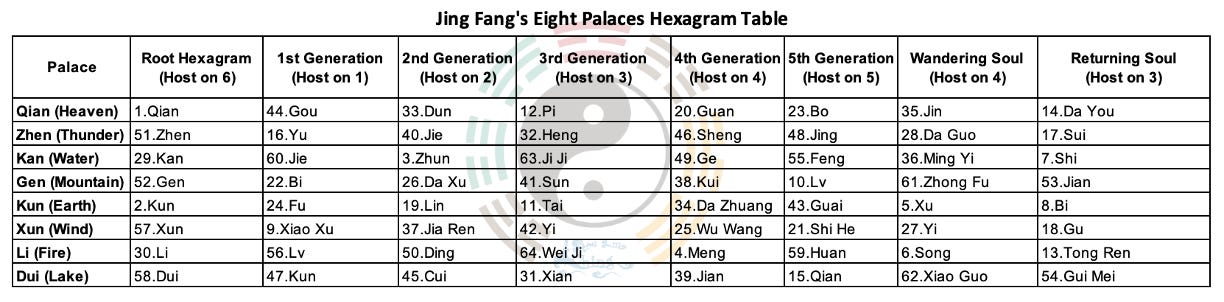
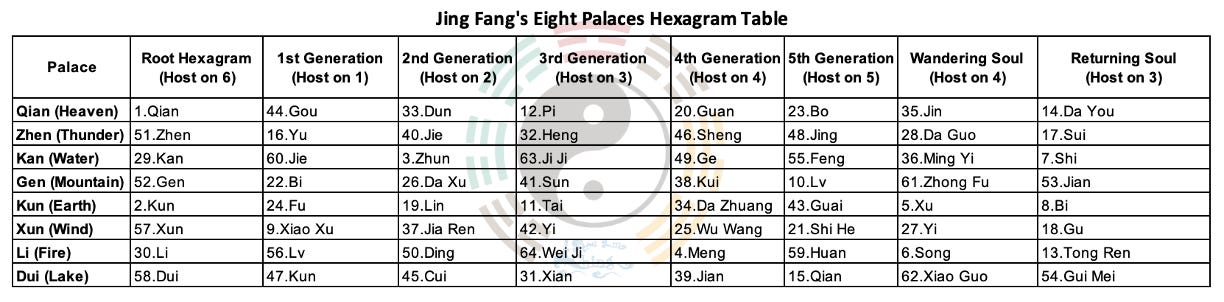
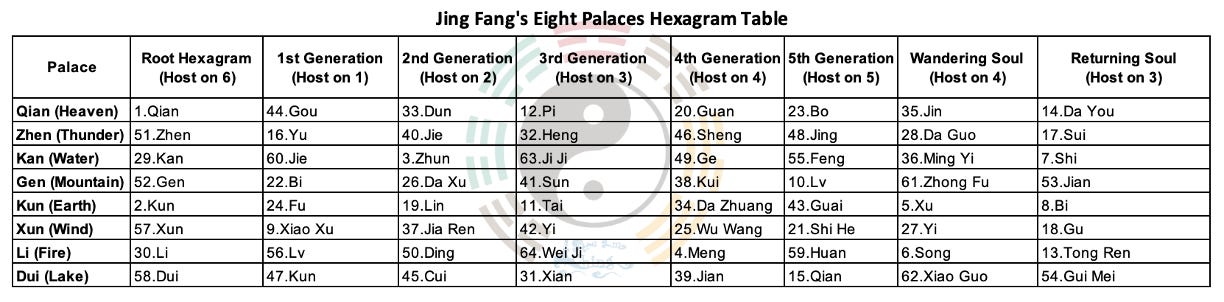
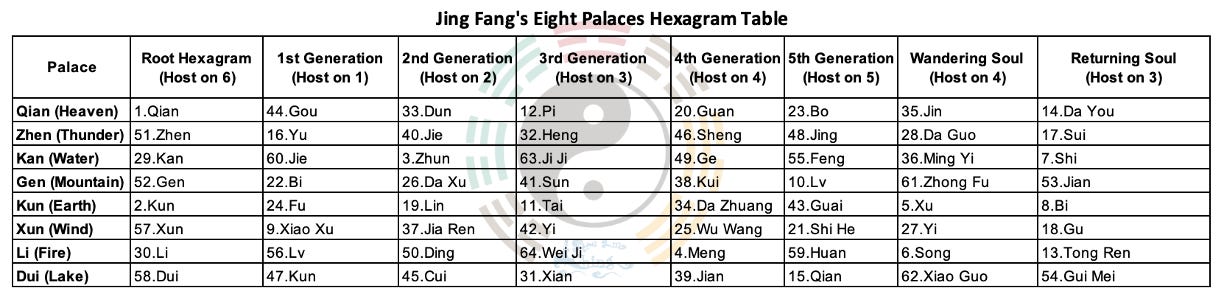
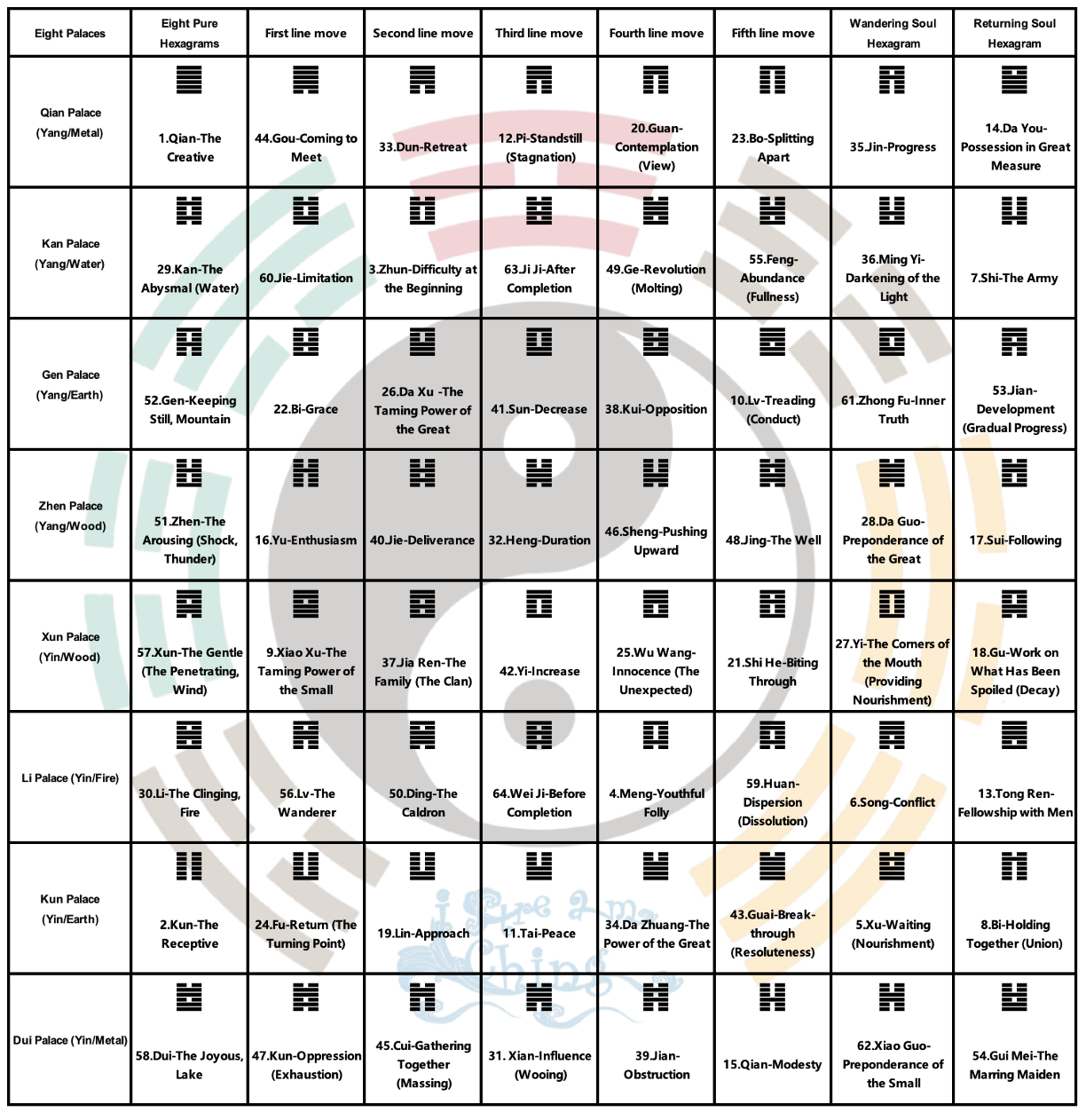
In practice, the Eight Palaces are best learned through a chart. The chart below shows each palace from left to right: the Eight Pure Hexagram, the 1st Generation Hexagram, the 2nd Generation Hexagram, the 3rd Generation Hexagram, the 4th Generation Hexagram, the 5th Generation Hexagram, the Wandering Soul Hexagram, and the Returning Soul Hexagram.
Each cell gives the actual six-line form of the hexagram, followed by its King Wen number, pinyin name, and English meaning. This allows the reader to see not only the name of the hexagram, but also its actual structure and its position within the Eight Palaces system.
Figure: Jing Fang’s Eight Palaces Hexagram Table
The Eight Palaces are as follows:
Qian Palace belongs to Metal.
Kan Palace belongs to Water.
Gen Palace belongs to Earth.
Zhen Palace belongs to Wood.
Xun Palace belongs to Wood.
Li Palace belongs to Fire.
Kun Palace belongs to Earth.
Dui Palace belongs to Metal.
The first hexagram in each palace is the Eight Pure Hexagram, also called the home-palace hexagram. For example, Qian is the home-palace hexagram of the Qian Palace, Kan is the home-palace hexagram of the Kan Palace, and Dui is the home-palace hexagram of the Dui Palace.
The next five hexagrams are the 1st Generation, 2nd Generation, 3rd Generation, 4th Generation, and 5th Generation Hexagrams. The seventh position is the Wandering Soul Hexagram, and the eighth position is the Returning Soul Hexagram.
The complete Eight Palaces sequence is as follows.
Qian Palace: Metal
The Qian Palace belongs to Metal.
Its eight hexagrams are:
1. Qian (The Creative) — Heaven over Heaven — the Eight Pure Hexagram / home-palace hexagram
44. Gou (Coming to Meet) — Heaven over Wind — the 1st Generation Hexagram
33. Dun (Retreat) — Heaven over Mountain — the 2nd Generation Hexagram
12. Pi (Standstill / Stagnation) — Heaven over Earth — the 3rd Generation Hexagram
20. Guan (Contemplation / View) — Wind over Earth — the 4th Generation Hexagram
23. Bo (Splitting Apart) — Mountain over Earth — the 5th Generation Hexagram
35. Jin (Progress) — Fire over Earth — the Wandering Soul Hexagram
14. Da You (Possession in Great Measure) — Fire over Heaven — the Returning Soul Hexagram
Kan Palace: Water
The Kan Palace belongs to Water.
Its eight hexagrams are:
29. Kan (The Abysmal / Water) — Water over Water — the Eight Pure Hexagram / home-palace hexagram
60. Jie (Limitation) — Water over Lake — the 1st Generation Hexagram
3. Zhun (Difficulty at the Beginning) — Water over Thunder — the 2nd Generation Hexagram
63. Ji Ji (After Completion) — Water over Fire — the 3rd Generation Hexagram
49. Ge (Revolution / Molting) — Lake over Fire — the 4th Generation Hexagram
55. Feng (Abundance / Fullness) — Thunder over Fire — the 5th Generation Hexagram
36. Ming Yi (Darkening of the Light) — Earth over Fire — the Wandering Soul Hexagram
7. Shi (The Army) — Earth over Water — the Returning Soul Hexagram
Gen Palace: Earth
The Gen Palace belongs to Earth.
Its eight hexagrams are:
52. Gen (Keeping Still, Mountain) — Mountain over Mountain — the Eight Pure Hexagram / home-palace hexagram
22. Bi (Grace) — Mountain over Fire — the 1st Generation Hexagram
26. Da Xu (The Taming Power of the Great) — Mountain over Heaven — the 2nd Generation Hexagram
41. Sun (Decrease) — Mountain over Lake — the 3rd Generation Hexagram
38. Kui (Opposition) — Fire over Lake — the 4th Generation Hexagram
10. Lv (Treading / Conduct) — Heaven over Lake — the 5th Generation Hexagram
61. Zhong Fu (Inner Truth) — Wind over Lake — the Wandering Soul Hexagram
53. Jian (Development / Gradual Progress) — Wind over Mountain — the Returning Soul Hexagram
Zhen Palace: Wood
The Zhen Palace belongs to Wood.
Its eight hexagrams are:
51. Zhen (The Arousing / Shock, Thunder) — Thunder over Thunder — the Eight Pure Hexagram / home-palace hexagram
16. Yu (Enthusiasm) — Thunder over Earth — the 1st Generation Hexagram
40. Jie (Deliverance) — Thunder over Water — the 2nd Generation Hexagram
32. Heng (Duration) — Thunder over Wind — the 3rd Generation Hexagram
46. Sheng (Pushing Upward) — Earth over Wind — the 4th Generation Hexagram
48. Jing (The Well) — Water over Wind — the 5th Generation Hexagram
28. Da Guo (Preponderance of the Great) — Lake over Wind — the Wandering Soul Hexagram
17. Sui (Following) — Lake over Thunder — the Returning Soul Hexagram
Xun Palace: Wood
The Xun Palace belongs to Wood.
Its eight hexagrams are:
57. Xun (The Gentle / The Penetrating, Wind) — Wind over Wind — the Eight Pure Hexagram / home-palace hexagram
9. Xiao Xu (The Taming Power of the Small) — Wind over Heaven — the 1st Generation Hexagram
37. Jia Ren (The Family / The Clan) — Wind over Fire — the 2nd Generation Hexagram
42. Yi (Increase) — Wind over Thunder — the 3rd Generation Hexagram
25. Wu Wang (Innocence / The Unexpected) — Heaven over Thunder — the 4th Generation Hexagram
21. Shi He (Biting Through) — Fire over Thunder — the 5th Generation Hexagram
27. Yi (The Corners of the Mouth / Providing Nourishment) — Mountain over Thunder — the Wandering Soul Hexagram
18. Gu (Work on What Has Been Spoiled / Decay) — Mountain over Wind — the Returning Soul Hexagram
Li Palace: Fire
The Li Palace belongs to Fire.
Its eight hexagrams are:
30. Li (The Clinging, Fire) — Fire over Fire — the Eight Pure Hexagram / home-palace hexagram
56. Lv (The Wanderer) — Fire over Mountain — the 1st Generation Hexagram
50. Ding (The Caldron) — Fire over Wind — the 2nd Generation Hexagram
64. Wei Ji (Before Completion) — Fire over Water — the 3rd Generation Hexagram
4. Meng (Youthful Folly) — Mountain over Water — the 4th Generation Hexagram
59. Huan (Dispersion / Dissolution) — Wind over Water — the 5th Generation Hexagram
6. Song (Conflict) — Heaven over Water — the Wandering Soul Hexagram
13. Tong Ren (Fellowship with Men) — Heaven over Fire — the Returning Soul Hexagram
Kun Palace: Earth
The Kun Palace belongs to Earth.
Its eight hexagrams are:
2. Kun (The Receptive) — Earth over Earth — the Eight Pure Hexagram / home-palace hexagram
24. Fu (Return / The Turning Point) — Earth over Thunder — the 1st Generation Hexagram
19. Lin (Approach) — Earth over Lake — the 2nd Generation Hexagram
11. Tai (Peace) — Earth over Heaven — the 3rd Generation Hexagram
34. Da Zhuang (The Power of the Great) — Thunder over Heaven — the 4th Generation Hexagram
43. Guai (Break) — Lake over Heaven — the 5th Generation Hexagram
5. Xu (Waiting / Nourishment) — Water over Heaven — the Wandering Soul Hexagram
8. Bi (Holding Together / Union) — Water over Earth — the Returning Soul Hexagram
Dui Palace: Metal
The Dui Palace belongs to Metal.
Its eight hexagrams are:
58. Dui (The Joyous, Lake) — Lake over Lake — the Eight Pure Hexagram / home-palace hexagram
47. Kun (Oppression / Exhaustion) — Lake over Water — the 1st Generation Hexagram
45. Cui (Gathering Together / Massing) — Lake over Earth — the 2nd Generation Hexagram
31. Xian (Influence / Wooing) — Lake over Mountain — the 3rd Generation Hexagram
39. Jian (Obstruction) — Water over Mountain — the 4th Generation Hexagram
15. Qian (Modesty) — Earth over Mountain — the 5th Generation Hexagram
62. Xiao Guo (Preponderance of the Small) — Thunder over Mountain — the Wandering Soul Hexagram
54. Gui Mei (The Marrying Maiden) — Thunder over Lake — the Returning Soul Hexagram
Installing the hexagram name is not merely a naming step. It tells us which palace the hexagram belongs to, which Five Element governs that palace, and where the hexagram stands within the Eight Palaces sequence.
Without identifying the correct palace, one cannot correctly determine which line is parents, siblings, descendants, wife and wealth, or officials and ghosts.
The hexagram name tells us what the hexagram is. The palace tells us where it belongs. The palace element tells us how the Six Relationships are assigned.
Together, they form the structural foundation of the Six Lines chart.