All personal information in this case study has been anonymized or omitted. This case study is provided for learning and reference only. It is not intended as medical, veterinary, legal, financial, investment, or other professional advice.
Time of divination: December 22, 2024.
Stem and branch time: I E year, A month, VII J day (void: A and B).
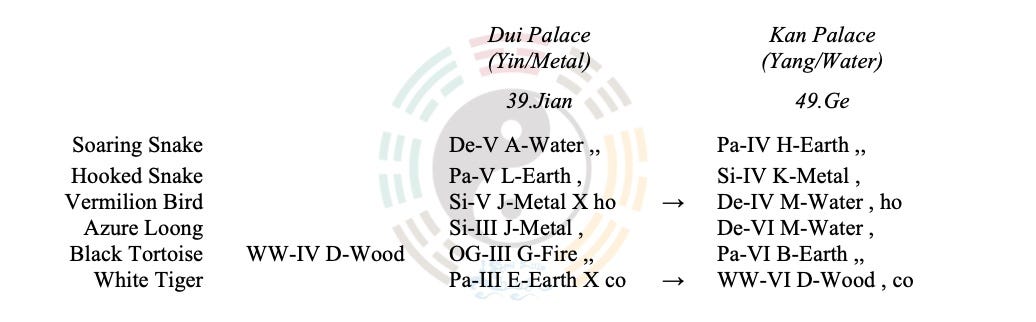
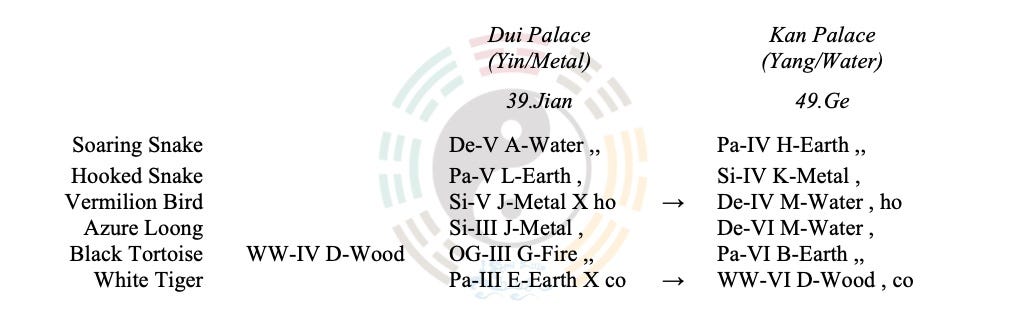
A friend came to ask about a possible promotion. The hexagram obtained was Jian to Ge.
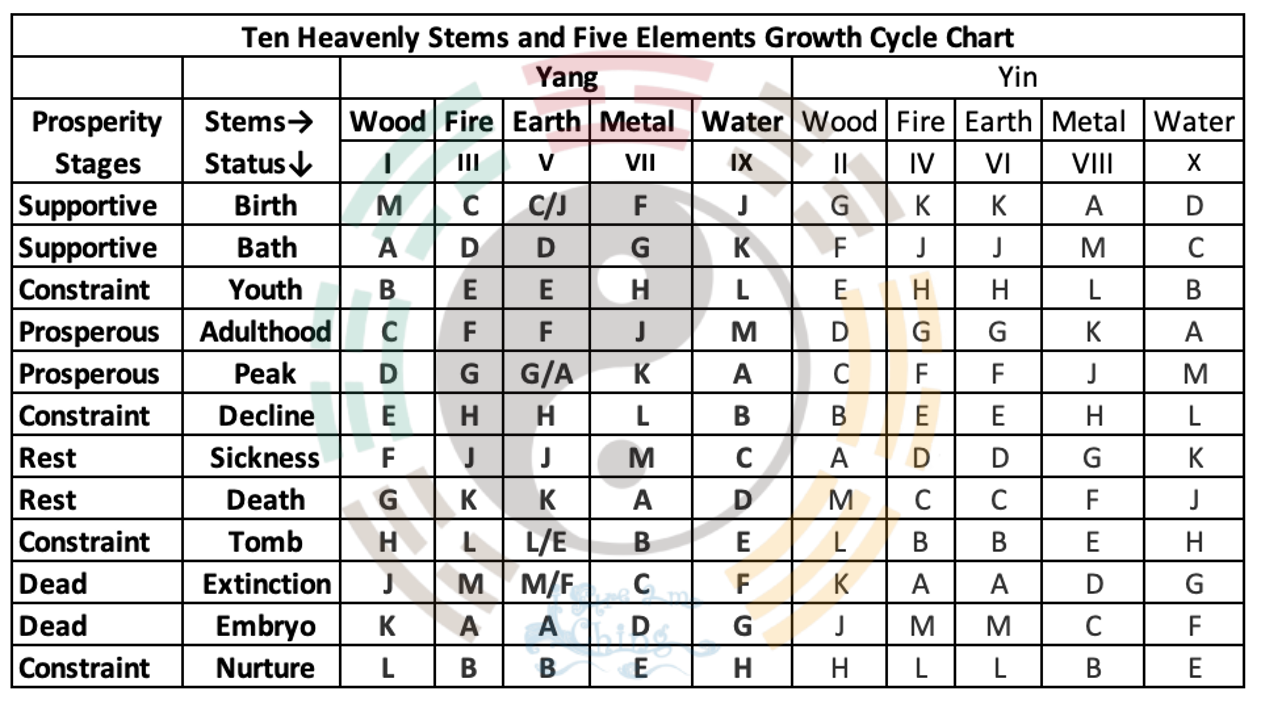
Judgment:In a promotion reading, the officials and ghosts line is taken as the significator. In this hexagram, the officials and ghosts line was G fire, representing the position, title, or promotion opportunity. However, G fire was clashed and overcome by the A month, forming monthly break. At the same time, fire was in a dead place in the A month and received no meaningful support from the daily branch. In the Twelve Stages of Life, the officials and ghosts G fire was also in Sickness. The significator representing the promotion was therefore damaged, weak, and unable to carry the matter. The significator representing the promotion was therefore damaged, weak, and unable to carry the matter. This already showed that the position would be difficult to obtain.
😄Thank you all for your support, and thank you for your patience. We know many of you have been waiting for this.
The package currently includes 7 major classical works and collections.
The estimated individual value of these 8 titles is around $1,309 before applicable taxes. By locking in now at $699 before applicable taxes, readers secure access to the current package, Yi Mao once added, and future books and selected materials added to this specific package without paying the later increased package price.
In short: early buyers can lock in long-term access to the major Six Lines divination classical texts at today’s lower package price.
Package buyers also receive free lifetime access to our private Discord study group, expected to begin formal operation in the second half of this year.
If you purchase the package together with our I Ching Divination Foundations pre-order course, you may also receive an additional study bonus. The course is currently available at the pre-order price, and the price will also increase after its official release.
👉 Your First Book:“I Ching Divination: A Practical Study Roadmap: A Simplified Guide to the Na Jia Method (Wen Wang Gua), Based on I Ching Divination: Complete and Restored (Zengshan Buyi 增删卜易)”
A practice-first roadmap for setting up charts, learning the core workflow, and building timing-aware judgment with a simplified, beginner-friendly structure.
All personal information in this case study has been anonymized or omitted. This case study is provided for learning and reference only. It is not intended as medical, veterinary, legal, financial, investment, or other professional advice.
Time of divination: November 13, 2024.
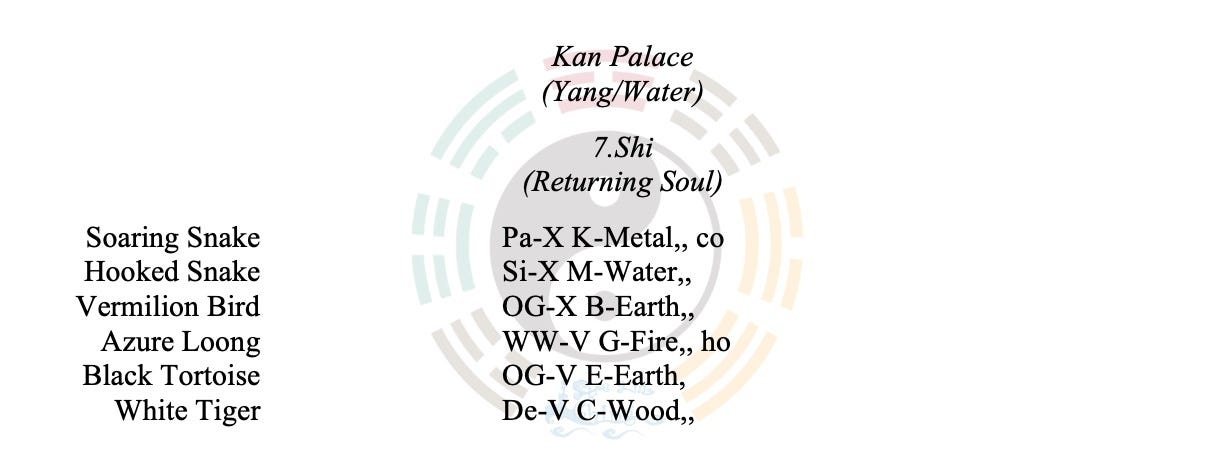
Stem and branch time: I E year, II M month, VIII F day (void: J and K).
The querent was interested in a project and was considering cooperating with others. He made a divination to ask about the project’s prospects and whether it would bring wealth later. The hexagram obtained was Shi.
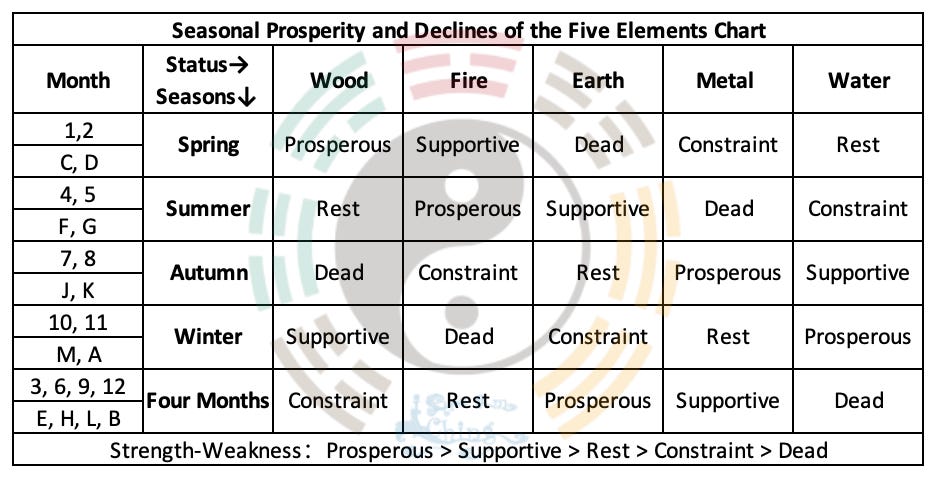
Judgment:To judge the prospects of a project, the parents line is taken as the significator. In this hexagram, the sixth-line corresponding line, parents K metal, represented the project being asked about. K metal was in rest and constraint in the M month and was also void in the cycle, because J and K were void. The project significator was neither prosperous nor supportive. Moreover, it was also void. This objectively showed that the project lacked substance and that its future prospects were poor.
The corresponding line also revealed the attitude of the project side or cooperation side. The sixth-line corresponding line represented the other party, the project side, or the proposed cooperation partner. This line was parents K metal and aligned with Soaring Snake. Soaring Snake governs falsehood, illusion, entanglement, and unreal things. Therefore, this indicated that the other party was not sincere and that the project carried a deceptive quality.
The source god of the parents line further exposed the other party’s hidden intention. The second-line officials and ghosts E earth acted as the source god that generated the parents line K metal. This E earth aligned with Black Tortoise and also formed compatibility with the parents line, because E and K are compatible. Black Tortoise governs obscurity, secrecy, deception, and hidden schemes. Additionally, the party was setting up a deceptive trap to lure the querent in.
😄Thank you all for your support, and thank you for your patience. We know many of you have been waiting for this.
The package currently includes 7 major classical works and collections. After Encompassing I Ching Divination (Yi Mao, 《易冒》) is added, it will include 8 major classical works and collections. The package price will increase to $849 before applicable taxes.
The estimated individual value of these 8 titles is around $1,309 before applicable taxes. By locking in now at $699 before applicable taxes, readers secure access to the current package and Yi Mao once added. In addition, they will receive future books and selected materials added to this specific package without paying the later increased package price.
In short: early buyers can lock in long-term access to the major Six Lines divination classical texts at today’s lower package price.
Package buyers also receive free lifetime access to our private Discord study group, expected to begin formal operation in the second half of this year.
If you purchase the package together with our I Ching Divination Foundations pre-order course, you may also receive an additional study bonus. The course is currently available at the pre-order price. However, the price will also increase after its official release.
👉 Lock in the current $699 package price before Yi Mao is added:
👉 Your First Book:“I Ching Divination: A Practical Study Roadmap: A Simplified Guide to the Na Jia Method (Wen Wang Gua), Based on I Ching Divination: Complete and Restored (Zengshan Buyi 增删卜易)”
A practice-first roadmap for setting up charts, learning the core workflow, and building timing-aware judgment with a simplified, beginner-friendly structure.
All personal information in this case study has been anonymized or omitted. This case study is provided for learning and reference only. It is not intended as medical, veterinary, legal, financial, investment, or other professional advice.
Time of divination: May 31, 2024.
Stem and branch time: I E year, VI F month, II H day (void: E and F).
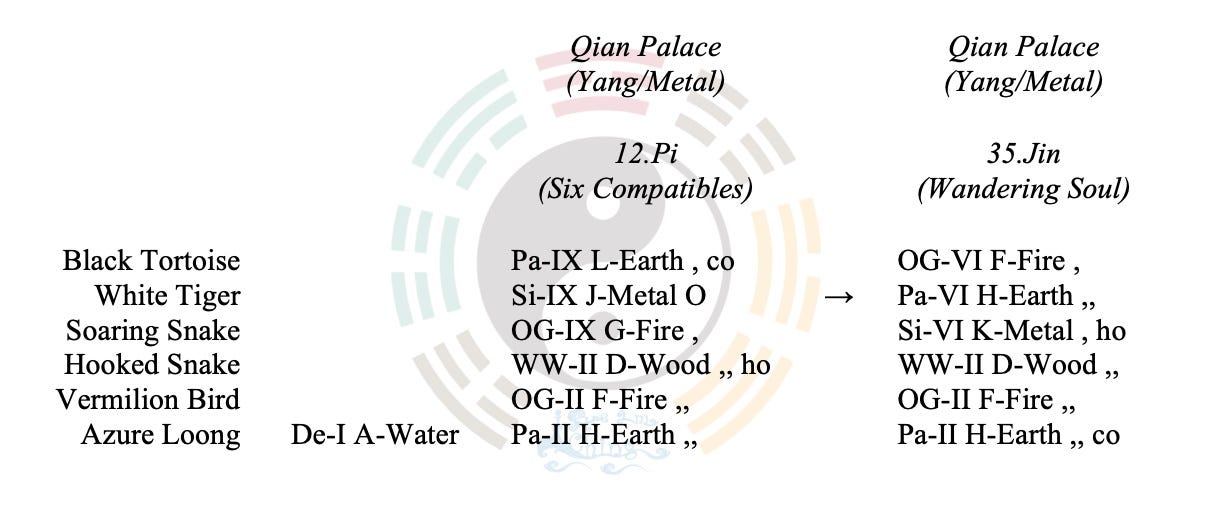
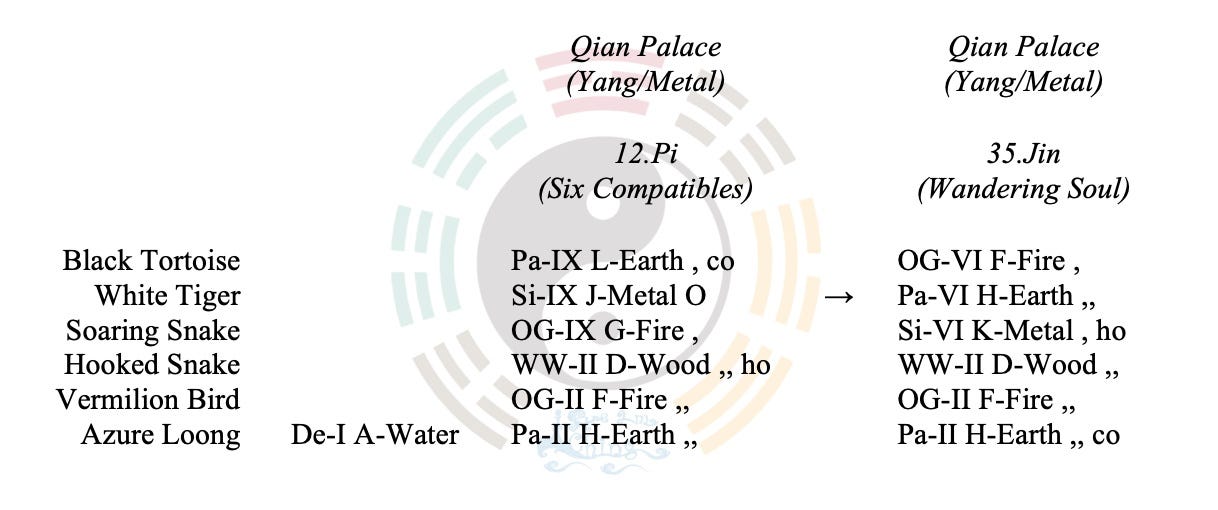
A female querent had just paid and signed a contract for a short-term rental. On the first day of moving in, she made a divination to ask whether the Feng Shui and living environment of this rental would benefit or harm her. The hexagram obtained was Pi to Jin.
Judgment:The hexagram first showed that the house was newly renovated, but the living condition was not ideal. The first-line parents H earth entered the hexagram through the daily branch and aligned with Azure Loong. Azure Loong governs cleanliness, freshness, neatness, and renovation.
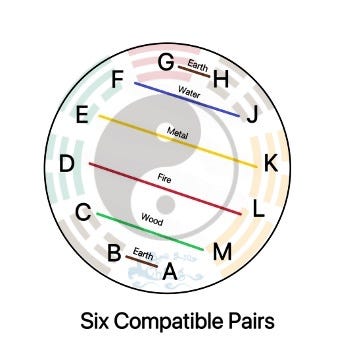
The lighting of the room was extremely poor. The second line represents the inside of the residence. In this hexagram, the second-line officials and ghosts F fire was void in the cycle, because E and F were void. The fourth-line officials and ghosts G fire was also held by compatible entanglement with the daily branch H earth, since G and H are compatible. Fire governs light. This reflected a room with very poor natural lighting and obvious obstruction.
The hexagram also showed poor ventilation and an unpleasant smell inside the room. The third-line host line represented the querent’s living place. It was the wife and wealth D wood, and wood governs wind and airflow. This line aligned with Hooked Snake and entered the tomb. Hooked Snake governs stagnation, heaviness, and accumulation. This directly showed that the room had very poor ventilation, a stuffy interior, and an unpleasant smell.
The external environment showed a road clash against the residence. The fifth line can represent roads. In this hexagram, the fifth-line siblings J metal aligned with White Tiger and was the only active line. White Tiger governs roads, harshness, danger, and harmful force. At the same time, on the H day, F fire was the Traveling Horse Star.[1] Therefore, the image of an active White Tiger road combining with the Traveling Horse residence line formed a clear Feng Shui image of road clash against the house, meaning that a main road directly rushed toward the residence.
The noise was also severe. The fifth-line White Tiger road was active, showing moving vehicles and harsh external disturbance.
The hexagram then showed the harmful effect on the querent herself. The host line was the wife and wealth D wood. In the H daily branch, it was in a state of rest and constraint and also entered the tomb. Entering the tomb is like entering confinement. Living in this place would lead to financial consumption, worries about money, and emotional pressure.
There was also a direct image of harm to the body. The fifth-line siblings J metal aligned with White Tiger and was the only active line. It directly overcame the third-line host line D wood. White Tiger carries a harmful and forceful nature, and metal overcoming wood is a direct image of injury, pressure, and harm. This was like escaping one danger only to enter another. It was highly unfavorable for the querent’s health.
The empty and entangled fire lines further showed possible physical hidden problems. This suggested that the Feng Shui environment could trigger or aggravate hidden issues related to the stomach and intestines, the heart, and gynecological conditions.
Conclusion:The rental was newly renovated, but its Feng Shui and living environment were unfavorable. The hexagram showed poor light, poor ventilation, unpleasant smell, heavy road disturbance, severe noise, and weak sound insulation. The road clash image was especially clear: the fifth-line White Tiger road was active and combined with the second-line Traveling Horse residence line, showing a road directly rushing toward the house.
For the querent personally, the host line entered the tomb and was overcome by the active White Tiger siblings line. This showed financial loss, emotional pressure, physical discomfort, and potential harm to health.The only practical option left was to consider Feng Shui adjustments and environmental remedies.
Feedback:The actual result matched the judgment. The querent confirmed that the room had indeed just been renovated and that she was the first tenant to move in. The lighting inside was poor.When the door was opened, there was indeed an unpleasant smell, and the ventilation was poor. Because the contract had already been signed and the rent had been paid, the querent could not withdraw from the rental and could only consider using Feng Shui arrangements to adjust and reduce the negative effects.
Note: [1] The Traveling Horse Star is associated with movement, distance, and the qualities of softness and hardness.
If there are certain themes you would like to see in future case studies, welcome to leave a comment and share what kinds of divination cases interest you most.
All personal information in this case study has been anonymized or omitted. This case study is provided for learning and reference only. It is not intended as medical, veterinary, legal, financial, investment, or other professional advice.
Time of divination: October 21, 2025, at 8:09 PM.
Stem and branch time: II F year, III L month, X M day (void: A and B), IX L hour.
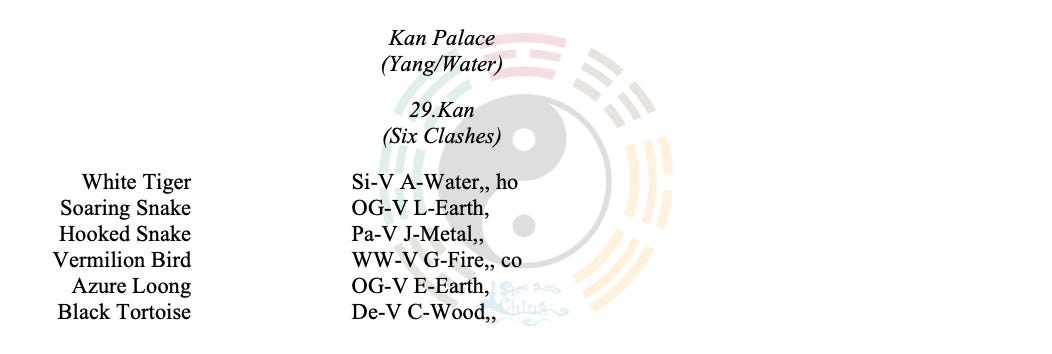
The querent’s wife had joined an online investment platform. When she tried to withdraw the money, the platform claimed that she had made an “operation error” and demanded that she add a large additional investment within a limited time. Only then would withdrawal be allowed. The husband had opposed the investment from the beginning. The hexagram obtained was Kan.
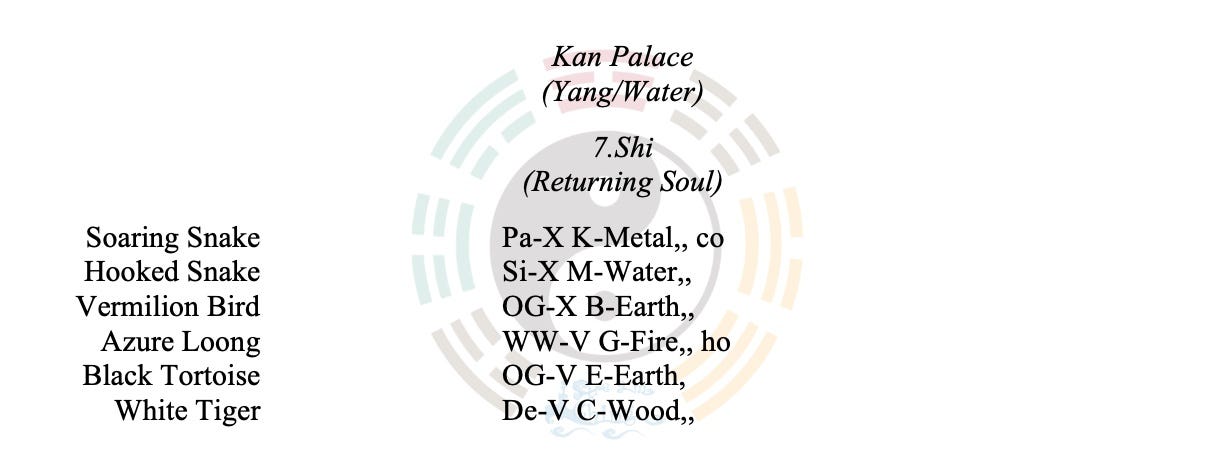
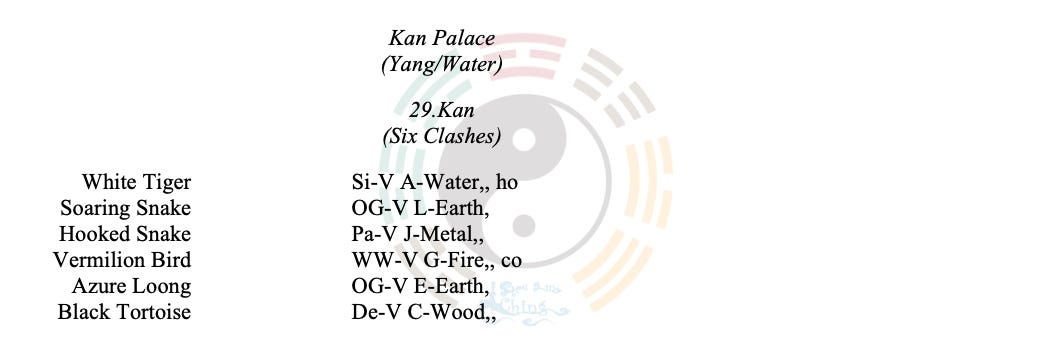
Judgment:The overall hexagram image first showed deep danger and entrapment. The hexagram obtained was Kan, repeated water.In addition, this hexagram is a Six Clashes hexagram. When asking about seeking money or recovering lost funds, encountering Six Clashes often indicates scattering, disruption, and failure to gather the matter back. It was similar to a pig-butchering scam.
In general, when seeking wealth, receiving Kan or a hexagram from the Kan Palace is unfavorable for wealth. However, the final judgment still depends on whether the wife and wealth line, as the significator for money, is prosperous and supportive. By contrast, when seeking wealth, receiving hexagrams from the Xun or Zhen Palace can often give a more favorable overall image for wealth.
To judge whether the money could be recovered, the wife and wealth line was taken as the significator. The host line, representing the querent’s side, was the sixth-line siblings A water. It aligned with White Tiger and was also void in the cycle, because A and B were void. The siblings line is the god of robbing wealth. When siblings hold the host line in a wealth recovery question, it already suggests loss of money. Its alignment with White Tiger further showed worry, damage, distress, and a painful financial matter.
The corresponding line, representing the money and the opposite side of the matter, was the third-line wife and wealth G fire. In this context, it matched an online platform using messages and excuses to demand more money.
The host line siblings A water and the corresponding line wife and wealth G fire formed an A and G clash. The host and corresponding lines were not only in a water and fire overcoming relationship, but also directly clashed with each other. This showed that the money and the querent’s side were in a state of opposition, rejection, and separation. Consequently, the money was not moving toward the querent.
The condition of the significator was also extremely weak.The wealth line was declining, drained, and overcome, with no vitality.
The platform’s demand for additional investment also matched the hexagram image. The wife and wealth line was weak and overcome, while the host line was siblings A water, the god of robbing wealth. Thus, the so-called additional payment was not a solution, but another layer of the trap.
Conclusion:The money could not be recovered. The overall image of Kan showed danger and entrapment, while Six Clashes indicated scattering and failure to gather the matter back. The host line was siblings A water, the god of robbing wealth, aligned with White Tiger and void in the cycle, showing loss, distress, and lack of effective control. Therefore, the money already invested was extremely unlikely to return.
Feedback:The actual result matched the judgment.In the early stage, the wife had invested a total of 70,000 RMB. Because the wife strongly refused to report the matter to the police, the querent ultimately chose not to report it. He made this decision partly to preserve her dignity and partly to let her learn a serious lesson. In the end, the money was not recovered.
All personal information in this case study has been anonymized or omitted. This case study is provided for learning and reference only. It is not intended as medical, veterinary, legal, financial, investment, or other professional advice.
III. Arranging the Six Lines Chart
After a hexagram is cast, the next step is to install the necessary components onto the Six Lines chart. One of the most important steps is installing the Heavenly Stems and Earthly Branches onto each line.
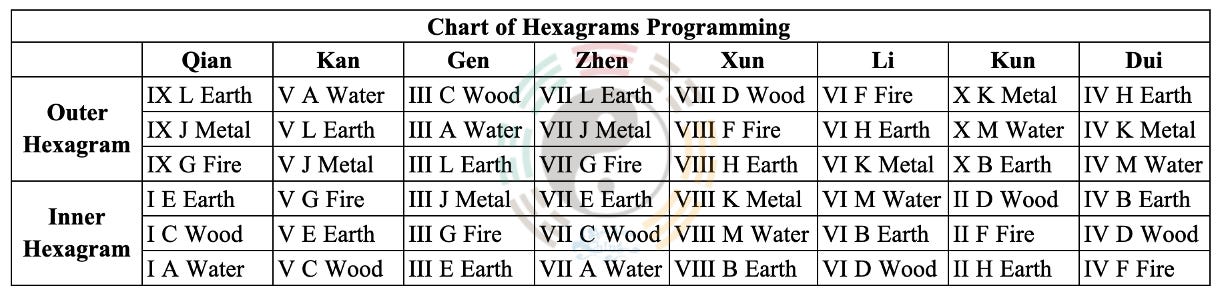
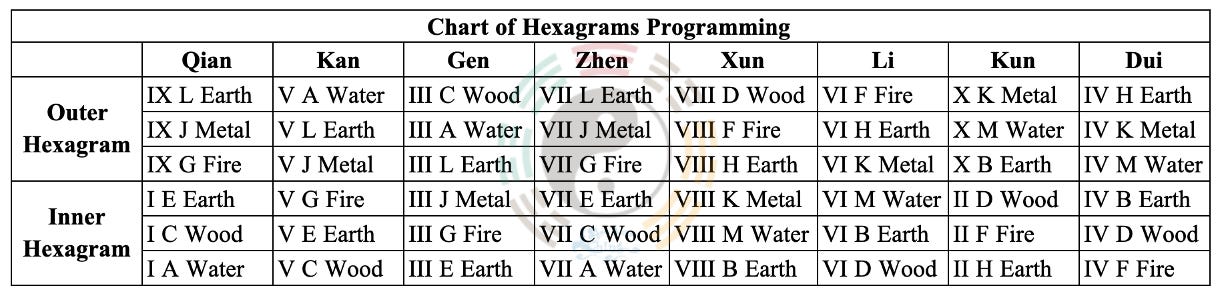
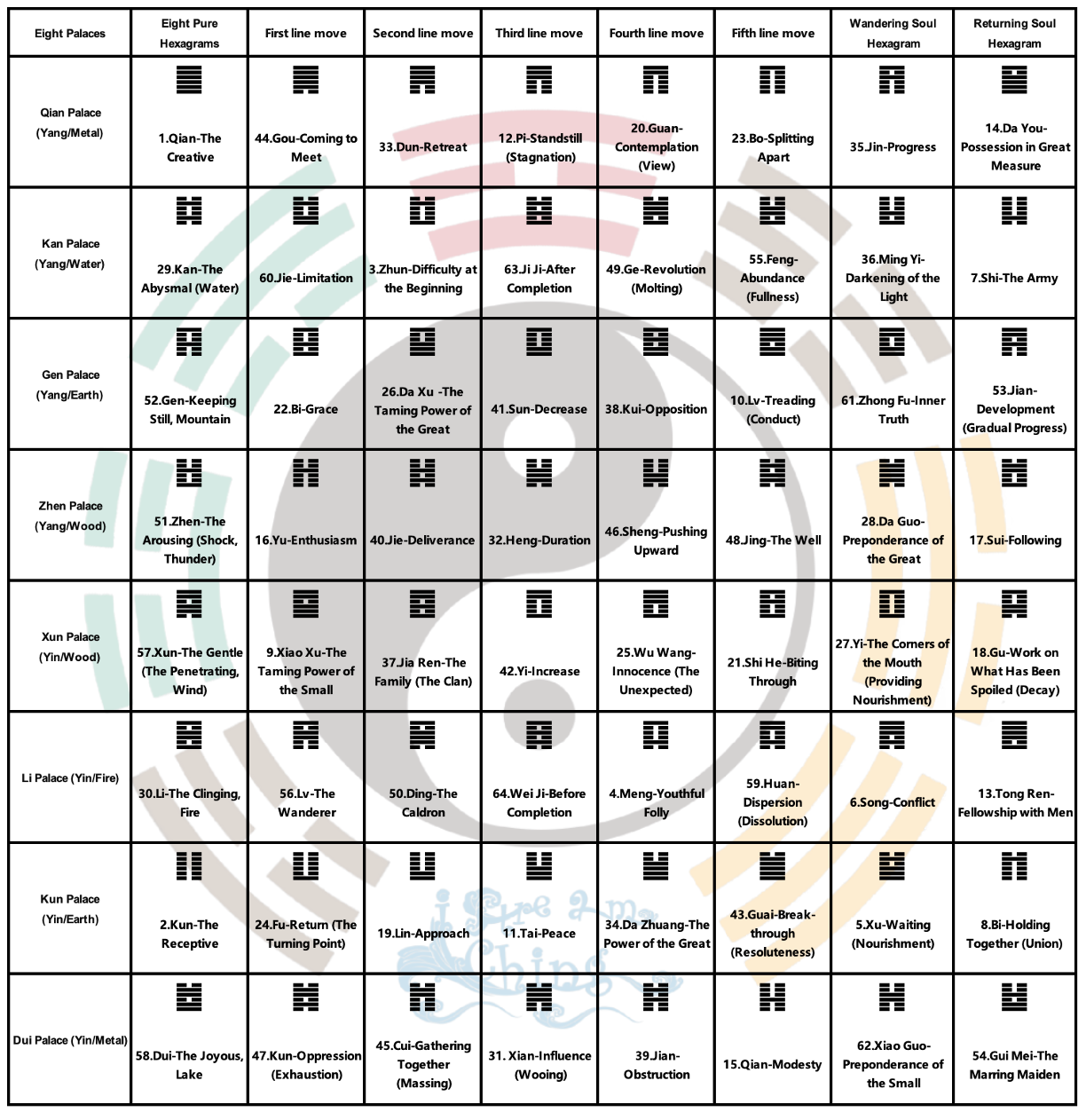
In Six Lines divination, each trigram has a fixed pattern of Stems and Branches. The assignment changes depending on whether the trigram appears as the inner trigram or the outer trigram. Specifically, the inner trigram refers to the lower three lines of the hexagram. In contrast, the outer trigram refers to the upper three lines.
The rules are as follows.
When Qian is the inner trigram, the first line begins with I A, the second line is I C, and the third line is I E.
When Kun is the inner trigram, the first line begins with II H, the second line is II F, and the third line is II D.
When Kan is the inner trigram, the first line begins with V C, the second line is V E, and the third line is V G.
These assignments are not optional decorations. Instead, they form the technical foundation for later steps in the Six Lines chart.
Therefore, before judging a hexagram, one must first identify the inner and outer trigrams correctly. After that, install the corresponding Stems and Branches line by line.
For the complete practical reference charts used in hexagram interpretation, including key tables for Six Lines divination, please visit https://www.ichingstream.com/reference-charts/.
That preface allowed us to hear Cheng Liangyu speak in his own voice. He told us how he lost his sight at the age of five, turned from medicine to I Ching divination, studied under Zhang Xingyuan, received further instruction from the Kupao Elder, compared earlier works, verified methods through practice, and finally began writing because he feared that the deeper reasoning of I Ching divination might not be transmitted clearly to later generations.
Today, I would like to share another preface, one that moves the story into a deeper and more painful place.
This is Wang Zehong’s Preface to Yi Mao.
Before entering the preface itself, it is worth noting who wrote these prefaces. They were not casual admirers, ordinary clients, or anonymous readers. Wang Zehong was a Qing dynasty official and scholar who passed the imperial examination in 1655 and later served as Minister of Rites. Gu Baowen was also a Qing official and scholar, a successful imperial examination candidate who later served as Censor of the Henan Circuit. Lu Jin was a scholar and poet associated with the Xiling literary circle.
For readers unfamiliar with classical Chinese society, this background matters. The imperial examination system was one of the main paths through which educated men entered official service and the scholarly elite. A preface written by such figures was not merely a polite introduction. It could function as recognition, endorsement, testimony, and transmission. The fact that men of this background wrote for Yi Mao shows that Cheng Liangyu’s work was not treated as ordinary fortune-telling, but as a serious contribution to Yi learning and practical divination.
This also reflects an important cultural background in classical China. Loyalty, righteousness, friendship, and moral obligation were not abstract ideals. When a friend entrusted a work before death, fulfilling that wish became a matter of honor.
To write a preface in such a context was not merely to praise a book. It was to bear witness, to keep faith, and to help carry a life’s work into the world.
Wang Zehong’s preface should be read within this moral world. Cheng Liangyu entrusted the book to his friends. Hu Lütang helped revise and arrange it. After Cheng Liangyu’s death, his son came in mourning dress to fulfill his father’s final command. Wang Zehong accepted the task because he understood that this was no ordinary request. It was an act of trust, and therefore it required an answer worthy of that trust.
If Cheng Liangyu’s own preface shows the life behind the book, Wang Zehong’s preface shows how the book became a final wish.
We also see the grief of his son, who came in mourning dress after his father’s death, holding a copy of Yi Mao, and asking Wang Zehong to fulfill his father’s final instruction.
This is one of the most moving moments in the entire set of prefaces.
Below is the full Wang Zehong’s Preface to Yi Mao from the upcoming I Ching Stream English edition.
Wang Zehong’s Preface to Yi Mao
When I[1] was in Chang’an, I had already heard of Master Cheng Yuanru’s virtue. Only ten years later did I finally have the chance to visit him at his home. Yuanru declined, citing illness. Through Hu Lütang’s introduction, I visited twice more, and only then did Yuanru come out to receive me. Listening to his discourse, I realized he belonged to the same company as the likes of Junping[2] of old. From that time on, I visited his home often. Although Yuanru lay ill in bed, he would always force himself to rise, sit with me, and talk at length without fatigue.
One day he said to me: “At five, I lost my sight from smallpox and could not pursue the examination path. I studied medicine but failed, and only then began studying the Yi. At first I studied under Master Xingyuan. Later in life I encountered the Kupao Elder. We tested and verified matters with each other and gained insight. I had someone write down notes, and over the years it became a book. I only worry that the wording is too verbose and that the meaning may at times repeat. So I have entrusted Lütang to consult with you for revision. When the book is finished, please write a preface for me.” I agreed.
Not long after, Lütang died. Yuanru’s grief deepened. He wept in mourning, and his illness worsened day by day. I went to inquire after him. He could not come out, yet I still marveled at his insistence on rising.
Before long, Yuanru also passed from this world. Alas, how painful. Barely ten days later, someone came in mourning dress, his face dark with grief, holding a copy of Yi Mao. He knelt for a long time, tears streaming, and said: “When my father was near death, he held my hand and solemnly instructed me. I have therefore faithfully followed his final command and come to seek you. I beg you, sir, do not refuse.” How could I bear to decline?
I privately lament that Yi learning today does not perish because people do not study the Yi, but perishes because so many who study it ruin it. Yet those who do not truly study the Yi steal heterodox techniques and call them the Yi. Of all forms of cutting it off, what could be worse? When Chengzi (程颐) transmitted the Yi, he based it on Wang Bi (王弼). Wang Bi derived it from Fei Zhi (费直). Zhu Xi’s (朱熹) Original Meaning was based on Lü Bogong (吕伯恭). The ancient Yi traced back to Tian He (田何). None ever used what is not the Yi to explain the Yi.[3]
Each time he divined a hexagram, he examined the line images, constancy and regret, yin and yang, movement and stillness, and a person’s lifelong good and ill fortune, along with remorse and humiliation, became as clear as fire seen in full view. Because of this, his reputation spread widely. Some even traveled a thousand li[4] to seek a single sentence and then left. Yet Yuanru never dared to think highly of himself. Day after day, he only contemplated images and practiced divination to verify matters through lived experience.
Alas. Among our contemporaries, some achieve prominent position and public renown, and arrogantly style themselves men of letters. Yet when others ask them about the central meaning of the classics they claim to have studied, they cannot even silently recall the chapters and lines, much less grasp their subtle essentials. How could they compare to Yuanru? Moreover, today’s affliction is that scholar officials regard mastering the classics and studying antiquity as pedantic, and instead chase ornate rhetoric and empty acclaim, taking pride in display. None have truly attained meaning, speaking of what lies beyond images and numbers.
As the book neared completion, Lütang and Yuanru died one after the other. Some say that profound meanings and secret principles cannot remain hidden as Heaven and Earth’s private store, or that the disclosure of the mechanism went too far. I say that studying the Yi reduces error. When reflection reaches its utmost, it connects with spirits and the divine.
I have never heard that the Way of Heaven forbids people to awaken deeply within principle and meaning. To hear the Way in the morning and die in the evening is sufficient. If not, then consider Yuanru’s end. His words did not turn to private matters. He held fast to this book alone. Was that love of fame? Rather, he feared later generations might not receive its transmission. So he did not worry for himself, but worried for others. In that case, the earnest intention with which Yuanru repeatedly entrusted this to me is, at last, consoled.
Written in the Middle Autumn Month, the Third Year of the Kangxi Reign (1664 CE)
Wang Zehong of the Anshi clan, Chujiang
Notes
[1] Wang Zehong (王泽弘), courtesy name Juanlai (涓来) and literary name Haolu (昊庐), was a Qing dynasty official and scholar from Huanggang, Huguang. He passed the imperial examination in 1655 CE and later served as Minister of Rites. In Yi Mao, he appears as the author of one of the prefaces. According to his preface, he came to know Cheng Liangyu through Hu Lütang and later wrote the preface at the request of Cheng Liangyu and his family.
[2] Junping refers to Yan Junping (严君平), a Han dynasty I Ching scholar who once practiced divination in the marketplace and was highly respected by later generations. Gongming refers to Guan Gongming, namely Guan Lu (管辂), a famous I Ching scholar and diviner of the Three Kingdoms period, known for his extraordinary skill in divination.
[3] Chengzi (程子) refers here to Cheng Yi (程颐, 1033 to 1107 CE), one of the major founders of Song dynasty Neo-Confucianism and the author of an influential commentary on the I Ching. Wang Bi (王弼, 226 to 249 CE) was a Cao Wei philosopher whose commentary on the Zhouyi became one of the most important interpretive works in the history of Yi learning. Fei Zhi (费直) was a Han dynasty Yi scholar associated with the Fei school of I Ching transmission, which later became an important textual lineage.
Zhu Xi (朱熹, 1130 to 1200 CE) was the central figure of Song Neo-Confucianism and the author of Zhouyi Benyi, or Original Meaning of the Zhouyi. Lü Bogong (吕伯恭), also known as Lü Zuqian (吕祖谦, 1137 to 1181 CE), was a Southern Song scholar closely associated with Zhu Xi and the scholarly transmission of the classics. Tian He (田何) was an early Han scholar traditionally regarded as a key transmitter of ancient I Ching learning into the Han dynasty.
In this passage, Wang Zehong invokes these figures to emphasize that legitimate Yi learning always developed through recognized textual and scholarly lineages, rather than by using teachings outside the Yi to explain the Yi.
[4] Traditional Chinese distance units varied by period and context, so modern equivalents should be understood as approximate references rather than exact conversions. In the modern standardized system, one li (里) is generally taken as 500 meters, or about 0.31 miles. One zhang (丈) equals ten chi (尺), about 3.33 meters. One chi is about 33.3 centimeters, and one cun (寸) is one tenth of a chi, about 3.33 centimeters. In many premodern texts, these units may not correspond exactly to modern measurements, but they provide a useful sense of scale for the reader.
Reading Wang Zehong’s preface, one can see how Yi Mao entered the world not merely as a manuscript, but as a trust.
Hu Lütang helped revise and arrange the work. Cheng Liangyu held fast to the book at the end of his life. His son came in mourning dress to fulfill his father’s final command. Wang Zehong accepted the task because he understood that this was not an ordinary request, but a responsibility.
This is how an enduring classic is born.
Not only through rules, methods, and technical insight, but through people who believe that a body of knowledge must not disappear.
Wang Zehong’s preface also reveals a deeply Chinese ideal of transmission. A book could be more than a text. It could be a trust between friends, a son’s duty to his father, a scholar’s moral obligation, and a gentleman’s promise to help carry worthy learning into the future.
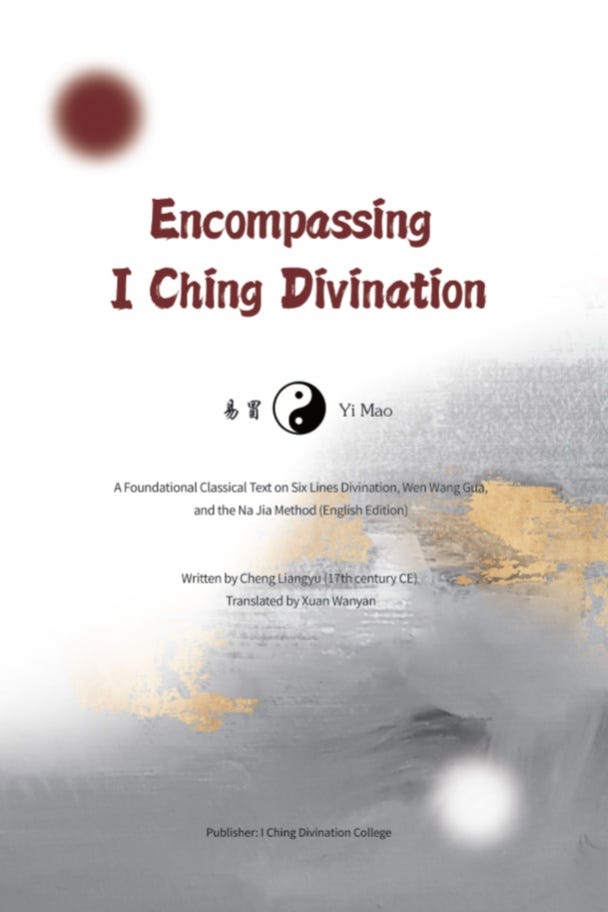
As I Ching Stream prepares to bring Encompassing I Ching Divination (Yi Mao, 《易冒》) to English readers, we feel deeply honored to continue this line of transmission.
More than three centuries ago, Cheng Liangyu wished that this work be given to the world.
Today, across languages and cultures, we are honored to help carry that wish forward.
May this flame continue to be passed from hand to hand.
A Brief Note for Readers
Encompassing I Ching Divination (Yi Mao, 《易冒》) is scheduled to be added to the I Ching Stream package in early June. Before it is added, the current package remains available at $699 before applicable taxes.
Once Yi Mao is added, the package will expand from 7 to 8 major classical works and collections, and the package price will increase to $849 before applicable taxes. Future additions to this specific package are also planned, including Supplement to the I Ching Forest (Yi Lin Bu Yi, 《易林补遗》), the important classical work traditionally associated with Zhang Xingyuan, Cheng Liangyu’s teacher.
👉 Lock in the current package price before Yi Mao is added:
All personal information in this case study has been anonymized or omitted. This case study is provided for learning and reference only. It is not intended as medical, veterinary, legal, financial, investment, or other professional advice.
Time of divination: September 10, 2025, at 8:57 PM.
Stem and branch time: II F year, II K month, IX G day (void: J and K), VII L hour.
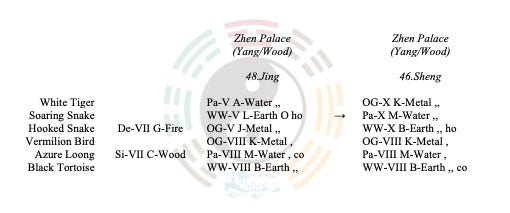
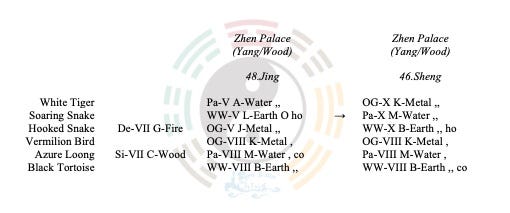
A fellow I Ching practitioner came to ask about a child’s health condition. The querent did not provide any specific symptoms or background information. The hexagram obtained was Jing to Sheng.
Judgment:In a health reading for a child, the descendants line is taken as the significator. In this hexagram, the descendants G fire was hidden beneath the fourth-line officials and ghosts J metal. Although the significator was hidden beneath another line and was not openly present, it directly coincided with the daily branch G fire. As a result, it received strong support from the day. The monthly branch K metal did not directly overcome the significator, so the significator itself remained extremely prosperous and supportive. Based on this, it was judged that although the child had symptoms, the condition was not serious. Therefore, the child would eventually recover.
The hexagram then revealed the symptoms: indigestion, retching, bloating, and abdominal discomfort. The sixth-line parents A water aligned with White Tiger and was clashed by the daily branch, becoming covertly active and then clashing and overcoming the hidden significator descendants G fire. White Tiger governs illness, pain, and physical discomfort. This image pointed to vomiting or retching symptoms in the child.
The fourth-line officials and ghosts J metal and the third-line officials and ghosts K metal were both void in the cycle. In image-based judgment, J metal can be associated with the Kun image, and Kun governs the spleen, stomach, abdomen, and digestion. This line also aligned with Hooked Snake, which governs fullness, swelling, and stagnation. When this image becomes void, it can indicate hollow sounds, emptiness, or rumbling. Consequently, it pointed to stomach bloating, abdominal fullness, and intestinal rumbling. K metal can be associated with the Dui image, and Dui governs the mouth, eating, and food intake. It aligned with Vermilion Bird, which also governs the mouth and speech. Its being void indicated that the illness was related to improper food intake. In other words, the child had eaten something that upset the stomach.
😄Thank you all for your support, and thank you for your patience. We know many of you have been waiting for this.
The package currently includes 7 major classical works and collections. After Encompassing I Ching Divination (Yi Mao, 《易冒》) is added, it will include 8 major classical works and collections. As a result, the package price will increase to $849 before applicable taxes.
The estimated individual value of these 8 titles is around $1,309 before applicable taxes. By locking in now at $699 before applicable taxes, readers secure access to the current package and Yi Mao once added. In addition, they will get future books and selected materials added to this specific package without paying the later increased package price.
In short: early buyers can lock in long-term access to the major Six Lines divination classical texts at today’s lower package price.
Package buyers also receive free lifetime access to our private Discord study group, expected to begin formal operation in the second half of this year.
If you purchase the package together with our I Ching Divination Foundations pre-order course, you may also receive an additional study bonus. The course is currently available at the pre-order price. Furthermore, the price will also increase after its official release.
👉 Lock in the current $699 package price before Yi Mao is added:
All personal information in this case study has been anonymized or omitted. This case study is provided for learning and reference only. It is not intended as medical, veterinary, legal, financial, investment, or other professional advice.
Time of divination: March 19, 2026, at 1:19 PM.
Stem and branch time: III G year, VIII D month, IX E day (void: G and H).
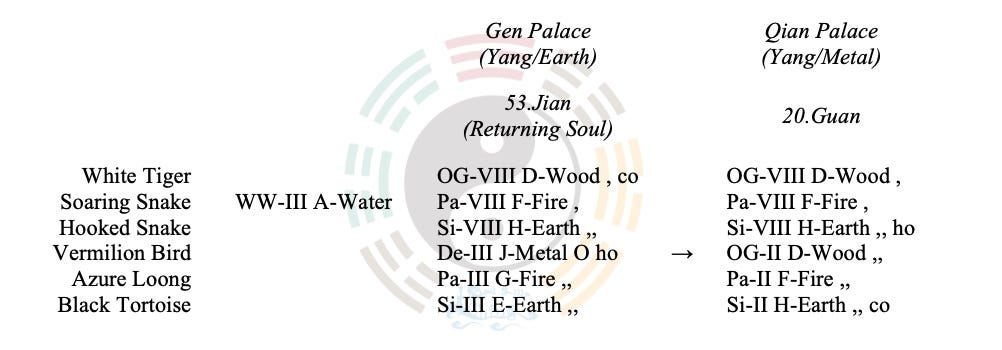
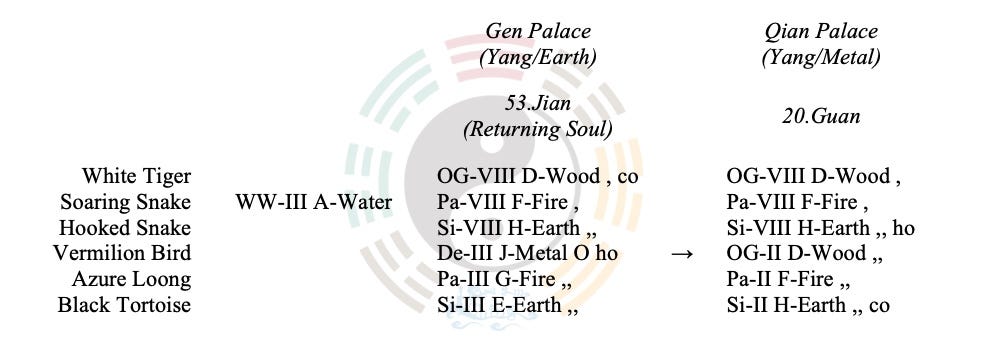
A querent had called a taxi to pick her up, but the taxi driver told her that the road ahead had been closed and the car could not come through. However, from where she stood, the querent could see other private vehicles entering the area. If she chose to believe the driver, she would need to walk about one kilometer to meet the taxi. Because what she saw with her own eyes, that some vehicles could enter, clearly conflicted with what the driver said, that the road ahead was closed, she became doubtful. As a result, she made a divination: was the driver telling the truth about the road closure? She obtained Jian to Guan.
Judgment: The first issue in this hexagram was whether there was truly an image of traffic obstruction ahead. In divinations about road conditions, vehicle access, and traffic information, the parents line can represent vehicles, roads, access conditions, and traffic information. In this hexagram, the fifth-line parents F fire was in the outer trigram, so it could represent the road ahead, outside vehicles, or the traffic condition outside. This line aligned with Soaring Snake. Soaring Snake carries the images of entanglement, obstruction, winding conditions, and restriction within a limited area. Therefore, the fifth-line parents F fire aligning with Soaring Snake could be taken as an image of vehicles or road access being restricted ahead. From this, it could be judged that the taxi driver’s claim that the road ahead was closed was not false. There was indeed some form of traffic control. In addition, there was access obstruction.
The main hexagram 53.Jian also supported the idea that this was not a sudden chaotic road closure, but more like an arranged and orderly temporary traffic control. Jian has the image of gradual progress, sequence, steps, and order. Therefore, in this context, it pointed more toward an arranged road restriction. Instead of a sudden accident or a random excuse made up by the driver, this seemed planned. Overall, the information that the road ahead was closed could be judged as true.
😄Thank you all for your support, and thank you for your patience. We know many of you have been waiting for this.
The package currently includes 7 major classical works and collections. After Encompassing I Ching Divination (Yi Mao, 《易冒》) is added, it will include 8 major classical works and collections. In addition, the package price will increase to $849 before applicable taxes.
The estimated individual value of these 8 titles is around $1,309 before applicable taxes. By locking in now at $699 before applicable taxes, readers secure access to the current package and to Yi Mao once added. Furthermore, they secure access to future books and selected materials added to this specific package without paying the later increased package price.
In short: early buyers can lock in long-term access to the major Six Lines divination classical texts at today’s lower package price.
Package buyers also receive free lifetime access to our private Discord study group. The group is expected to begin formal operation in the second half of this year.
If you purchase the package together with our I Ching Divination Foundations pre-order course, you may also receive an additional study bonus. The course is currently available at the pre-order price. Moreover, the price will also increase after its official release.
👉 Lock in the current $699 package price before Yi Mao is added:
All personal information in this case study has been anonymized or omitted. This case study is provided for learning and reference only. It is not intended as medical, veterinary, legal, financial, investment, or other professional advice.
Time of divination: January 23, 2023.
Stem and branch time: IX C year, X B month, VIII F day (void: J and K).
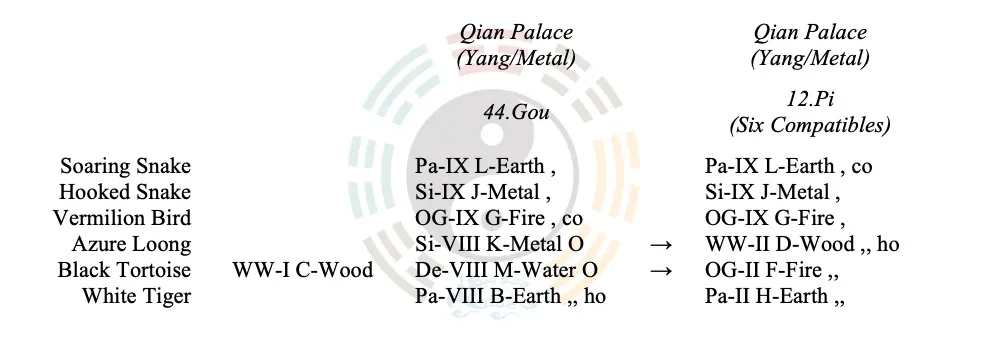
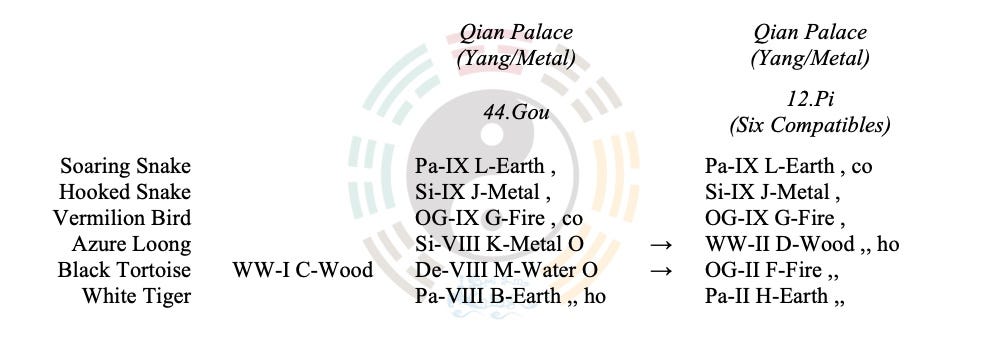
A querent asked about buying a house after the seller went back on the deal and a dispute arose. The querent obtained Gou to Pi.
Judgment: In a house purchase divination, the parents line is taken as the significator. In this hexagram, the first line parents B earth held the host line. The host line represented the buyer, namely the querent. The fourth line corresponding line represented the seller.
The significator parents line held the host line. It also received support from the monthly branch B earth and generation from the daily branch F fire, so its own condition was very prosperous and supportive. In addition, the corresponding line generated the host line, because the officials and ghosts G fire generated the parents B earth. If one only looked at the host and corresponding lines, and the condition of the significator, this seemed to show an auspicious image in which the house purchase could be completed smoothly.
However, the real turning point lay in the transformation. The inner trigram changed from Xun to Kun, forming contradictory echo. This is because in the transformation from the Xun trigram to the Kun trigram, the transformed earthly branches clash with the original earthly branches: K clashes with D, and F clashes with M. This was therefore a classic case of line transformation contradictory echo.
😄Thank you all for your support, and thank you for your patience. We know many of you have been waiting for this.
⚡️Quick reminder: the current I Ching Stream package is still $699 before applicable taxes before Yi Mao is added.
The package currently includes 7 major classical works and collections. After Encompassing I Ching Divination (Yi Mao, 《易冒》) is added, it will include 8 major classical works and collections, and the package price will increase to $849 before applicable taxes.
The estimated individual value of these 8 titles is around $1,309 before applicable taxes. By locking in now at $699 before applicable taxes, readers secure access to the current package, Yi Mao once added, and future books and selected materials added to this specific package without paying the later increased package price.
In short: early buyers can lock in long-term access to the major Six Lines divination classical texts at today’s lower package price.
Package buyers also receive free lifetime access to our private Discord study group, expected to begin formal operation in the second half of this year.
If you purchase the package together with our I Ching Divination Foundations pre-order course, you may also receive an additional study bonus. The course is currently available at the pre-order price, and the price will also increase after its official release.
👉 Lock in the current $699 package price before Yi Mao is added:
All personal information in this case study has been anonymized or omitted. This case study is provided for learning and reference only. It is not intended as medical, veterinary, legal, financial, investment, or other professional advice.
III. Arranging the Six Lines Chart
Part 1.1. Casting a Hexagram with Three Coins
In Six Lines divination, the first step is to cast the hexagram correctly. The traditional method uses three copper coins.
Before casting, write down the question and the exact time of casting. In Na Jia and Six Lines divination, the casting time is an essential part of the chart. One divination should focus on one clear question, and the question should not be changed during the casting process.
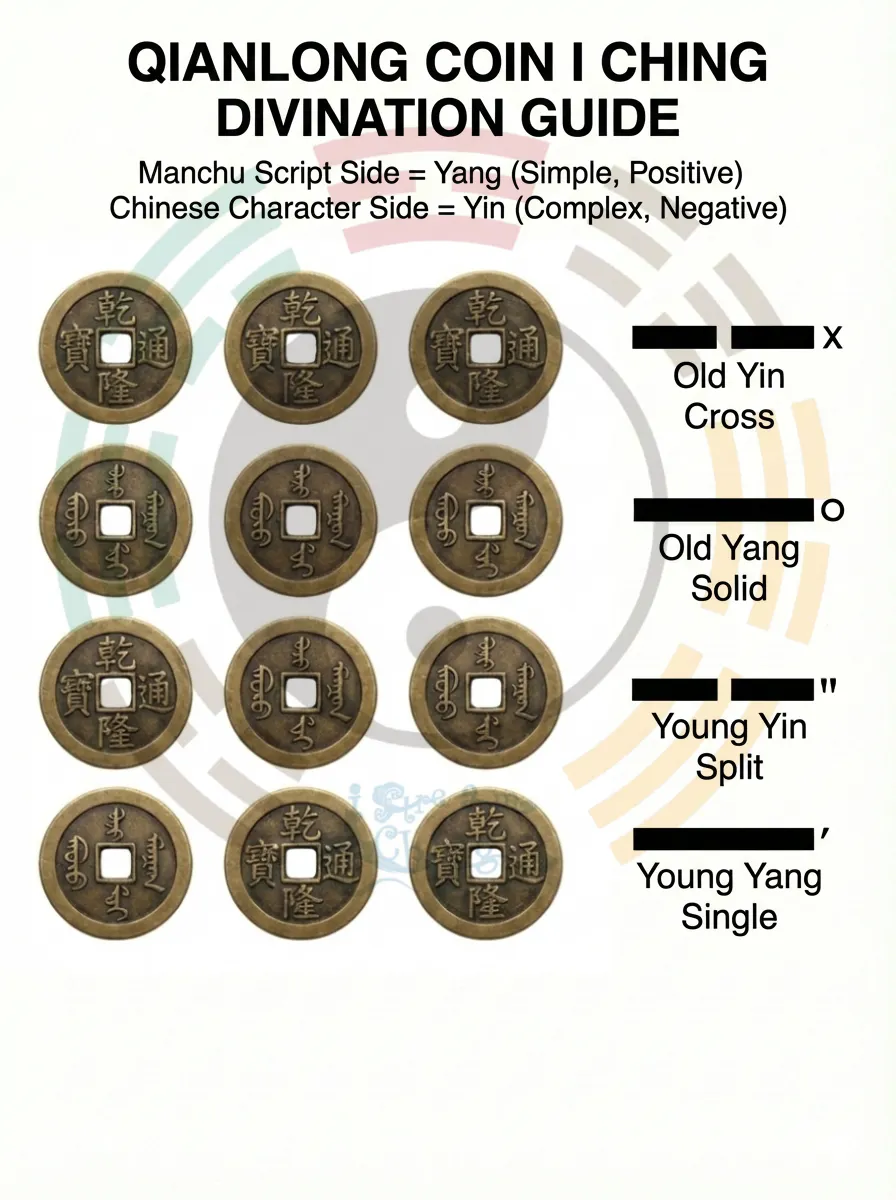
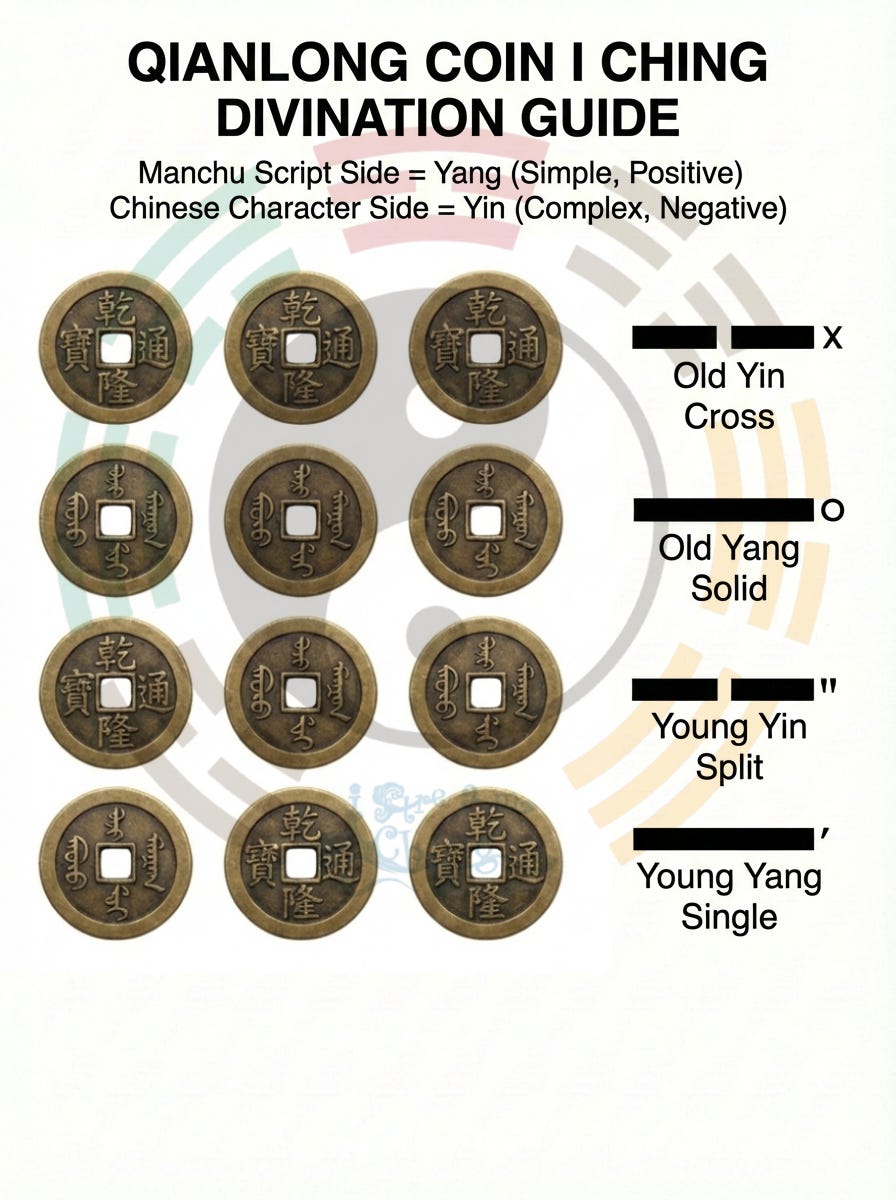
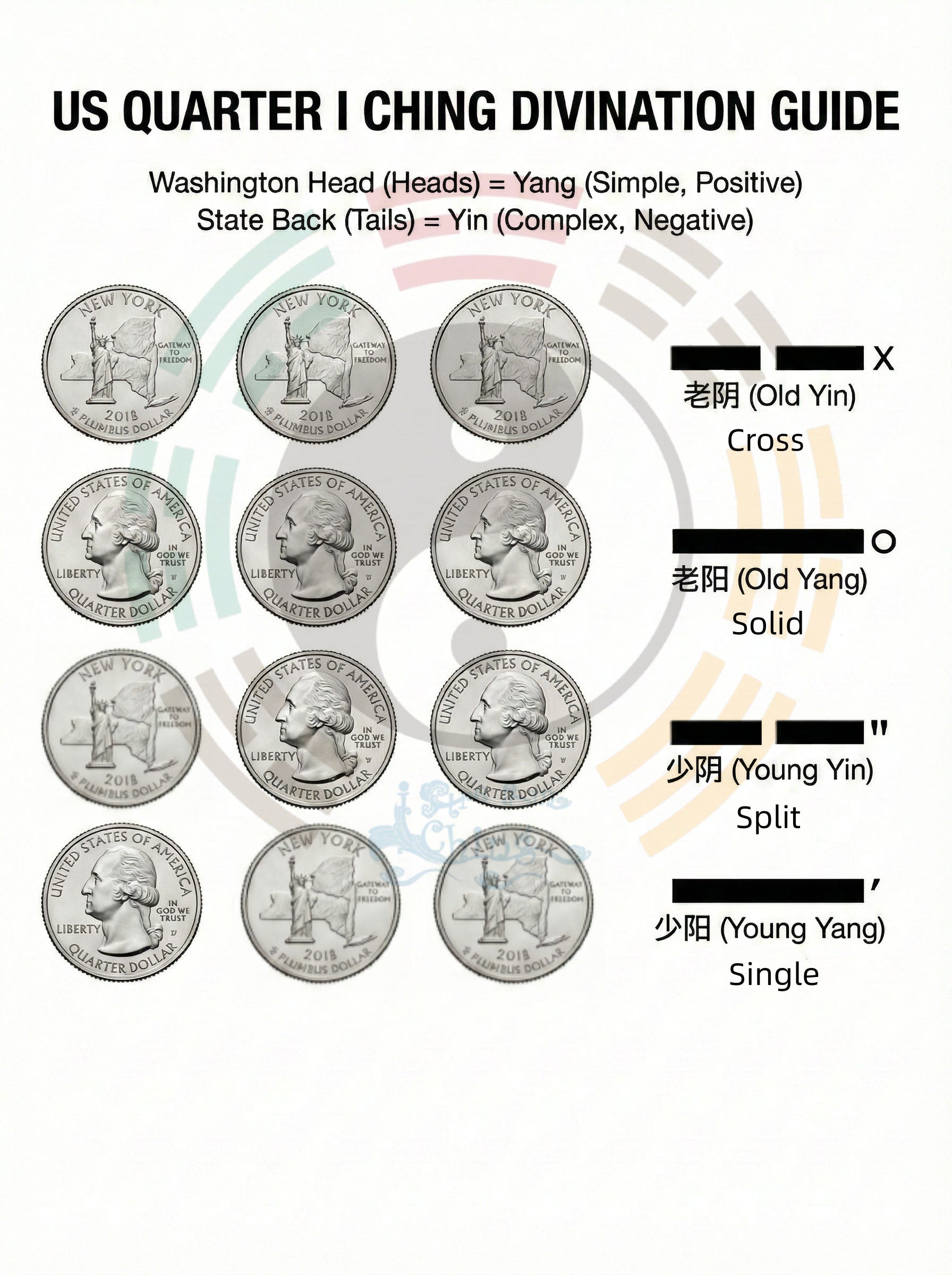
Before casting, clearly distinguish the front and back of the coins, and set which side represents yang and which side represents yin. A practical rule is to treat the simpler side as yang and the more detailed or patterned side as yin. Once this rule is set, it must remain unchanged throughout all six casts.
When casting the hexagram, place the three coins together between both palms. At this moment, silently focus on the matter you wish to predict, calm the mind for about one minute, and allow the person, Heaven, and the matter being asked to enter a state of resonance.
After this, shake the coins six times and record the line image produced by each cast.
The coins may produce the following four combinations:
When there is one back and two faces, this is called “single.” It is drawn as “—” and represents Young Yang.
When there are two backs and one face, this is called “split.” It is drawn as “–” and represents Young Yin.
When there are three backs and no faces, this is called “solid.” It is drawn as “O” and represents Old Yang. This is an active line.
When there are three faces and no backs, this is called “cross.” It is drawn as “×” and represents Old Yin. This is also an active line.
Each cast produces one line. Since a complete hexagram contains six lines, the coins must be shaken and recorded six times. The first cast is the first line and is drawn at the very bottom of the hexagram. Each following line is then drawn above the previous one. The sixth cast becomes the sixth line and is drawn at the very top.
If the hexagram contains “×” or “O”, then a transformed hexagram must also be drawn. This is because “O” represents Old Yang, which changes into Yin, while “×” represents Old Yin, which changes into Yang. These active lines show where the original hexagram transforms and how the later development of the matter begins to appear.
For beginners, the most important thing is to remember the order: the hexagram is cast from bottom to top. The first cast is not placed at the top. It forms the foundation of the hexagram. Only after all six lines are recorded can the original hexagram and transformed hexagram be properly arranged.
Note
The yarrow-stalk method is the classical divination procedure, but it is detailed and not always practical for quick use. This simplified guide therefore focuses on the widely used three-coin method.
Avoid repeated casting on the same matter within a short period of time. Repeated casting often creates noise and makes verification difficult. A divination answer should be treated as one complete event, formed by the interaction of the question, the person’s attention, the timing, and the cast.
For the complete practical reference charts used in hexagram interpretation, including key tables for Six Lines divination, please visit https://www.ichingstream.com/reference-charts/.